

 Login
Login

 September 22, 2026
|
Voiced by Amazon Polly |
As organizations continue their digital transformation journey, the demand for unified analytics platforms has never been greater. Businesses require solutions that seamlessly integrate data engineering, data integration, real-time analytics, AI, and business intelligence while reducing operational complexity.
Microsoft Fabric addresses these challenges by bringing together end-to-end analytics capabilities in a single Software-as-a-Service (SaaS) platform. With the June 2026 Microsoft Fabric update, Microsoft introduced significant enhancements across OneLake, Data Engineering, Data Warehouse, Real-Time Intelligence, Conversational Analytics, and Data Factory. These innovations empower data engineers to build scalable, intelligent, and enterprise-ready data solutions faster than ever before.
In this blog, we’ll explore the latest Microsoft Fabric features introduced in 2026 and discuss how they help modern data engineering teams improve productivity, governance, collaboration, and real-time analytics.
Start Learning In-Demand Tech Skills with Expert-Led Training
- Industry-Authorized Curriculum
- Expert-led Training
Enhanced OneLake: Smarter Storage Management
OneLake continues to serve as the unified storage foundation for Microsoft Fabric, providing a single source of truth across all analytics workloads. Organizations no longer need to maintain multiple copies of data across different services, significantly reducing storage costs and simplifying governance.
The June 2026 release introduces two major enhancements that make storage management even more efficient:
- Management automatically moves data between storage tiers based on access patterns, helping organizations optimize storage costs without sacrificing accessibility.
- OneLake Item-Size Reporting provides detailed visibility into storage consumption across Fabric items, enabling administrators to monitor capacity utilization and make informed storage decisions.
Additional benefits include:
- Improved governance and security
- Enhanced interoperability across Fabric workloads
- Better collaboration between engineering and analytics teams
- Simplified enterprise-scale data management
The configuration interface for OneLake Storage Tiers and Lifecycle Management is shown in Figure 1, demonstrating how organizations can define automated lifecycle policies for cost-efficient data storage.
The OneLake Storage Report in Microsoft Fabric, shown in Figure 2, provides a centralized view of workspace storage consumption, including user data, system data, and soft-deleted data for effective storage monitoring and cost management
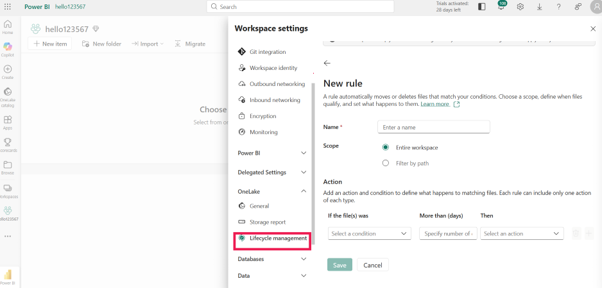
Fig 1: Illustrates the configuration of OneLake Storage Tiers and Lifecycle Management.
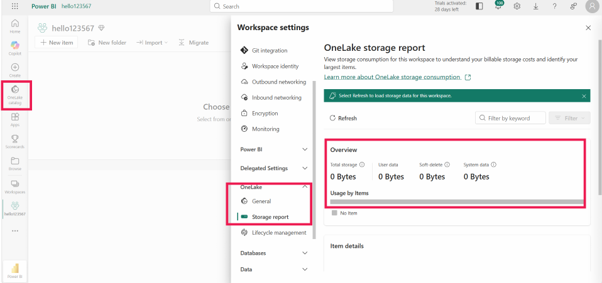
Fig 2: Shows the OneLake Storage Report in Microsoft Fabric.
Data Engineering Gets Smarter
Microsoft continues to simplify data engineering by introducing new capabilities that improve transparency, automation, and API development.
Some notable additions include:
- Extended Lineage for Materialized Lake Views, providing better visibility into data transformations and dependencies.
- Authorizer User Data Functions for API for GraphQL (Preview), enabling more secure and flexible API implementations for enterprise applications.
These capabilities help engineering teams improve governance, simplify troubleshooting, and strengthen data quality across modern data platforms.
If you’re looking to build expertise in Microsoft Fabric Data Engineering, consider the DP-700: Implementing Data Engineering Solutions Using Microsoft Fabric course from companies like CloudThat. The course provides comprehensive, hands-on training in designing and implementing modern data engineering solutions using Microsoft Fabric. Participants gain practical experience with core Fabric capabilities, including OneLake, Lakehouse, Data Factory, Data Warehouse, Real-Time Intelligence, Eventstream, Eventhouse, Apache Spark, Delta Lake, and data orchestration.
Data Science: AI Functions Become More Powerful
Microsoft Fabric continues to simplify AI and machine learning workflows with significant improvements to AI Functions. These enhancements make it easier for data scientists, analysts, and data engineers to integrate AI capabilities directly into their data workflows without the complexity of managing external dependencies.
The June 2026 release introduces three major improvements:
- Foundry Tools in Fabric (preview): Microsoft Fabric now seamlessly integrates with Foundry Tools (Preview), enabling users to enrich and analyze data using prebuilt AI models without requiring additional setup or separate authentication. By using Fabric authentication, AI workloads are billed against your existing Fabric capacity, making it easier to incorporate AI capabilities directly into your analytics workflows.
- No Package Dependency: Users no longer need to manually install or manage Python packages or machine learning libraries before using AI Functions. This simplifies development, reduces environment configuration issues, and enables faster deployment of AI-powered solutions.
- Enhanced Usage Statistics: Improved usage monitoring provides detailed insights into AI function consumption, helping administrators track usage patterns, optimize resource allocation, and better manage operational costs.
Powerful New Data Warehouse Features
Microsoft Fabric Data Warehouse receives one of its largest updates in 2026, introducing enterprise-grade capabilities that improve performance, deployment, and governance.
New features include:
- GPU-Accelerated Fabric Data Warehouse
- CI/CD support for SQL Analytics Endpoint(Preview)
- Warehouse Monitor (Preview)
- Time Travel using SQL Analytics Endpoint(preview)
- Configurable Data Retention(preview)
- ALTER COLUMN support(preview)
- Metadata Sync (Preview)
- Pre & Postscripts (Preview)
These improvements simplify enterprise data warehouse management while enabling organizations to deploy analytical solutions more efficiently.
Databases Apps: Build Intelligent Application Backends with Fabric Apps
Microsoft Fabric introduces Fabric Apps (Preview), a new capability that enables developers to build and run application backends directly within the Microsoft Fabric ecosystem using the Rayfin SDK. This feature extends Fabric beyond analytics, enabling organizations to create data-driven applications that seamlessly integrate with Fabric’s unified data platform.
With Fabric Apps, developers can leverage data stored in OneLake, Fabric Warehouse, Lakehouse, and other Fabric services to power modern applications without relying on separate backend infrastructure. The Rayfin SDK simplifies application development by providing tools to build scalable, secure, cloud-native backends that integrate seamlessly with Fabric.
Microsoft Fabric Apps (Preview) extends the Fabric ecosystem by enabling developers to build secure, data-driven applications with built-in authentication, managed hosting, and seamless integration with OneLake and other Fabric workloads.
Future-Ready Data Engineering
Microsoft Fabric continues to evolve as Microsoft’s unified analytics platform, bringing together data engineering, data integration, AI, real-time analytics, and business intelligence within a single SaaS experience.
The June 2026 release introduces one of the most comprehensive sets of enhancements to date. From smarter OneLake storage management and GPU-accelerated Data Warehousing to AI-powered Real-Time Dashboards, advanced Data Factory automation, and enhanced Copilot capabilities, Microsoft Fabric provides everything data engineers need to design modern, scalable, and intelligent data platforms.
Upskill Your Teams with Enterprise-Ready Tech Training Programs
- Team-wide Customizable Programs
- Measurable Business Outcomes
About CloudThat


WRITTEN BY Sangeetha S
Sangeetha S is a Subject Matter Expert at CloudThat, specializing in Data, and Networking. She is a Microsoft Certified Trainer with over 10+ years of experience in technical training. She has trained more than 3,000 professionals from India, the United States and the United Kingdom to upskill in Azure cloud services, data engineering and AI technologies. Known for simplifying complex concepts and delivering hands-on, impactful sessions, she brings deep technical knowledge and practical insights into every learning experience. Sangeetha's passion for bridging technology with business outcomes reflects in her unique approach to learning and development. "


 PREV
PREV










Comments