

 Login
Login


 July 28, 2026
|
Voiced by Amazon Polly |
Introduction
Serverless computing has transformed application development by allowing developers to focus on code while cloud providers manage the underlying infrastructure. AWS Lambda is one of the leading serverless platforms, but scaling it securely across millions of customer workloads requires stronger isolation than traditional container-based environments, which share the host operating system kernel. To solve this, AWS developed Firecracker, an open-source virtualization technology that powers Lambda MicroVMs. Firecracker combines the security of virtual machines with the speed and efficiency of containers, enabling each AWS Lambda function to run in its own lightweight, isolated MicroVM with millisecond startup times. This architecture delivers stronger security, high performance, and massive scalability, making it a core technology behind AWS Lambda’s ability to run millions of serverless functions reliably.
Pioneers in Cloud Consulting & Migration Services
- Reduced infrastructural costs
- Accelerated application deployment
Objective
By the end of this article, you’ll understand what AWS Lambda MicroVMs are, why AWS introduced Firecracker, and how it provides stronger security than traditional containers while maintaining fast startup times. You’ll learn how Firecracker powers Lambda’s architecture and execution lifecycle, improves isolation in multi-tenant environments, handles function invocations, and enables scalable serverless computing. Finally, we’ll cover its key advantages, limitations, practical use cases, and best practices for building optimized AWS Lambda applications.
Understanding AWS Lambda MicroVMs
AWS Lambda MicroVMs are lightweight virtual machines that provide isolated execution environments for serverless functions. At the heart of this technology is Firecracker, a purpose-built Virtual Machine Monitor (VMM) developed by AWS. Firecracker leverages the Linux Kernel-based Virtual Machine (KVM) to create highly efficient virtual machines that boot in milliseconds and consume only a small amount of memory.
When a Lambda function is invoked, AWS creates or reuses a Firecracker MicroVM to execute the function. Each MicroVM operates independently with its own kernel, memory allocation, CPU resources, and runtime environment. Once execution is complete, AWS may retain the MicroVM for subsequent invocations (warm starts) or terminate it after a period of inactivity.
This design provides an ideal balance between security, efficiency, and scalability, enabling AWS Lambda to execute millions of isolated workloads concurrently across its global infrastructure.
Why AWS Introduced Firecracker?
Before Firecracker, AWS Lambda primarily relied on Linux containers to isolate customer workloads. Containers offered excellent performance and fast startup times, making them well suited for serverless computing. However, they also introduced certain architectural limitations.
The most significant concern was kernel sharing. Since all containers running on a host share the same operating system kernel, any kernel vulnerability could affect multiple workloads. Although container security technologies such as namespaces, control groups (cgroups), and seccomp filters provide strong isolation, they cannot eliminate the risks associated with a shared kernel in large-scale multi-tenant environments.
As AWS Lambda expanded to support millions of users executing billions of functions daily, AWS sought a stronger security model that could deliver:
- Virtual machine-level isolation
- Container-like startup speed
- High resource efficiency
- Massive execution density
- Low operational overhead
As a result, AWS Lambda can now launch isolated execution environments in milliseconds while maintaining the scalability and cost efficiency required to support millions of concurrent serverless applications.
Why MicroVMs Instead of Containers?
Containers package applications together with their dependencies, allowing them to run consistently across different environments. However, all containers running on the same host rely on a shared operating system kernel.
This shared-kernel model introduces an inherent security consideration. A vulnerability in the host kernel could affect multiple containerized workloads.
MicroVMs address this limitation by assigning each execution environment its own guest kernel. Rather than relying solely on operating system–level isolation, MicroVMs use hardware-assisted virtualization provided by KVM.
Consequently, Firecracker MicroVMs provide an effective balance between container performance and the security of traditional virtual machines, making them well suited for modern multi-tenant serverless platforms.
Firecracker Architecture Diagram
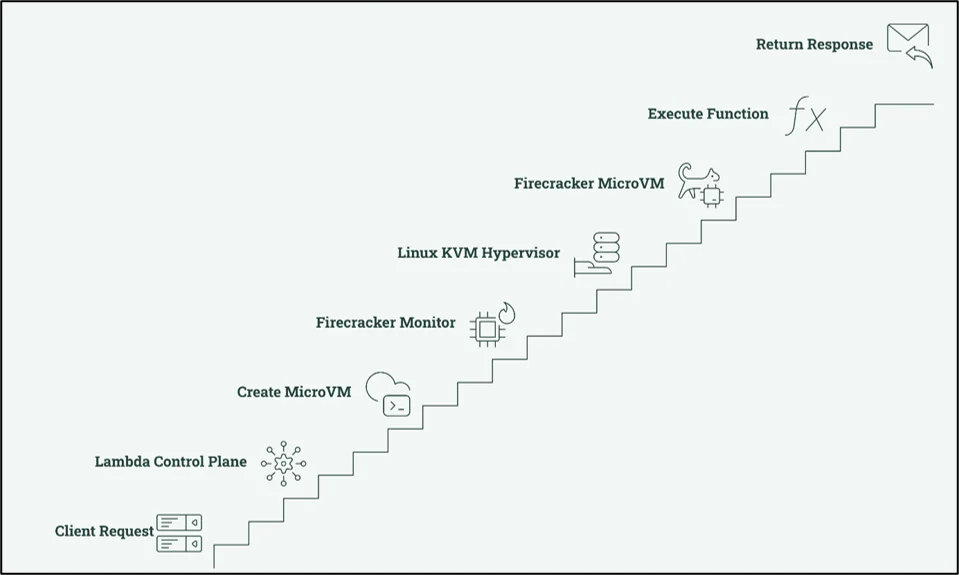
The execution flow highlights how AWS Lambda combines lightweight virtualization with automated orchestration to deliver secure and scalable serverless computing:
- The AWS Lambda Control Plane orchestrates the entire execution lifecycle.
- Firecracker creates lightweight MicroVMs in milliseconds.
- Linux KVM provides hardware-assisted virtualization and strong isolation.
- Each Lambda function runs inside its own isolated MicroVM with a dedicated guest kernel.
- After execution, the response is returned to the client, and the MicroVM may be reused for future invocations to reduce latency.
Security Features and Isolation Mechanisms
One of Firecracker’s primary design goals is to maximize security while maintaining high performance.
AWS achieves this through multiple layers of isolation.
- Dedicated Guest Kernel
Each MicroVM runs its own Linux kernel, providing stronger isolation than shared-kernel containers.
- Hardware-Assisted Virtualization
Uses Linux KVM and CPU virtualization features to enforce secure hardware-level isolation.
- Minimal Device Model
Exposes only essential virtual devices, reducing unnecessary hardware emulation and security risks.
- Minimal Attack Surface
A smaller codebase and fewer interfaces minimize potential attack vectors.
- Jailer Process
Adds an extra security layer using Linux namespaces, cgroups, seccomp, capabilities, and chroot.
- Strong Tenant Isolation
Every Lambda function runs in its own isolated MicroVM, preventing interference between tenants.
Performance Optimizations
- Minimal Memory Footprint
Uses a lightweight guest OS and minimal services to reduce memory consumption.
- Fast Boot Time
Launches MicroVMs in milliseconds, helping minimize Lambda cold starts.
- Lightweight Virtualization
Optimized for short-lived workloads with fast creation, reuse, and cleanup of MicroVMs.
- High-Density Execution
Enables thousands of isolated MicroVMs to run efficiently on the same physical server.
Conclusion
AWS Lambda MicroVMs, powered by Firecracker, represent a major advancement in serverless computing by combining the strong isolation of traditional virtual machines with the speed and efficiency of containers.
Drop a query if you have any questions regarding AWS Lambda MicroVMs, and we will get back to you quickly.
Empowering organizations to become ‘data driven’ enterprises with our Cloud experts.
- Reduced infrastructure costs
- Timely data-driven decisions
About CloudThat
FAQs
1. Is Firecracker open source?
ANS: – Yes. Firecracker is an open-source project maintained by AWS. Its source code, documentation, and development updates are publicly available, allowing the broader community to explore, contribute to, and build upon the technology.
2. How are Firecracker MicroVMs different from Docker containers?
ANS: – Docker containers share the host operating system kernel, whereas Firecracker MicroVMs include their own guest kernel. This provides stronger isolation between workloads while still maintaining lightweight virtualization and fast startup times.
3. Does Firecracker eliminate AWS Lambda cold starts?
ANS: – No. Firecracker significantly reduces cold-start latency by launching lightweight MicroVMs in milliseconds, but it cannot eliminate cold starts entirely. Initialization time still depends on factors such as runtime selection, package size, and application initialization logic.


WRITTEN BY Balaji M
Balaji works as a Research Associate in Data and AIoT at CloudThat, specializing in cloud computing and artificial intelligence–driven solutions. He is committed to utilizing advanced technologies to address complex challenges and drive innovation in the field.


 PREV
PREV











Comments