

 Login
Login

 July 29, 2026
|
Voiced by Amazon Polly |
Introduction
Confused about which cloud training institute is worth your time and money? Here’s what separates elite training from average.
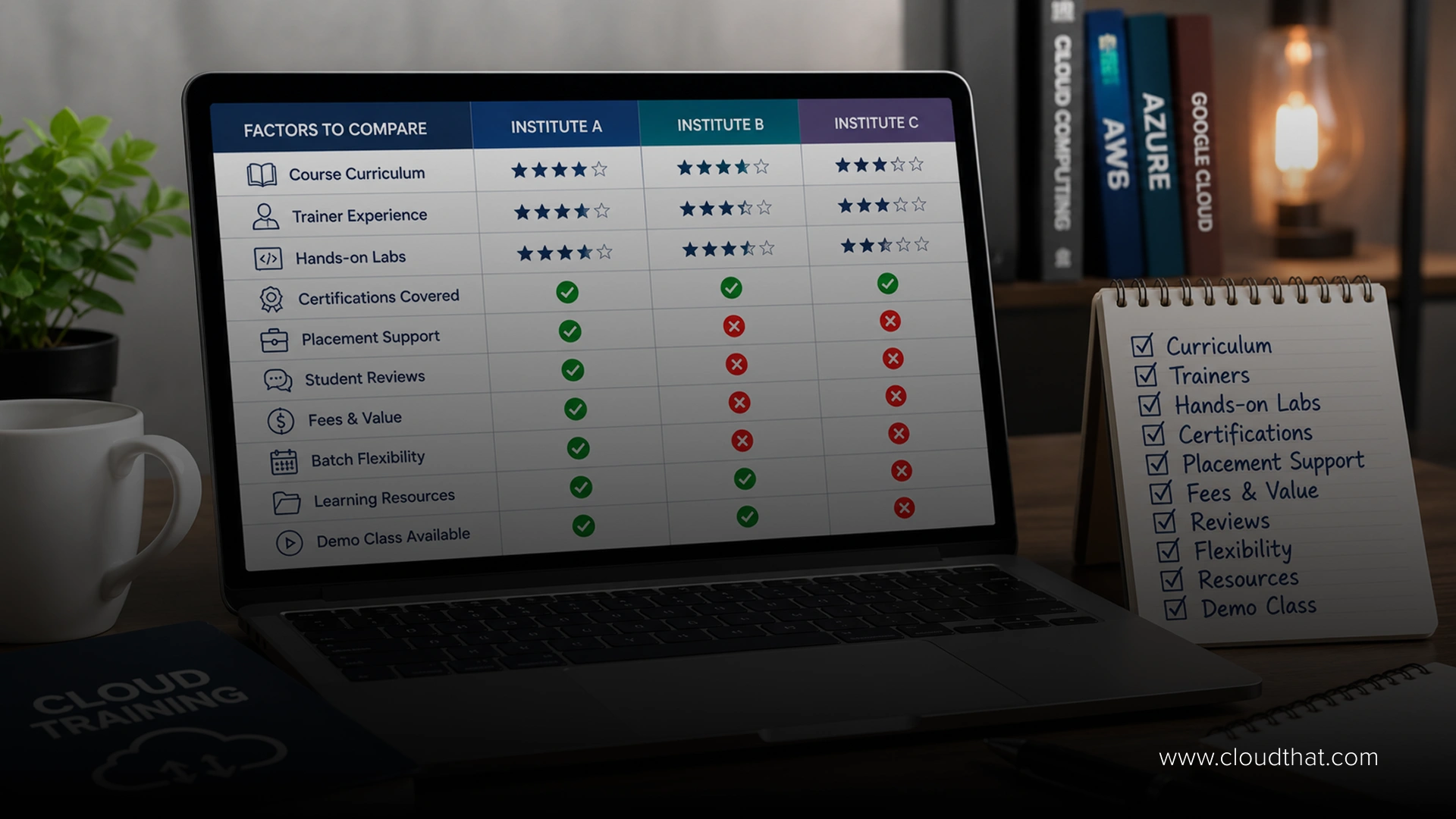
Check for: instructor credentials (practicing consultants, not freelancers), hands-on labs (50-60% of course time minimum), curriculum freshness (updated within last 3 months), industry partnerships (AWS Premier Tier, Microsoft Partner status), alumni outcomes (job placement rates, salary data), and transparent pricing.
Most people pick training based on cost or brand recognition alone. That’s how they end up spending ₹50,000 and retaining nothing six months later.
Accelerate Your Azure Career Without Quitting Your Job
- Authorized Training
- Live Hands-on Labs
- Flexible Batches
The Cost of Choosing Wrong
Let’s start with the brutal math.
You commit 4 to 6 months of evenings and weekends to cloud training. You’re exhausted after work. You skip social events. Your family gets less of your attention. You spend ₹50,000 to ₹1,15,000. Then you finish the course.
You pass the exam. You feel accomplished. Then reality hits.
Your job interviews ask you to design a system architecture. Not “What’s a VPC?” but “Design a multi-region system handling one million daily users with auto-scaling, cost optimization, and disaster recovery.” You freeze. You realize the course taught you syntax but not judgment. The labs were step-by-step walkthroughs where you clicked the buttons a trainer told you to. You never designed anything from scratch. You never failed and had to debug.
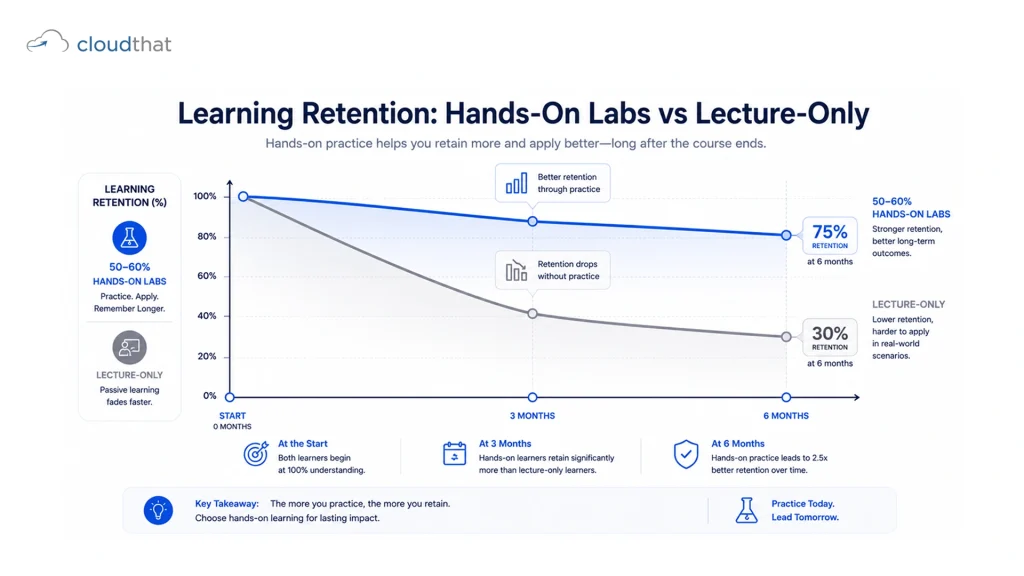
Six months later, you’ve forgotten 70% of the material. The certification looks good on your resume, but you can’t back it up in conversations. Your career stalls because you have a badge but lack the skills employers want.
That’s the cost of choosing the wrong institute. Not just the money. It’s the time wasted, the career momentum lost, and the compounding regret.
Now imagine the opposite. You choose an institute with practicing cloud architects as instructors. The labs make you design systems, not just follow scripts. You get feedback from professionals who actually run production systems. You learn frameworks, not just facts. When you interview, you speak with authority because you’ve built things. You get the offer.
The difference comes down to what you scrutinized before enrolling. Most people skip that step.
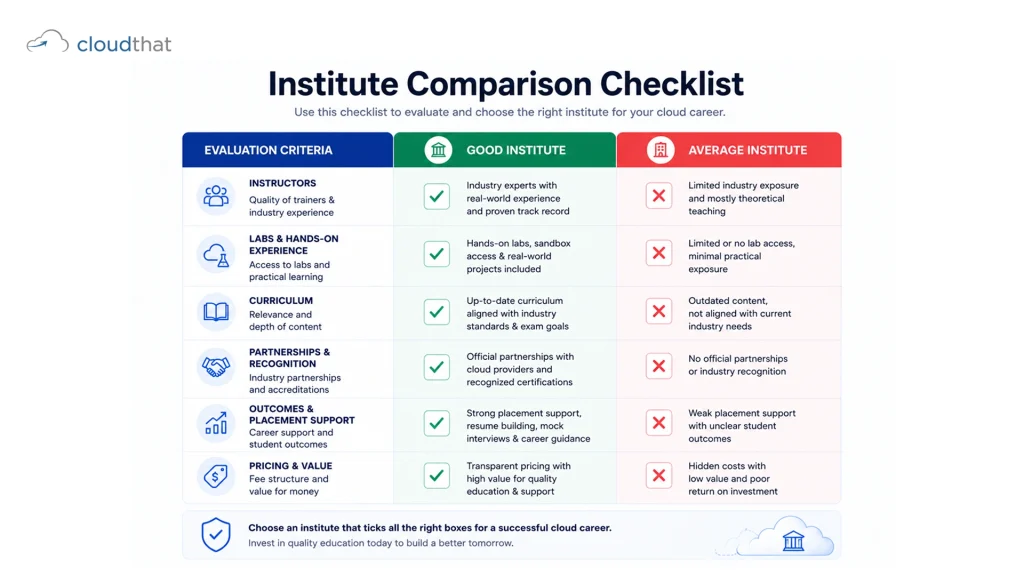
Instructor Credentials: Why Your Teacher Matters More Than The Logo
Here’s a hard truth about training institutes: they’re only as good as their instructors.
You could have the best curriculum written by AWS itself. But if it’s taught by someone reading slides for the first time, it doesn’t matter. Learning doesn’t transfer.
When evaluating cloud training institutes, ask a specific question: Who teaches this course? Get their names. Look them up on LinkedIn. What’s their actual experience? Not “10 years in IT.” But “Led cloud migrations for 15 Fortune 500 companies,” “Architected systems handling 500,000 daily users,” or “Built CI/CD pipelines that reduced deployment time from hours to minutes.”
Here’s what separates elite institutes from average ones: instructors are practicing professionals, not contract lecturers who record videos once and push them to 10,000 students.
A practicing cloud architect brings real-world war stories. They explain not just how something works but why companies make specific architecture choices. They’ve debugged systems at 3 AM. They know the trade-offs between perfection and on-time shipping. They understand cloud economics because they’ve optimized actual bills.
Compare that to a freelancer who took an AWS course, got certified, and now teaches it for ₹500 per hour. They know the material but not the context. They teach syntax without judgment. Students leave with facts but not frameworks.
When comparing institutes, ask: Are instructors full-time employees or contract lecturers? Do they work on consulting engagements alongside teaching, or is teaching their only job? Can you see their actual project experience? Do they have recognizable credentials or awards in the cloud space?
The institutes that publish instructor profiles with real credentials are putting their reputation on the line. That matters. Instructors working on real-world consulting projects bring production experience directly into the classroom.
Hands-On Labs: The Difference Between Watching and Building
This is where most cloud training fails.
A course slides across the screen explaining EC2 instances, auto-scaling groups, and load balancers. It sounds good. You take notes. You understand the concepts. Then the lab section arrives. Instead of designing a system yourself, you follow a step-by-step walkthrough. Click this. Then click that. The system works because you followed instructions, not because you understood design principles.
Real hands-on labs force you to fail.
You’re tasked to: “Design a system that handles sudden traffic spikes without manual intervention.” You have access to AWS services. You have no script. You need to figure out which services to use, how to configure them, and how to monitor them. You make mistakes. Your system doesn’t scale properly. You debug. You adjust. You rebuild. That process, spread over 2 to 3 hours, embeds knowledge more deeply than watching someone else build for 20 minutes.
When comparing cloud training institutes, ask: What percentage of course time is hands-on labs? The answer matters enormously.
Generic courses might say “20% hands-on.” Elite institutes aim for 50 to 60% hands-on. Here’s why: the first 40% is lecture and concept introduction. You need that foundation. But if the remaining 60% is more lecture and review, you’re wasting time. If it’s hands-on projects where you design, build, break, and fix, you’re learning.
Also ask: Are labs guided step by step or open-ended? Step-by-step is easier and feels productive but builds muscle memory for following instructions, not for design. Open-ended labs are harder but build the judgment professional systems require.
The best institutes make failure part of the learning experience. They give you labs designed to help you hit specific problems, so you know how to solve them in production next time.
Curriculum Freshness: How Outdated Training Kills Your Career
AWS launched Lambda in 2014. DynamoDB gained additional features in 2015. Container services evolved. Managed databases multiplied. In 2024, cloud infrastructure looks almost nothing like it did in 2014.
Yet some training institutes teach 2015 architecture patterns to 2024 students.
It’s not malicious. It’s just hard to maintain the curriculum. Rewriting courses costs money and resources. But students paying ₹1,00,000 shouldn’t learn outdated patterns.
Ask institutes: When was this curriculum last updated? If the answer is “more than 6 months ago,” that’s a red flag. The cloud moves fast. A course written 18 months ago teaches patterns that are now considered suboptimal. You spend months learning “best practices” that are actually old practices.
For example, if a course teaches VMs as the primary deployment model without emphasizing containerization and serverless, it’s outdated. If it doesn’t cover GenAI integration and modern AI/ML services, it’s missing the mark on where the market is going. If it doesn’t mention infrastructure-as-code and configuration management, it’s teaching dinosaurs.
The institutes worth trusting have clear schedules for curriculum updates. They tie training to cloud provider releases. When AWS launches major features, good institutes integrate them within weeks, not years.
Check the course preview or syllabus. Look for references to recent AWS, Azure, or Google Cloud announcements. If you don’t see anything about 2023-2024 services, you know the curriculum isn’t up to date.
Industry Partnerships: What AWS Premier Tier Actually Means
Here’s where marketing gets tricky.
Many institutes claim AWS partnership. Some have it. Most don’t, or have the lowest tier. There’s a massive difference.
AWS has multiple partner tiers. Reseller partners can use the AWS logo. They buy and resell services. It’s basic. Advanced partners have deeper relationships. Premier Tier partners are the top tier. AWS validates them for specific competencies like training, migration, security, and others. Premier Tier partners have AWS engineers reviewing their training materials. They attend AWS conferences where only the best partners are invited. Their instructors train at the same venues as AWS employees.
If an institute claims to be an “AWS Partner” without specifying the tier, call and ask. If they’re evasive, that’s your answer.
The same logic applies to Microsoft and Google Cloud partnerships. A Google Cloud Training Partner means Google has validated the curriculum and instructor quality. It’s not automatic or easy to achieve.
When comparing cloud training institutes, use partnerships as a proxy for credibility. Not the only metric, but an important one. AWS doesn’t hand out Premier Tier status to fly-by-night operations.
Alumni Outcomes: Follow the Money (and the Job Offers)
Here’s the question that matters most: Do graduates actually get hired?
Ask institutes: What percentage of your graduates land cloud roles within 3 months of finishing? Do you have job placement data? Can you connect me with recent alumni? Do graduates get salary bumps?
Good institutes track this. They know their alumni outcomes because they care. Bad institutes don’t track it or aren’t transparent about it.
Look for case studies. “Engineer transitioned from on-premise systems to cloud engineer role, salary increased 30%.” “Data analyst upskilled to cloud data engineer, got a promotion.” These aren’t guarantees, but they signal outcomes matter to the institute.
Also ask: Do you have a job guarantee or placement assistance program? Some institutes offer placement guarantees (if you don’t get a job within 6 months, they refund tuition). That’s risky for the institute, but it signals they’re confident in the outcomes.
LinkedIn is your friend here. Search alumni from the institute. Filter by recent years. Read their profiles. Did they get hired? Did they move into cloud roles? Are they still in those roles a year later, or did they bounce? Follow the patterns.
The institutes producing outcomes will have plenty of people on LinkedIn with recent certificates, cloud job titles, and endorsements from their trainers. Institutes producing mediocre outcomes? Their alumni either don’t list the training or moved on to different fields. Institutes with proven corporate training programs that have upskilled employees at Fortune 500 companies demonstrate this clearly through their alumni networks.
The Teaching Model: Live, Self-Paced, or Blended
Every institute offers a teaching model. Most offer multiple. Understand the tradeoffs.
Self-paced means you watch videos whenever you want. Flexibility is the upside. Isolation is the downside. When you hit a confusing concept, there’s no instructor to clarify. You post in a forum. Waits 24 hours for an answer. By then, momentum is lost.
Live instructor-led means scheduled classes. You show up at a specific time. The instructor teaches. You ask questions in real time. The downside is inflexibility. If you can’t make the 6 PM session, you’re out.
Blended combines both. You get recorded videos for self-paced review. You get live sessions for complex topics and Q&A. The upside is flexibility plus instructor access. The downside is that blended programs cost more.
The best institutes offer all three and let you choose among them. They understand that professionals have different schedules. Parents with kids need flexibility. Full-time students can handle rigid schedules. Career-switchers might need both.
When comparing institutes, ask: Can I try a live session before enrolling? Can I access recordings if I miss a session? Are instructors available outside scheduled class times? Is there a community or forum where I can ask questions?
Pricing Transparency: What You’re Actually Paying For
This is where most institutes get sneaky.
You see a course advertised at ₹49,900. You think that’s the cost. You enroll. Then you discover: that’s just the course. The exam voucher is extra (₹8,000 to ₹15,000). The “advanced lab” module is extra. The “additional study materials” are extra. Suddenly, your ₹49,900 course costs ₹85,000.
When comparing cloud training institutes, demand transparency. Ask for an itemized breakdown. What does the course price include? What costs extra? What’s the total cost of certification?
Also ask about financing. Do they offer EMI options? Can you pay monthly instead of upfront? Some institutes offer ₹4,999 monthly payments with no-cost EMI. That changes affordability significantly.
Compare total cost, not just headline pricing. An institute charging ₹1,14,900 annually for unlimited courses and certifications might be cheaper than institutes charging ₹49,900 per course if you plan to pursue multiple certifications.
Also check refund policies. If the course doesn’t meet expectations, can you get a refund? Most institutes offer 7 to 14 days. Some offer none. That signals confidence (or lack thereof) in the quality of their training.
Why CloudThat Stands Apart in Best Cloud Training Comparison
When you evaluate cloud training institutes against the criteria above, CloudThat hits every mark.
CloudThat is an AWS Premier Tier Training Partner. That’s not a basic partnership. It means AWS has validated the curriculum, the instructors, and the outcomes. AWS doesn’t hand out that status to mediocre operations. Their instructors aren’t freelancers recording videos once. They’re practicing cloud consultants who run real consulting engagements. They bring production experience into every classroom.
The model is hands-on and outcome-focused. AWS Training & Certification at CloudThat dedicates 50 to 60% of course time to hands-on labs where you design systems rather than follow scripts. Labs are updated quarterly as new AWS services and patterns emerge. The curriculum doesn’t sit stale. It evolves. When CloudThat’s consulting arm implements new architecture patterns for clients, those patterns get integrated into training within weeks.
Similarly, Azure Certifications and DevOps Certifications follow the same principles: practicing consultants teaching, hands-on design-focused labs, and quarterly curriculum updates.
On outcomes, CloudThat has trained 1.1 million professionals across 30 countries. That volume creates accountability. Graduates are everywhere. They’re posting on LinkedIn. They’re changing roles. They’re earning more. That public accountability drives quality.
The teaching model combines live instructor-led sessions with self-paced recordings and community support. Choose your schedule. Instructors are available for questions. The AWS Mastery Pass bundles 35+ courses, including foundational through professional certifications, hands-on labs, study materials, and certification exam vouchers for ₹1,14,900 annually. Compare that to other institutes that charge per course, and you’ll see the difference in total cost.
Curriculum freshness is baked in. When AWS launches major services, CloudThat integrates them into training within the quarter. The consulting team’s real-world experience feeds back into training. It’s a closed loop: consulting identifies gaps, training fills them, alumni solve problems better, consulting learns more.
Instructors work on real projects every day. When someone teaches about DevOps and production pipelines, they’re not reading from a script; they’re explaining what they deployed last week. This connection between consulting and training separates CloudThat from institutes where instructors only teach.
Explore the AWS Mastery Pass if you’re pursuing multiple AWS certifications. Review the corporate training options if your organization is upskilling teams. And investigate additional specialized certifications, such as Microsoft Security, if you’re targeting specific domains.
Choosing Your Training: Three Final Questions
Before enrolling anywhere, ask yourself three questions:
First, “Can I see instructor credentials and alumni outcomes?” If the answer is no, keep looking. Good institutes confidently showcase instructors and outcomes. They have nothing to hide.
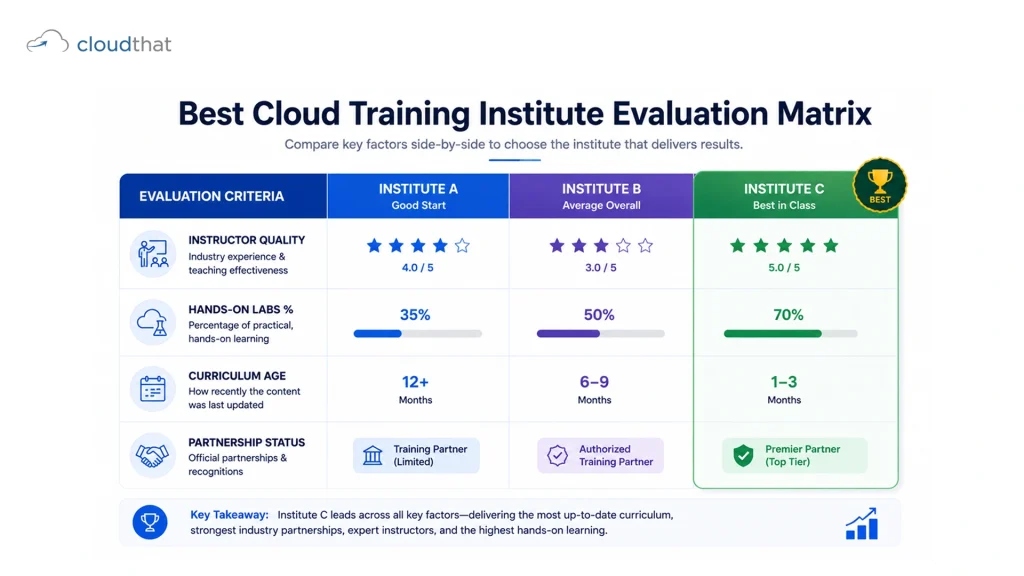
Second, “What percentage of the course is hands-on labs?” If it’s less than 40%, you’re buying a lecture series, not actionable training. If it’s 50% or more, you’re buying the real thing.
Third, “Is this curriculum fresh?” Ask when it was last updated. If the answer is recent (within the last 3 months), you’re learning current patterns. If the answer is vague or outdated (more than 6 months old), you’re learning history.
If three institutes land equally on these criteria, price becomes the deciding factor. But never choose based on price alone. You’ll regret it. Check the training calendar to see upcoming batches and make your enrollment decision on a timeline that works for you.
Conclusion
Choosing the wrong cloud training institute costs you months of wasted time and thousands of rupees. Choosing the right one accelerates your career trajectory and compounds with every subsequent certification.
The institutes worth enrolling with are transparent about instructor credentials, outcomes, and what you’re getting. They invest in hands-on labs and keep the curriculum fresh. They have real industry partnerships. Their alumni are getting hired and moving up.
Use the criteria in this guide. Ask the hard questions. Compare institutes rigorously. Your career growth depends on it. When you’re ready to commit, look for training that combines best-in-class instructors, 50-60% hands-on labs, fresh curriculum, and transparent outcomes. That’s what separates elite training from average.
Ready to compare training options? Explore the AWS Mastery Pass for a comprehensive curriculum covering foundational through professional certifications, or browse the individual cloud training courses to build your own path.
Key Takeaways
- Instructor credentials matter more than institute branding; practicing consultants teach better than freelance lecturers.
- Hands-on labs should comprise 50-60% of course time; anything less is lecture-heavy and won’t stick.
- Curriculum freshness determines relevance; courses updated more than 6 months ago teach outdated patterns.
- AWS Premier Tier partnership signals AWS has validated curriculum and instructor quality.
- Alumni outcomes reveal whether graduates are actually hired and retain their skills; follow LinkedIn for evidence.
- Teaching model flexibility (live, self-paced, blended) affects learning style fit; choose based on your schedule.
- Transparent pricing with itemized breakdowns beats vague course costs hiding expensive add-ons.
- Total cost comparison beats per-course pricing when pursuing multiple certifications.
- Exam vouchers, study materials, and lab access should be included rather than sold as extras.
- Real job readiness requires practice designing systems from scratch, not following step-by-step walkthroughs.
Access to Unlimited* Azure Trainings at the cost of 2 with Azure Mastery Pass
- Microsoft Certified Instructor
- Hands-on Labs
- EMI starting @ INR 4999*
About CloudThat
FAQs
1. Is expensive cloud training always better than affordable options?
ANS: – Not always, but correlation exists. Cheap courses often cut corners on instructor quality or hands-on labs. Premium courses invest in both. That said, price alone isn’t the metric. A ₹1,00,000 course with mediocre instructors is worse than a ₹50,000 course with excellent instructors and comprehensive labs. Check quality indicators, not just cost.
2. Can self-paced training produce job-ready outcomes?
ANS: – Yes, but with caveats. Self-paced works if you’re highly disciplined, have prior cloud experience, and invest in real hands-on labs (not just watching videos). Most people learn better with instructor interaction for complex concepts. Blended models usually produce better outcomes than pure self-paced.
3. How long should I spend on cloud training?
ANS: – Foundational certifications: 4-8 weeks. Associate-level: 8 to 12 weeks. Professional-level: 12 to 24 weeks. These assume 8 to 10 hours per week alongside your job. Rushing through training produces certification badges without actual skills. Take the time to let concepts compound.
4. What's the difference between instructor-led and self-paced hands-on labs?
ANS: – Instructor-led labs mean a trainer guides you, clarifies confusion in real time, and gives feedback on your approach. Self-paced labs mean you work independently and rely on documentation or forums for help. Instructor-led produces faster learning. Self-paced offers flexibility. Many institutes offer both in blended programs.
5. Should I choose training based on a specific cloud (AWS, Azure, GCP) or learn broadly?
ANS: – Choose based on what your employer uses or where jobs are concentrated in your region. AWS dominates enterprise adoption. Azure dominates companies using Microsoft technologies. Google Cloud dominates startups and data-heavy companies. Master one cloud deeply before branching to others.
6. How do I know if an institute's job guarantee is legitimate?
ANS: – Ask for specifics. What’s the guarantee, exactly? “Job placement assistance” (they help you, but no guarantee) is different from “job guarantee” (they refund if you don’t get hired in X months). Also ask whether that guarantee requires you to be job-ready according to their criteria, or whether they guarantee placement regardless. Legitimate guarantees have specific terms and conditions.

WRITTEN BY Himisha Raval
Himisha Raval is a Digital Marketing Manager at CloudThat with a strong command of search engine optimization, web analytics, link building, and content strategy. She brings a data-driven approach to digital marketing, helping IT companies strengthen their online presence, improve search rankings, and generate consistent leads across channels. Beyond execution, she plays an active role in ideation, campaign strategy, and website performance optimization. Outside of work, she balances her analytical side with a love for travel, nature painting, and dancing.


 PREV
PREV











Comments