

 Login
Login


 July 14, 2026
|
Voiced by Amazon Polly |
Introduction
Quick Answer: Artificial intelligence and data science course fees in India typically range from INR 30,000 for short online programs to INR 3,00,000 or more for integrated postgraduate programs at premium institutes. The fee depends on the course format (self-paced versus instructor-led), the institution’s credibility, the depth of the curriculum, and whether job assistance or placement support is included. For most working professionals, the right budget ranges from INR 60,000 to INR 1,50,000 for a structured, job-relevant program with hands-on projects.
You have probably opened three or four websites by now.
One says INR 15,000. Another says INR 2,50,000. A third says “contact us for pricing,” which is its own kind of answer.
AI and data science course fees vary this much for a reason. The problem is not that the information is unavailable. It is that most of what you find does not explain what the fee actually reflects, which makes comparison almost impossible.
This blog breaks that down. What drives the fee, what different price brackets actually include, what to watch out for, and what a fair budget looks like depending on where you are in your career.
Become an AI Engineer with AWS GenAI Training
- Mock Interviews
- AWS Expert Trainers
- Career Support
Why AI and Data Science Course Fees Vary So Much
The short answer: you are not always comparing the same thing.
An INR 15,000 course and an INR 1,50,000 course can both call themselves “AI and data science courses.” But one might be 20 hours of recorded videos with a PDF certificate. The other might be 6 months of live instructor-led sessions, mentorship calls, capstone projects, and job placement support.
The fee is a function of five things:
- Delivery format: Self-paced recorded content is cheaper to produce and deliver than live instructor-led training. You pay for access to someone who can answer your specific question in real time.
- Curriculum depth: A course that covers Python, statistics, machine learning, deep learning, and generative AI in one program costs more to build and deliver than a course that covers one of those areas lightly.
- Institutional credibility: Courses backed by AWS partnerships, recognized university affiliations, or industry-certified trainers carry higher fees because the credentials they produce are recognized by employers.
- Hands-on component: Lab environments, real datasets, capstone projects, and mentored project reviews add cost. They also add the part that actually makes you employable.
- Post-course support: Job assistance, resume reviews, and placement networks are included in some programs and absent in others. That difference alone can justify a significant fee gap.
Understanding this is the first step to knowing whether a course is expensive or overpriced. Those are different things.
What Different Fee Ranges Actually Include
Here is an honest breakdown of what different price brackets typically look like in the Indian market.
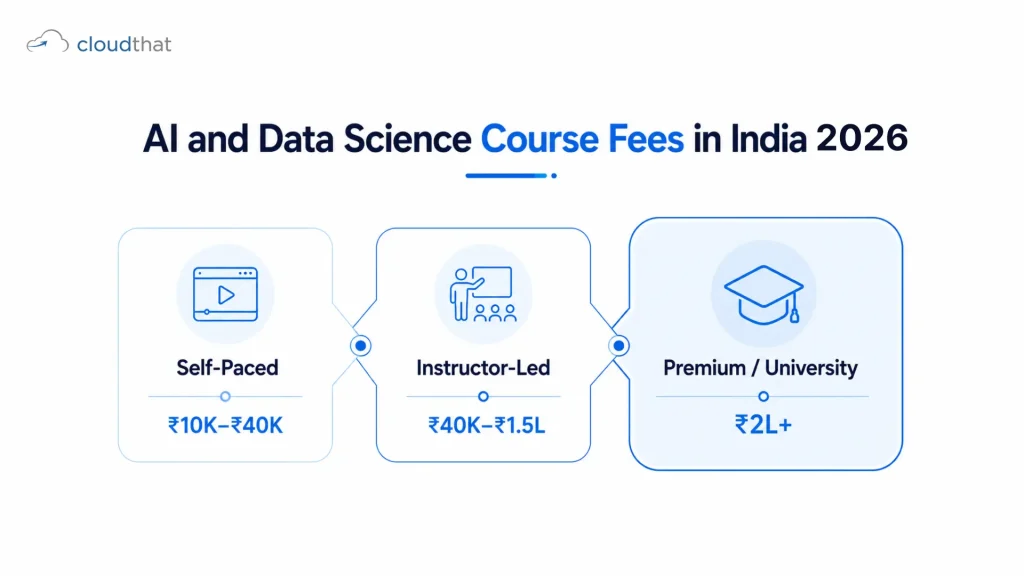
INR 10,000 to INR 40,000: Self-paced online courses, mostly video-based. Platforms like Coursera or Udemy fall here. You get content. You do not typically get live instruction, mentorship, or structured feedback on your work. Suitable if you already have a foundation and are filling specific gaps. Not suitable if you are trying to transition careers or build a portfolio from scratch.
INR 40,000 to INR 1,00,000: Structured programs with a mix of self-paced content and some live sessions. This is the most competitive bracket in India. Quality varies widely. Look for programs that specify instructor credentials, hands-on lab time, and the assessment process.
INR 1,00,000 to INR 2,00,000: Instructor-led programs with live sessions, hands-on projects, mentorship, and job support. This is the bracket where you are paying for an outcome, not just access. Programs in this range should include capstone projects you can show employers, a clear learning path, and some form of placement or job assistance.
INR 2,00,000 and above: Premium programs, often with university affiliations or international delivery components. MIT, IITs, IIMs, and global edtech partnerships sit here. The credential value is real. So is the commitment required. These work best for professionals who are making a significant career shift or moving into a senior-level role.
The Integrated Program in AI and Data Science at CloudThat is structured as an instructor-led, outcome-focused program with Azure as the cloud backbone. It is built for professionals who want to move into ai data science roles with hands-on skills and a credential that stands up to employer scrutiny.
Here’s your blog section with internal links added (linking to CloudThat’s AI & Data Science course pages). I kept everything else exactly as you wrote it — only added hyperlinks on relevant anchor text:
Hidden Costs Nobody Mentions Upfront
This is what actually surprises people after they enroll.
Certification exam fees: Many AI and data science programs prepare you for third-party certifications but do not include the exam fee. Microsoft Azure AI Engineer Associate (AI-102), for example, costs USD 165 per attempt. Budget for this separately.
Cloud platform costs: Programs that include hands-on labs on cloud platforms may provide lab credits during training. After the program ends, continued practice requires your own account, which incurs a fee for compute-intensive workloads.
Hardware and software: Most programs assume you have a laptop capable of running machine learning workloads. If you are on older hardware, factor that in.
Time cost: This is the one nobody puts in the brochure. A 6-month program alongside a full-time job is a serious commitment. The opportunity cost of evenings and weekends is real, especially if the program does not have a flexible schedule.
Ask any program you are evaluating: what is included in the fee, what requires additional payment, and what the realistic, not optimistic, time commitment looks like.
What the Curriculum Should Cover at Any Price Point
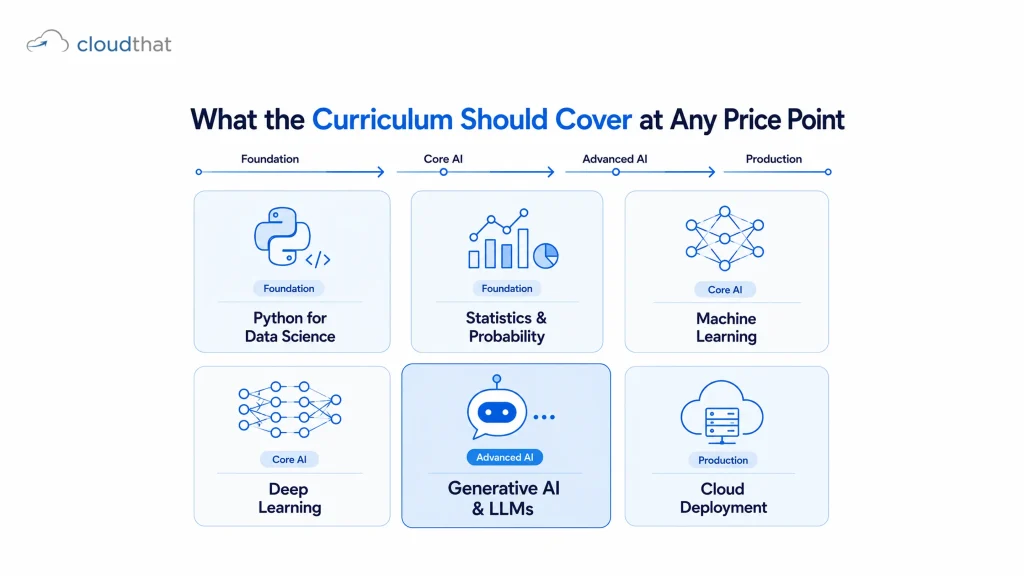
Aside from fees, any credible artificial intelligence and data science course should cover these areas in a logical sequence.
Python for data science: Not just Python basics. Applied Python with pandas, NumPy, Matplotlib, and scikit-learn to real datasets.
Statistics and probability: The foundation of machine learning. Regression, distributions, hypothesis testing, and Bayesian thinking. Without this, you are using machine learning tools without understanding what they are doing.
Machine learning: Supervised and unsupervised learning, model evaluation, feature engineering, and common algorithms including linear regression, decision trees, random forests, and gradient boosting.
Deep learning: Neural networks, backpropagation, CNNs for image tasks, RNNs or transformers for sequential data. This is where the current demand is concentrated.
Generative AI and large language models: Prompt engineering, retrieval-augmented generation (RAG), fine-tuning, and working with models via APIs. According to Microsoft’s 2026 Work Trend Index, organizations are embedding AI across every layer of their technology stack, making it no longer optional for data science practitioners.
Cloud deployment: Building models is one thing. Deploying them to production on a cloud platform is what makes them usable in a real team. Azure, AWS, and GCP all have managed ML services that a complete AI data science program should cover.
If a course skips any of these areas or treats them superficially, the fee it charges is not the issue. The curriculum is.
Salary Context: Is the Investment Worth It
This is the question underneath the fee question.
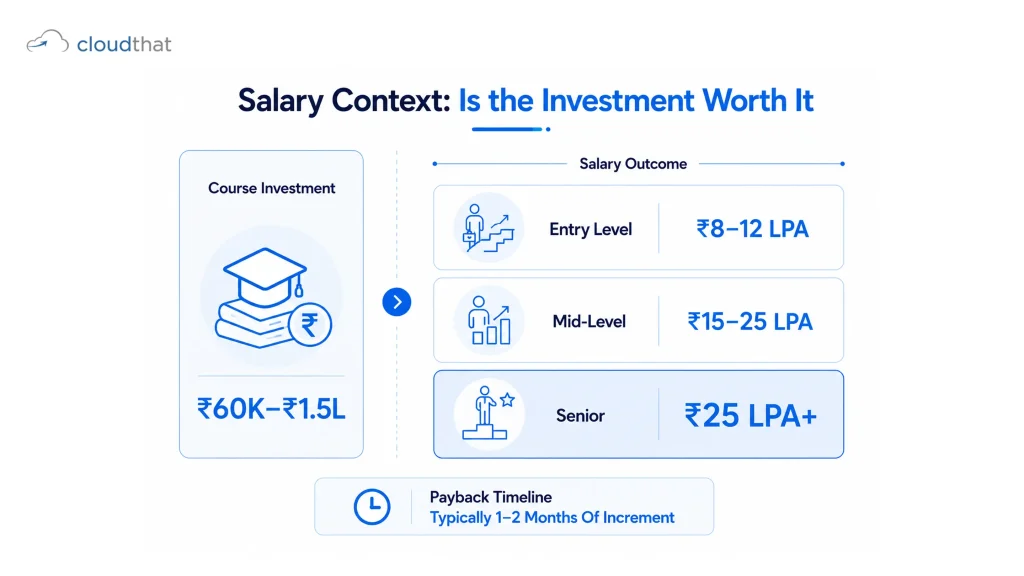
AI and data science professionals in India earn between INR 8 and 30 LPA, depending on experience, specialization, and the company they work for. Entry-level roles start at 8-12 LPA. Mid-level data scientists with 3 to 5 years of experience and strong ML or GenAI skills command 15 to 25 LPA. Senior roles at product companies and AI-first firms go higher.
The U.S. Bureau of Labor Statistics projects 36 percent growth in data science roles through 2031, reflecting global demand that is drawing Indian talent into multinational and remote roles.
A course fee of INR 1,00,000 that results in a 5-8 LPA salary jump pays for itself within two months of the increment taking effect. The calculation is straightforward. What matters is whether the course actually produces that outcome, not whether it costs less than the alternatives.
What to Look For Beyond the Fee
Before you compare fees across programs, compare these things first.
Trainer credentials: Are the people teaching this program practitioners who work with AI and data science in production environments, or are they primarily educators? The difference is significant in how they handle real-world edge cases in class.
Hands-on lab time: What percentage of the program is spent building things versus watching things being built? Aim for 50 percent or more in actual lab work.
Project portfolio: Does the program help you build 2 to 3 projects you can put on GitHub and discuss in interviews? A certificate without portfolio evidence is significantly weaker in a hiring conversation.
Placement support: Is there structured job assistance, mock interviews, or a hiring network? Be specific when you ask. “We have placement support” and “we connect you with 100 hiring partners and run mock technical interviews” are not the same offer.
Flexibility: Can you attend sessions live and access recordings if you miss? For working professionals, this is not a nice-to-have.
Why CloudThat Is the Right Investment for AI and Data Science Training
If you are budgeting for an artificial intelligence and data science course that actually moves your career, the program needs to combine credible instruction, cloud-native tooling, and structured outcomes.
CloudThat is a Microsoft Azure Partner and an NVIDIA Training Partner, which means its AI and data science curriculum is not built on generic content. The Integrated Program in AI and Data Science is delivered by instructors who run live AI and ML projects for enterprise clients, so the training reflects what is currently in production, including Azure Machine Learning, Azure OpenAI Service, and GenAI deployment workflows.
For professionals specifically targeting GenAI roles, CloudThat’s AI/ML course catalog includes 23 courses across machine learning, deep learning, and generative AI, with NVIDIA-certified training content for engineers working on GPU-accelerated AI workloads. The NVIDIA training partnership covers GenAI fundamentals through to production-level model deployment.
What makes the fee worth it is the hands-on component. More than 50 percent of training time is in labs, building models, deploying to cloud environments, and working through real datasets. That is what produces a portfolio, and a portfolio is what produces job offers.
Conclusion
The fee for an artificial intelligence and data science course is not the most important number. The most important number is what your career looks like 12 months after completing it. Get that calculation right first, then find the program that gives you the best shot at that outcome within a budget you can commit to.
Key Takeaways:
- AI and data science course fees in India range from INR 10,000 to over INR 2,00,000, and the gap reflects real differences in format, depth, and outcome support.
- Self-paced video courses are cheaper but rarely sufficient for career transition. Live instructor-led programs with lab time produce better job outcomes.
- Hidden costs including certification exam fees, cloud credits, and time investment are rarely mentioned upfront but should be factored into your total budget.
- A credible course must cover Python, statistics, machine learning, deep learning, generative AI, and cloud deployment in a logical sequence.
- Hands-on lab time above 50 percent is the single biggest predictor of whether training translates into employability.
- Entry-level AI and data science roles in India pay 8 to 12 LPA. A course fee of INR 1,00,000 typically pays for itself within two months of a salary increment.
- Trainer credentials matter more than institution branding. Practitioners who work on live AI projects teach differently from those who only teach.
- Ask any program specifically what the hands-on component includes, what projects you will build, and what placement support actually looks like.
- GenAI and cloud deployment skills are now expected in mid-level and senior data science roles, not just nice-to-have additions.
- The right budget question is not “what is the cheapest course” but “what is the program most likely to produce the career outcome I am targeting.”
Ready to map this to your own situation? Explore the Integrated Program in AI and Data Science at CloudThat for a structured, instructor-led path built around Azure, machine learning, and GenAI skills. Or browse the full AI and ML course catalogue to find the right entry point for where you are now.
Launch Your AI Career with AWS GenAI Training
- Interview Guarantee
- Up to 75% Money Back
- Real-World Learning
About CloudThat
FAQs
1. Which course is best for data science and AI?
ANS: – The best course is one that covers Python, statistics, machine learning, deep learning, and generative AI with hands-on labs and instructor access. Avoid programs that are primarily video content with no project work. In India, instructor-led programs with cloud platform integration and job assistance produce the strongest outcomes.
2. What is the salary of an AI data scientist in India?
ANS: – Entry-level AI and data science roles in India pay between INR 8 to 12 LPA. Mid-level professionals with 3 to 5 years of experience and GenAI or MLOps skills earn 15 to 25 LPA. Senior roles at product companies or AI-first firms pay more, particularly for those with experience in cloud deployment and agentic AI.
3. Can I learn AI and data science in 3 months?
ANS: – You can learn the fundamentals in 3 months with focused study. To reach job-ready level, including machine learning, deep learning, generative AI, and cloud deployment, budget 5 to 8 months in a structured program. Career-transition-level readiness typically takes 6 months or more.
4. Is data science still worth it in 2026?
ANS: – Yes. The demand for professionals who can work with machine learning, GenAI, and cloud-based AI tools is growing across every industry. The role is evolving to include more GenAI and agentic AI skills, but the core demand for data-driven decision-making is not shrinking.
5. Which pays more, AI or data science?
ANS: – They overlap significantly. AI engineering and machine learning engineering roles often pay slightly more than traditional data analyst or data scientist roles, particularly for professionals with specializations in deep learning, GenAI, or MLOps. The highest-paying roles combine both.
6. Is there a free course for AI and data science?
ANS: – AWS, Microsoft, Google Cloud, and NVIDIA all offer free introductory content. These are useful for exploration but insufficient for a career transition. Free content typically lacks structured progression, hands-on labs, mentorship, and the credential value that employers recognize.
7. How do I evaluate whether an AI and data science course fee is worth it?
ANS: – Check the trainer’s credentials, the hands-on lab percentage, the projects you will build, whether placement support is structured or vague, and what flexibility looks like for working professionals. A higher fee with those elements is usually worth more than a lower fee without them.

WRITTEN BY Himisha Raval
Himisha Raval is a Digital Marketing Manager at CloudThat with a strong command of search engine optimization, web analytics, link building, and content strategy. She brings a data-driven approach to digital marketing, helping IT companies strengthen their online presence, improve search rankings, and generate consistent leads across channels. Beyond execution, she plays an active role in ideation, campaign strategy, and website performance optimization. Outside of work, she balances her analytical side with a love for travel, nature painting, and dancing.


 PREV
PREV











Comments