

 Login
Login


 June 22, 2026
|
Voiced by Amazon Polly |
Introduction
The way we interact with AI is evolving. Instead of relying on a single model to handle every task, we’re moving toward systems that leverage multiple specialized AI agents collaborating, each contributing unique capabilities to solve complex problems. Microsoft’s AutoGen framework sits at the forefront of this shift, offering developers a powerful toolkit for orchestrating multi-agent workflows.
AutoGen is an open-source framework developed by Microsoft Research for building agentic AI systems. Rather than treating AI as a monolithic assistant, AutoGen allows you to create networks of agents that observe, reason, plan, and act, often autonomously, on behalf of humans.
These agents can use tools (like web browsers or memory systems), collaborate in teams, and interact naturally through conversation. Since its initial release in October 2023, AutoGen has exploded in popularity, amassing over 2.7 million downloads, 37,000 GitHub stars, and a vibrant community of contributors.
The latest major release, AutoGen 0.4, introduced a re-architected foundation: modular components, event-driven workflows, and first-class support for debugging and monitoring. It also ships with AutoGen Studio, a no-code graphical interface for designing agent workflows by dragging and dropping components.
Pioneers in Cloud Consulting & Migration Services
- Reduced infrastructural costs
- Accelerated application deployment
Key Features
- Intelligent Multi-Agent Collaboration – AutoGen enables multiple AI agents to work together as a coordinated team. Each agent can be assigned a specialized role, such as researcher, developer, analyst, or reviewer, allowing complex tasks to be divided, executed, and refined through natural language interactions.
- Flexible Workflow Orchestration – The framework supports a variety of collaboration patterns, including sequential workflows, group discussions, nested conversations, and human-guided interactions. This flexibility allows developers to design agent ecosystems tailored to different business and technical requirements.
- Seamless Tool and System Integration – AutoGen agents can extend beyond conversation by interacting with external tools and services. They can execute code, call APIs, browse the web, access databases, and integrate with enterprise systems, enabling them to perform real-world actions and automate end-to-end workflows.
- Event-Driven and Scalable Architecture – Built on a modular, event-driven foundation, AutoGen supports asynchronous communication between agents. This architecture enables scalable, distributed, and long-running workflows while simplifying the integration of custom agents, tools, and memory systems.
- Human-in-the-Loop Control – AutoGen provides built-in mechanisms for human oversight and intervention. Users can review outputs, approve critical decisions, and guide agent behavior at any stage, ensuring greater transparency, reliability, and control.
- Built-In Observability and Debugging – The latest versions of AutoGen include advanced tracing, monitoring, and debugging capabilities. Developers can inspect agent interactions, track execution flows, and diagnose issues more effectively, making it easier to develop and maintain production-grade AI applications.
- Visual Development with AutoGen Studio – AutoGen Studio offers a no-code graphical interface for designing, testing, and managing multi-agent workflows. By using drag-and-drop components, both technical and non-technical users can rapidly prototype sophisticated AI systems without extensive coding.
Real-World Use Cases of AutoGen
- Business Process Automation – Organizations can use AutoGen to automate complex, multi-step business workflows, such as invoice processing, employee onboarding, compliance verification, and customer support. Specialized agents can handle data extraction, validation, decision-making, and reporting, significantly reducing manual effort and operational costs.
- AI-Powered Software Development – AutoGen is particularly effective for software engineering workflows. Teams of AI agents can collaborate to generate code, review implementations, identify bugs, write test cases, and optimize performance. This accelerates development cycles while improving code quality and consistency.
- Research and Knowledge Discovery – Researchers and analysts can leverage AutoGen to automate information gathering, literature reviews, data synthesis, and report generation. By combining multiple agents with retrieval capabilities, organizations can quickly process large volumes of information and extract actionable insights.
- Data Analysis and Business Intelligence – AutoGen agents can work together to collect data, perform analysis, generate visualizations, and summarize findings. This makes it valuable for business intelligence applications, helping organizations make faster, data-driven decisions.
- Intelligent Customer Support – Businesses can deploy multi-agent customer support systems where different agents specialize in issue classification, information retrieval, troubleshooting, and escalation. This improves response quality while reducing support workload and resolution times.
- Personal Productivity Assistants – AutoGen can power intelligent personal assistants that manage emails, schedule meetings, summarize conversations, track tasks, and automate routine activities. Multiple agents can collaborate behind the scenes to efficiently handle complex requests.
- Educational and Tutoring Systems – Educational platforms can use AutoGen to create interactive learning environments. Different agents can act as instructors, mentors, reviewers, or debate partners, providing personalized guidance and helping learners understand concepts from multiple perspectives.
- Financial and Compliance Operations – Financial institutions can utilize AutoGen for tasks such as document verification, risk assessment, fraud detection, regulatory compliance checks, and report generation. Multiple specialized agents can collaborate to improve accuracy and reduce processing time.
- Healthcare and Medical Documentation – Healthcare organizations can employ AutoGen to assist with patient record summarization, medical documentation, appointment coordination, and administrative workflows. Human oversight ensures that critical decisions remain under professional supervision.
- Autonomous Enterprise Workflows – Large enterprises can build end-to-end autonomous workflows that enable agents to coordinate across departments, applications, and databases. For example, a procurement workflow could automatically gather requirements, evaluate vendors, generate purchase orders, and prepare approval reports with minimal human intervention.
Code Examples
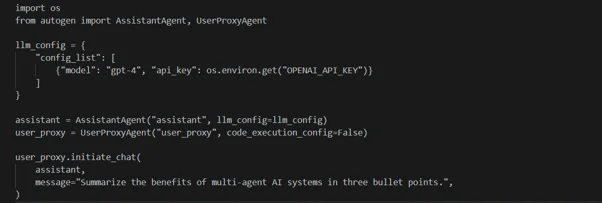
- Basic Two-Agent Conversation
This example demonstrates the simplest AutoGen workflow. A user proxy agent initiates a conversation with an assistant agent, which processes the request and generates a response.
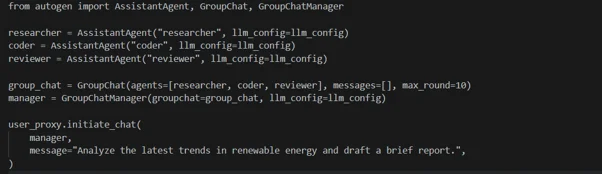
- Multi-Agent Group Chat
Here, three agents collaborate: a researcher, a coder, and a reviewer. A manager agent coordinates.
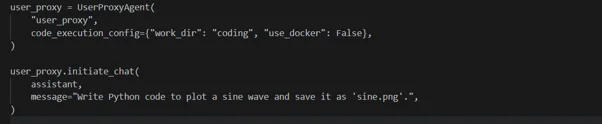
- Code Generation and Execution
One of AutoGen’s powerful capabilities is allowing agents to write and execute code. In this example, the assistant generates Python code to create a sine wave plot and saves the resulting image.
Conclusion
As AI systems become increasingly sophisticated, the focus is shifting from standalone models to collaborative agent ecosystems capable of tackling complex, real-world challenges. AutoGen is at the forefront of this evolution, providing a powerful framework for building intelligent multi-agent applications that can reason, communicate, and take action autonomously.
With the addition of AutoGen Studio’s no-code interface, the framework becomes accessible to both developers and business users, accelerating experimentation and innovation. As the adoption of agentic AI continues to grow, AutoGen offers a strong foundation for building the next generation of intelligent, collaborative, and production-ready AI systems.
Drop a query if you have any questions regarding AutoGen, and we will get back to you quickly.
Making IT Networks Enterprise-ready – Cloud Management Services
- Accelerated cloud migration
- End-to-end view of the cloud environment
About CloudThat
FAQs
1. What programming languages does AutoGen support?
ANS: – AutoGen is primarily a Python-based framework for building multi-agent AI applications.
2. Is AutoGen free to use?
ANS: – Yes, AutoGen is open-source and available under the MIT License.
3. Can AutoGen work with models other than OpenAI's GPT?
ANS: – Yes. AutoGen supports multiple AI providers, including OpenAI, Azure OpenAI, Google Gemini, and other compatible models.


WRITTEN BY Livi Johari
Livi Johari is a Research Associate at CloudThat with a keen interest in Data Science, Artificial Intelligence (AI), and the Internet of Things (IoT). She is passionate about building intelligent, data-driven solutions that integrate AI with connected devices to enable smarter automation and real-time decision-making. In her free time, she enjoys learning new programming languages and exploring emerging technologies to stay current with the latest innovations in AI, data analytics, and AIoT ecosystems.


 PREV
PREV












Comments