

 Login
Login


 June 11, 2026
|
Voiced by Amazon Polly |
Introduction
An AI and data science course worth paying for in 2026 covers Python, statistical modeling, machine learning, deep learning, generative AI (RAG, agentic workflows, LLM orchestration), and hands-on deployment inside a real cloud environment. Fees for structured, instructor-led programs with job support range from ₹80,000 to ₹1,50,000. Mid-level data scientists with ML exposure earn between ₹12 and ₹22 LPA in India, while GenAI specialists command a significant premium over that range. If you want the full picture on which skills matter, what good projects look like, and how to evaluate programs before paying, read on.
Most people looking for an AI and data science course already know they need one. What they don’t know is what separates a course that actually delivers from one that eats six months of your evenings and leaves you with a certificate no one asks about.
This guide covers the skills that matter in 2026, what a structured AI and data science program should include, realistic salary benchmarks with sources, and how to evaluate your options without getting sold a dream.
Launch Your AI Career with AWS GenAI Training
- Interview Guarantee
- Up to 75% Money Back
- Real-World Learning
What the AI and Data Science Field Looks Like in 2026
The hype around AI has not died down. It has compounded.
But most introductory content gets one thing wrong. AI and data science are not on the same track. Data science focuses on extracting insight from data through statistical modeling, analysis, and visualization. AI (specifically machine learning and generative AI) builds systems that learn and generate. In 2026, the well-paying roles sit at the intersection of both.
A data scientist who cannot work with ML models is getting squeezed out of better-paying roles. An ML engineer who cannot interpret data cleanly is building on shaky ground. The right AI and data science course closes that gap.
According to the U.S. Bureau of Labor Statistics Occupational Outlook Handbook, data science roles are projected to grow 36 percent between 2021 and 2031, making it one of the fastest-growing technical disciplines. In India, demand is outpacing supply in ML and GenAI roles.
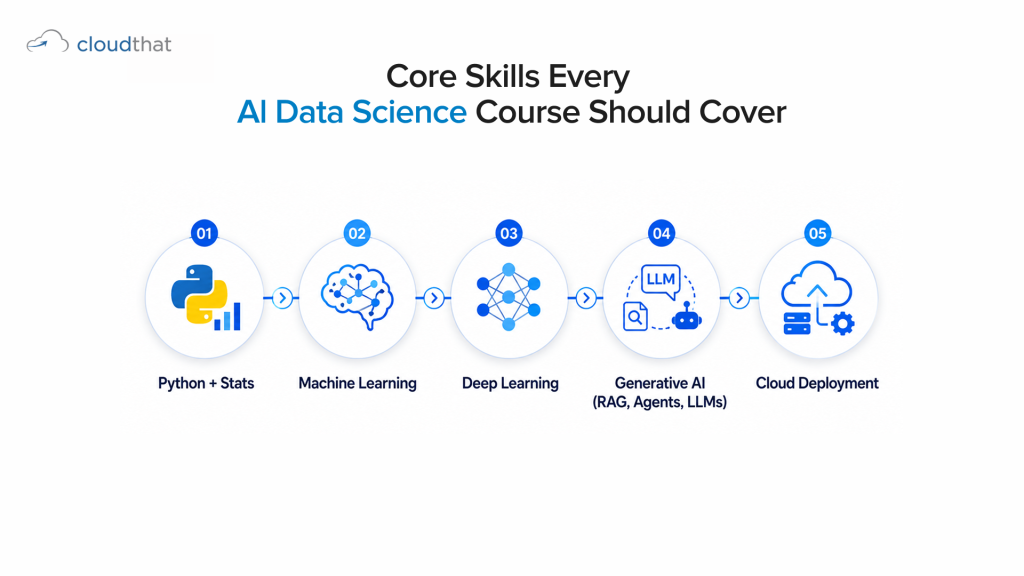
Core Skills Every AI Data Science Course Should Cover
This is the list to run against any program before you pay.
Python and Statistical Foundations: Not just syntax. You need to understand distributions, hypothesis testing, and regression well enough to explain them to a stakeholder who does not code. Courses that treat this as optional pre-work are cutting corners.
Machine Learning (Supervised and Unsupervised): Classification, regression, clustering, ensemble methods. The ability to build and evaluate models using Scikit-learn, not just run a notebook someone else wrote.
Deep Learning and Neural Networks: At a minimum, understanding architectures like CNNs and RNNs. At the applied level, working with TensorFlow or PyTorch.
Generative AI and Large Language Models: This is where 2026 separates current programs from outdated ones. Prompt engineering, retrieval-augmented generation (RAG), multi-agent systems, and LLM orchestration are no longer advanced topics; they are baseline expectations. According to McKinsey’s The State of AI 2024 report, GenAI adoption has more than doubled year over year. Courses without this content are already behind.
Data Engineering Basics: ETL pipelines, SQL, and working with cloud data warehouses like Amazon Redshift or Google BigQuery. A data scientist who cannot get their own data is a bottleneck on every team.
Cloud Platforms AWS SageMaker, Azure Machine Learning, and Google Cloud’s Vertex AI are where real models get deployed. Knowing algorithms in theory is not enough. The course needs to give you hands-on time inside these environments.
What Good Projects Look Like (and Why Most Courses Get This Wrong)
Most programs hand you a Kaggle dataset and call it a capstone.
That is not how real data science work happens.
A strong AI and data science course builds projects around actual business scenarios: customer segmentation for a retail company, demand forecasting for a quick-commerce platform, credit default prediction for a digital lender, and defect detection on a manufacturing line. These are the cases that come up in interviews. They are also what hiring managers look at in portfolio reviews when they are paying attention.
What makes a project portfolio useful:
- The problem statement is specific, not generic
- You own the data pipeline from raw to output
- The model is deployed somewhere, not just sitting in a local notebook
- You can explain every decision you made and why
If a course cannot point you to this level of output, the certificate is decorating your LinkedIn, not opening doors.
What an AI and Data Science Course Should Cost
Course fees in 2026 vary significantly based on depth, delivery format, and what outcomes are actually built in.
Self-paced platforms: Under ₹2,000 for a single course. No live instruction, no feedback, no placement support. Completion rates across self-paced platforms sit below 10 percent. Useful for filling a specific gap, not for a career move.
Mid-tier online programs with some live instruction: ₹30,000 to ₹80,000. Better than self-paced, but the quality of trainers and the hands-on component vary widely. Ask to see a sample lab environment and the trainer’s LinkedIn before committing.
Structured programs with cloud lab access, live instructor-led delivery, and job support: ₹80,000 to ₹1,50,000. This is the correct range if you are making a serious career move. The lab environment, trainer experience, and placement process are worth the premium.
University or executive programs (MIT Applied AI, IIM, ISB): ₹3,00,000 to ₹5,00,000 and above. A credential carries weight for specific consulting and senior roles. Overkill for most engineering career moves.
One thing most advertised prices do not include: exam vouchers, cloud sandbox credits, and retake fees. Always ask for the all-in cost before committing.
The Google Cloud Skills Boost platform offers free introductory labs as a reasonable way to test whether you genuinely enjoy working in these environments before spending on a full program.
Career Scope and Salary Reality
The number of titles under the AI and data science umbrella has grown considerably in 2026.
Data Scientist: Statistical analysis, modeling, communicating findings to non-technical stakeholders. Salary range in India: ₹8 to ₹20 LPA, depending on specialization and company tier. Source: AmbitionBox India Salary Data, 2024–25.
ML Engineer: Building and deploying machine learning systems in production. Salary range: ₹12 to ₹28 LPA. High demand, higher technical bar.
AI/ML Specialist: Applied AI implementations with a cloud-specific focus on AWS, Azure, or GCP. Usually requires a vendor certification alongside a portfolio.
GenAI Engineer: Newer role, growing quickly. Bedrock, Vertex AI, and Azure OpenAI integrations. Strong practitioners with real deployment experience are not struggling to find offers; salaries are still trending upward.
Data Analyst with ML exposure: Entry-level to mid-level, ₹5 to ₹12 LPA. More accessible starting point with a clear upgrade path toward data scientist or ML engineer roles.
The gap between someone with a certificate and someone with a certificate, plus real project work, plus cloud platform deployment, is not small. It typically translates to ₹4 to ₹6 LPA at the entry level.

Why CloudThat Is the Right Starting Point for AI and Data Science in 2026
If you want an AI and data science course that reflects what cloud environments and GenAI deployments look like in production today, not what they looked like two years ago, CloudThat is built for that. Training is delivered by practitioners who run live enterprise migrations, Bedrock-based agentic workflows, and intelligent document processing deployments. The curriculum is not static.
The Integrated Program in AI and Data Science covers the full stack: Python and statistical foundations, machine learning model building, deep learning architectures, Azure Machine Learning workflows, and GenAI implementation, with labs running inside actual cloud environments, not sandboxed demos.
For learners focused on specific certifications, the AWS Certified Machine Learning Specialty and AI-102 Azure AI Engineer Associate programs run as instructor-led live courses with exam preparation built into the schedule.
For enterprises upskilling data and engineering teams at scale, the Capability Development Framework runs the full cycle from skill assessment to project-ready validation. It is the same model that moved Protiviti’s fresh hires from onboarding to billable in 45 days. CloudThat holds AWS Premier Tier Services Partner status with competencies in Machine Learning, MLOps, and GenAI, and has trained over 1.1 million professionals across 30 countries.
Conclusion
The right AI and data science course in 2026 is not about the brand on the certificate. It is about whether the program gives you Python fluency, real ML model experience, GenAI exposure, and cloud deployment practice, delivered by someone with actual industry context, not someone reading from a curriculum written two years ago.
Evaluate programs on those criteria, not on how many hours of video content they include. If you are ready to start, explore CloudThat’s AI and Data Science training programmes or speak to the team about corporate training options for your organization.
Key Takeaways
- AI and data science are overlapping but distinct tracks. Strong careers in 2026 sit at the intersection of both.
- Python, ML modeling, deep learning, GenAI, and cloud deployment are the five non-negotiable skill areas for any serious course.
- GenAI knowledge (RAG, agentic workflows, prompt engineering) is now a baseline expectation, not an advanced module.
- Structured programs with live instruction and job support are priced between ₹80,000 and ₹1,50,000. That is the right range for a career move.
- Self-paced platforms have completion rates below 10 percent. Live, instructor-led programs produce better outcomes.
- A portfolio of real, scenario-based projects matters more in interviews than the certificate alone.
- Mid-level ML engineers in India earn ₹12 to ₹28 LPA. GenAI specialists with deployment experience command a premium above that.
- Cloud certifications (AWS ML Specialty, Azure AI-102, DP-100) add measurable weight to any AI or data science profile.
- No PhD required. Demonstrated skills plus a strong project portfolio is what industry roles evaluate.
- Evaluate programmes on trainer background, lab access, and capstone structure, not hours of video content.
Become an AI Engineer with AWS GenAI Training
- Mock Interviews
- AWS Expert Trainers
- Career Support
About CloudThat
FAQs
1. Which course is best for data science and AI in 2026?
ANS: – The best course depends on your background and career goals. Strong programs combine Python, machine learning, cloud platforms, and hands-on AI projects. Avoid anything that skips GenAI or cloud deployment. Those are no longer optional.
2. What is the salary for AI data science roles in India?
ANS: – Entry-level roles start at ₹5 to ₹8 LPA. Mid-level data scientists with ML exposure earn ₹12 to ₹22 LPA. ML engineers and GenAI specialists with deployment experience earn above that band. Source: AmbitionBox India Salary Data, 2024–25.
3. Can I learn AI and data science in 3 months?
ANS: – You can build a solid foundation in three months with consistent effort. Becoming job-ready with deployable projects and cloud skills typically takes six to nine months for someone already in tech.
4. Do I need a PhD to become a data scientist?
ANS: – No. Most companies hire on practical skills, certifications, and a project portfolio. Academic research backgrounds matter for specific research roles, not for industry data science or ML engineering positions.
5. What AI tools and platforms should I know?
ANS: – Python, SQL, Scikit-learn or PyTorch, and at least one cloud AI platform (AWS SageMaker, Azure ML, or Vertex AI) are the baseline. Add prompt engineering and RAG frameworks if you are targeting GenAI roles.
6. Is data science full of maths?
ANS: – Statistics and probability are part of the work, but most professionals learn them gradually through practical applications. You do not need a maths degree to get started. You need enough to interpret your model outputs correctly.
7. What are the top jobs in AI in 2026?
ANS: – ML Engineer, GenAI Engineer, Data Scientist, MLOps Engineer, and AI/ML Specialist are among the fastest-growing and highest-paid positions in the market right now.

WRITTEN BY Himisha Raval
Himisha Raval is a Digital Marketing Manager at CloudThat with a strong command of search engine optimization, web analytics, link building, and content strategy. She brings a data-driven approach to digital marketing, helping IT companies strengthen their online presence, improve search rankings, and generate consistent leads across channels. Beyond execution, she plays an active role in ideation, campaign strategy, and website performance optimization. Outside of work, she balances her analytical side with a love for travel, nature painting, and dancing.


 PREV
PREV












Comments