

 Login
Login


 May 22, 2026
|
Voiced by Amazon Polly |
Overview
Traditional FinOps practices often focus heavily on reducing cloud spend, but mature FinOps organizations measure success differently, by understanding the business value generated from every dollar spent. Cost visibility alone is no longer enough; organizations must connect infrastructure spending with product growth, engineering efficiency, and unit economics. This article explores how engineering, finance, and product teams can use AWS-native FinOps practices to move beyond cost optimization and build a value-driven operating model centered around measurable business outcomes.
Pioneers in Cloud Consulting & Migration Services
- Reduced infrastructural costs
- Accelerated application deployment
Introduction
Your cloud bill went up. That might be the best news your business has received this quarter.
A growing product with growing users should produce a growing infrastructure bill. The real question isn’t “how much are we spending?”, it’s “what’s our cost per transaction, and is it trending in the right direction?” Most organizations never ask this question because their FinOps practice is stuck in the “reduce the bill” phase. They celebrate when spending drops and panic when it rises, regardless of what the business is doing. That cycle breaks when you shift from measuring absolute cost to measuring unit economics.
The Maturity Shift: From Cost to Value
The FinOps Foundation defines three phases of organizational maturity: Inform, Optimize, and Operate. Most organizations are stuck between the first two.
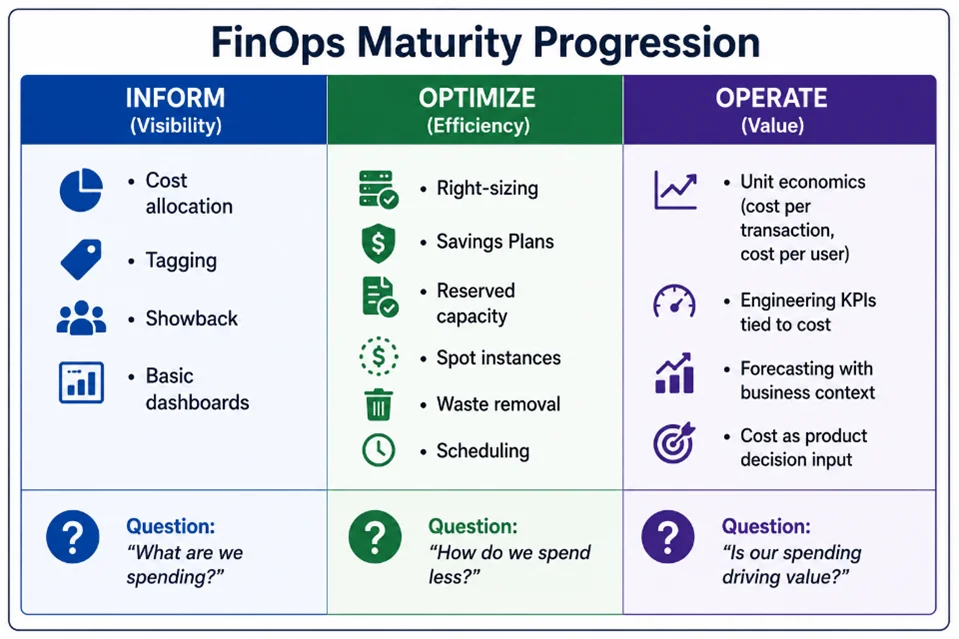
The Operate phase is where FinOps becomes a business capability rather than a cost-reduction exercise. And the key concept that unlocks it is unit economics.
Unit Economics: The Metric That Changes Everything
Total monthly spend: $180,000. Is that good or bad? Impossible to say without context.
Now add context:
- Cost per API transaction: $0.0003
- Cost per active subscriber: $1.20/month
- Infrastructure cost as a percentage of revenue: 7.8%
These numbers tell you something actionable. If cost-per-transaction is trending down while subscriber count grows, you’re scaling efficiently. If it’s trending up, you have an engineering problem to investigate, regardless of the total bill.
Implementing Unit Economics on AWS
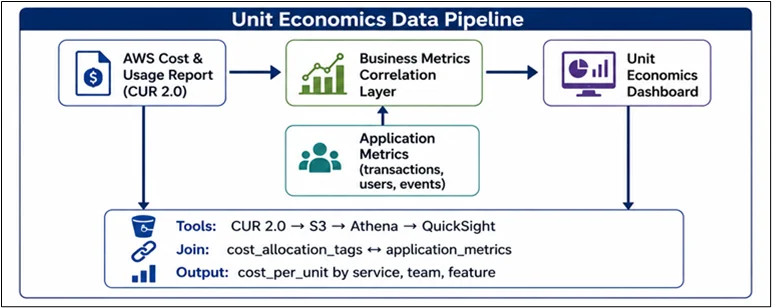
Step 1: Enable CUR 2.0 with resource-level detail exported to Amazon S3.
Step 2: Implement consistent tagging. At minimum: cost-center, product, environment, and team. Use AWS Organizations Tag Policies to enforce compliance.
Step 3: Correlate cost data with business metrics. This is the step most organizations skip. Join your CUR data (queried via Athena) with application metrics, transactions processed, users served, and features used.
Step 4: Build unit-cost dashboards. Set alerts on unit-cost thresholds rather than absolute spend. Alert when cost-per-transaction exceeds $0.0005, not when monthly spend exceeds $200,000.
Making Engineers Accountable (Without Making Them Miserable)
The most effective FinOps programs give engineering teams visibility and ownership, not restrictions and approval gates.
What works:
- Team-level cost visibility — Each team sees their cost-per-unit metrics in their existing dashboards (Grafana, Datadog, or QuickSight). Updated daily. No separate tool to check.
- Cost context in CI/CD — Infrastructure changes show estimated cost impact before merging. AWS CDK’s cdk diff, combined with cost estimation, gives engineers immediate feedback on the financial impact of their architecture decisions.
- Architecture reviews with cost as a dimension — Every design document includes a section on expected unit economics. Not “how much will this cost?” but “what’s the cost-per-unit at 10x our current scale?”
- Celebrating efficiency, not just savings — A team that reduces cost-per-transaction by 30% while handling 2x more traffic deserves recognition, even though their total bill went up.
What doesn’t work:
- Centralized approval gates for every resource provisioning request
- Blanket “reduce spend by 20%” mandates without a business context
- Punishing teams whose costs grow because their product is succeeding
- Making FinOps someone else’s problem (it’s everyone’s responsibility)
FinOps as a Product Decision Input
Here’s where mature FinOps creates business value beyond cost management:
A product team considering a free tier can model the decision using unit economics. If cost-per-user is $1.20/month and ad revenue per free user is $0.80/month, the free tier loses $0.40 per user. But if 12% of free users convert to paid ($14.99/month), the unit economics work.
That decision, whether to offer a free tier, is a product decision informed by infrastructure economics. This is FinOps operating at the strategic level, not the tactical “delete unused EBS volumes” level.
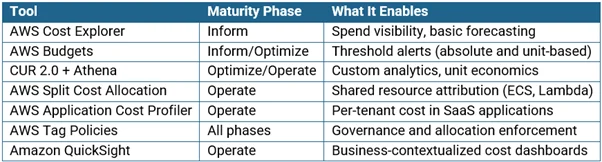
AWS Tools for Mature FinOps
Conclusion
When your FinOps practice can answer “is our spending driving value?” instead of just “what are we spending?”, you’ve graduated from cost management to value engineering. That’s the competitive advantage.
Drop a query if you have any questions regarding FinOps and we will get back to you quickly.
Empowering organizations to become ‘data driven’ enterprises with our Cloud experts.
- Reduced infrastructure costs
- Timely data-driven decisions
About CloudThat
FAQs
1. How do we start with unit economics if our tagging is incomplete?
ANS: – Start small. Pick one product or one team. Get their resources tagged correctly, build their unit-cost dashboard, and demonstrate the insight it provides. Success with one team creates organizational momentum. You don’t need 100% tag coverage to begin, you need one compelling example that makes other teams want the same visibility.
2. Who should own FinOps in the organization?
ANS: – FinOps works best as a cross-functional practice, not a single team’s responsibility. The FinOps Foundation recommends a dedicated practitioner (or a small team) who bridges finance, engineering, and product, someone who can translate cost data into business outcomes. Engineering owns efficiency. Finance owns budgets. The FinOps practitioner connects the two.
3. How do Savings Plans and Reserved Instances fit into a value-driven FinOps model?
ANS: – They’re optimization tactics that reduce your cost-per-unit baseline, still valuable, still worth pursuing. But they belong in the Optimize phase, not the Operate phase. Buy Savings Plans to lower your unit costs, then track whether those lower unit costs translate into better business margins. The commitment purchase is a means to an end, not the end itself.
4. What's the difference between showback and chargeback, and which should we implement?
ANS: – Showback means showing teams their costs without financial consequences, it builds awareness and is low-friction to implement. Chargeback means teams pay out of their own budgets, it drives accountability but requires mature tagging and allocation. Most organizations start with showback, prove the data is accurate and fair, then graduate to chargeback once teams trust the numbers.


WRITTEN BY Vignesh J
Vignesh Jagadeesan is the Head of Presales at CloudThat with 12+ years of experience driving digital transformation for Public Sector, SMB, and Enterprise customers across India and the USA. He specializes in Cloud Consulting, Data Management, MDM, Analytics, and enterprise modernization. Vignesh has led transformation engagements spanning cloud adoption, analytics, managed services, and enterprise solutioning across government, BFSI, healthcare, retail, manufacturing, and energy sectors, partnering with business stakeholders and cloud partners to deliver scalable, outcome-driven solutions.


 PREV
PREV












Comments