

 Login
Login


 January 6, 2026
|
Voiced by Amazon Polly |
Generative AI is no longer an emerging trend; it has become a core capability across various industries. From automated content creation to intelligent code generation and data analysis, organizations are actively seeking professionals who can work confidently with generative models. As we enter 2026, learning Generative AI is less about curiosity and more about career sustainability.
But with so many artificial intelligence courses available, the challenge isn’t whether to learn. It’s what to learn and in what order?
This blog breaks down the five most important areas of Generative AI learning that professionals should focus on in 2026.
Ready to lead the future? Start your AI/ML journey today!
- In- depth knowledge and skill training
- Hands on labs
- Industry use cases
1. Generative AI Foundations
Before diving into tools or applications, it’s essential to understand how Generative AI works. A solid Gen AI Course should cover topics like large language models, transformers, training methodologies and real-world use cases.
This foundational knowledge helps learners move beyond surface-level usage and understand the strengths and limitations of generative systems. Platforms such as CloudThat offer foundational Generative AI programs that focus on practical understanding rather than abstract theory, making them suitable for professionals entering the rapidly evolving world of AI.
2. Prompt Engineering as a Core Skill
Prompt engineering has emerged as a distinct and valuable skill set. Knowing how to structure inputs for generative models directly impacts the quality, reliability and efficiency of the output. A well-designed Prompt Engineering course teaches learners how to control AI behaviour, reduce hallucinations and optimize responses for business use cases.
In 2026, prompt engineering will be relevant not only for developers, but also for analysts, marketers, researchers and product teams working with AI-powered tools. Learning this skill early helps professionals adapt as AI interfaces continue to evolve.
3. Machine Learning Fundamentals for Long-Term Growth
While Generative AI tools are powerful, they are built on core machine learning concepts. A structured Machine Learning certification strengthens understanding of data pipelines, model training, evaluation and performance optimization.
This knowledge enables professionals and students to transition from merely using AI to building and enhancing AI systems. Many learners find it beneficial to pair Generative AI learning with machine learning fundamentals to ensure long-term relevance as tools and frameworks change.
4. AI Engineer Skill Path
As organizations deploy AI at scale, the demand for engineers who can design, integrate and manage AI systems continues to grow. An AI-Engineer certification typically validates a broader skill set that includes Generative AI, machine learning, cloud platforms and deployment strategies.
For professionals seeking technical or architecture-level roles, following an AI engineer learning path offers a structured and clear approach. CloudThat, for example, offers role-based certification paths that align technical skills with real-world enterprise expectations, rather than focusing on isolated tools.
Career-Aligned AI Learning Roadmap
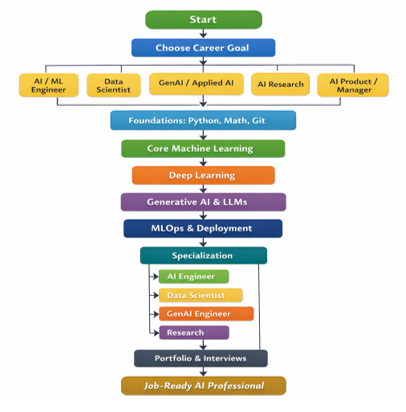
Fig 1: AI learning roadmap from foundational skills to advanced specialization for job-ready.
This flowchart shows a step-by-step AI learning journey, starting from choosing a career goal and building foundations in Python, Math and ML. It progresses through Deep Learning, Generative AI, deployment and specialization to become a job-ready AI professional.
How to Choose the Right AI Course in 2026
When evaluating AI learning options, professionals should focus on:
- Real-world relevance over theory-heavy content
- Hands-on projects and use cases
- Alignment with long-term career goals
- Industry-recognized credentials
Rather than chasing every new AI trend, investing in strong fundamentals and applied skills offers better returns in the long run.
Future-Ready Generative AI Careers
Generative AI will continue to transform the way work is done across industries in 2026 and beyond. For professionals, the goal shouldn’t be to learn everything, but to learn the right things in the correct sequence. By focusing on the foundations of Generative AI, prompt engineering, machine learning and structured engineering pathways, learners can develop skills that remain relevant as AI technology continues to evolve. With the proper roadmap and credible learning resources, mastering Generative AI becomes not only achievable but also sustainable.
Upskill Your Teams with Enterprise-Ready Tech Training Programs
- Team-wide Customizable Programs
- Measurable Business Outcomes
About CloudThat


WRITTEN BY Najmusseher
Najmusseher is a Subject Matter Expert in Azure AI/ML at CloudThat and a Research Scholar in Computer Science specializing in Artificial Intelligence and Deep Learning. With a strong academic background and a passion for innovation, her research focuses on AI-powered EEG-based seizure classification, driving impactful healthcare applications. Her passion for teaching reflects in her unique approach to learning and development. She has delivered training sessions and lectures to over 1000+ participants, ranging from students to industry professionals, combining technical expertise with an engaging teaching style. Najmusseher has published nine research papers, serves as a reviewer for reputed journals indexed in the Web of Science, and contributed a healthcare brain dataset to the UCI Machine Learning Repository. Her journey reflects a blend of academic rigor and practical industry expertise, making her a recognized contributor in Python, Data Science, AI and Deep Learning.


 PREV
PREV












Comments