

 Login
Login

 September 23, 2026
|
Voiced by Amazon Polly |
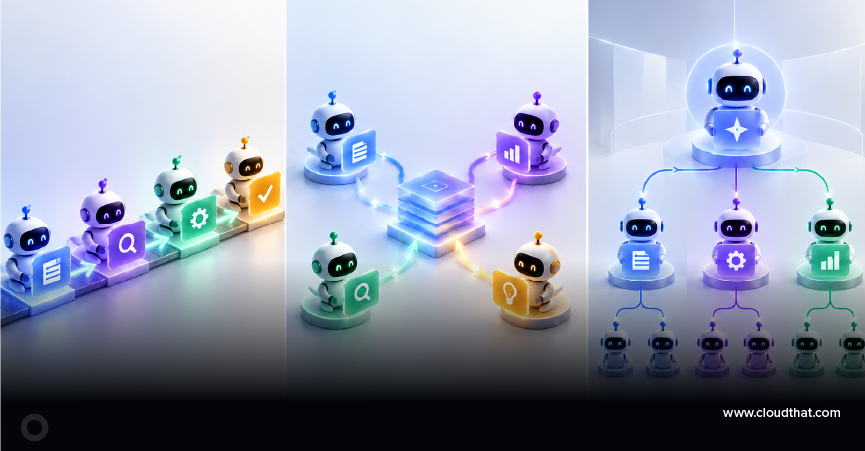
Most multi-agent AI projects don’t fail because the agents are dumb. They fail because someone picked the wrong coordination pattern for the job. This post breaks down the three core agent orchestration patterns, sequential, concurrent, and hierarchical, what each one costs, where each one breaks, and which one fits your workflow.
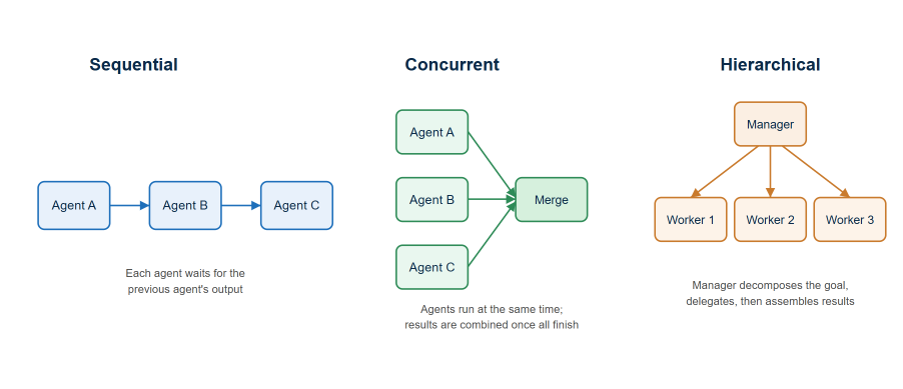
Fig 1: Comparing sequential, concurrent, and hierarchical AI agent orchestration patterns.
Start Learning In-Demand Tech Skills with Expert-Led Training
- Industry-Authorized Curriculum
- Expert-led Training
What is agent orchestration, and why does the pattern matter?
Agent orchestration is the layer that decides which AI agent runs, in what order, and how their outputs get merged. According to Microsoft’s Azure Architecture Center, the pattern you choose directly affects cost, because multi-agent systems multiply model calls, and each agent consumes tokens for its own instructions, context, and reasoning. Choosing a pattern more complex than the task requires is one of the most common architectural mistakes enterprises make when moving from a single-agent pilot to production.
What is sequential agent orchestration, and when should you use it?
Sequential orchestration chains agents in a fixed, linear order, with each agent taking the previous agent’s output as input, like an assembly line. It’s the simplest pattern to build, audit, and debug, which is why the Azure Architecture Center recommends it as the default starting point before adding any coordination complexity.
Where it works:
- Classification-then-summarization-then-drafting pipelines
- Compliance-heavy processes where the order of steps has to be provable
- Document workflows such as intake, extraction, validation, and routing
Where it breaks:
- A single wrong step corrupts everything downstream, since no later agent can catch an earlier agent’s mistake
- Latency stacks. A production benchmark from DEV Community puts each agent hop at 1–3 seconds of added latency, meaning a 3-agent sequential pipeline adds 3–9 seconds minimum before the reply is ready
What is concurrent agent orchestration, and when should you use it?
Concurrent (or parallel) orchestration runs multiple agents at the same time on independent pieces of a task, then an orchestrator merges the results. A research assistant who dispatches three agents to search different sources simultaneously and then combines their findings is a concurrent pattern.
Where it works:
- Multi-source research that splits cleanly into independent subtasks
- Running several agents against the same input to cross-check each other
- Fanning a large document out into chunks for parallel review
Where it breaks:
- The slowest agent bounds the total run time, not the fastest, so one stuck sub-agent stalls the entire batch
- Resource use spikes when every agent calls the model at the same moment, which the Azure Architecture Center flags as a direct cost and capacity risk
- Two agents writing to the same shared state at once can leave the system in an inconsistent condition if the workflow isn’t designed for it
What is hierarchical agent orchestration, and when should you use it?
Hierarchical orchestration puts a manager agent in charge. The manager receives the goal, breaks it into subtasks, delegates each one to a specialized worker agent, and then assembles the final result. Enterprise orchestration research from Dataiku describes this as the pattern enterprises reach for most often on ambitious, open-ended tasks, because it mirrors how a human team lead runs a complex project, for example, one agent pulling account data, a second inspecting product telemetry, and a third drafting an engineering escalation, all coordinated by a manager.
Where it works:
- Open-ended goals with no fixed sequence of steps
- Tasks that benefit from a mix of specialist agents using different tools or models
- Workflows where the manager has to build the plan itself before execution starts
Where it breaks:
- It’s the most expensive and least predictable pattern. A 2026 EffGen benchmark study measured the manager’s own decomposition and synthesis work at 15–20% of total run time, on top of every worker agent’s cost
- The same DEV Community benchmark found that a three-level hierarchical system adds 6+ seconds of latency before any worker agent starts doing real work
- The manager becomes a single point of failure if it misjudges the plan; every worker inherits that mistake
How do sequential, concurrent, and hierarchical agents compare?
Sequential is the cheapest and easiest to debug, but the slowest end-to-end because latency stacks with every agent. Concurrent is the fastest for independent work, but the hardest to keep consistent once agents share state. Hierarchical handles the most complex, open-ended goals, but at the highest and least predictable cost because the manager’s planning overhead is added on top of every worker’s cost.
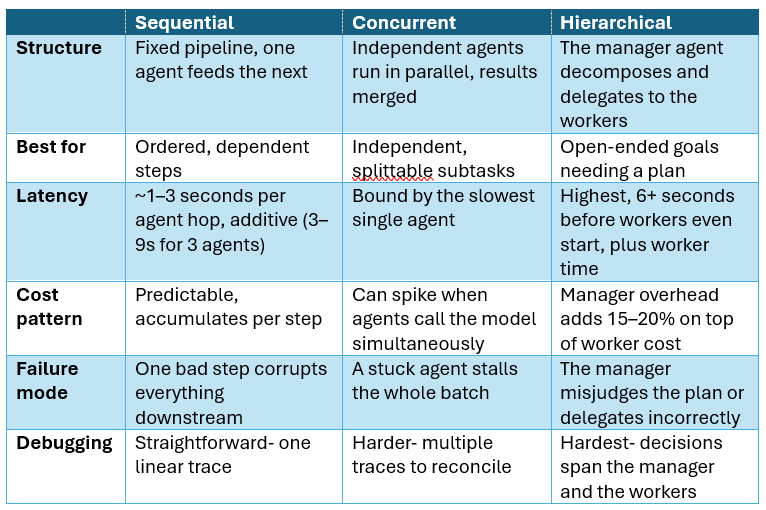
Sources: Azure Architecture Center, DEV Community production benchmark, EffGen 2026 study.
Which pattern should you actually choose?
Match the pattern to the shape of the work, not to whichever framework is trending:
- Choose sequential when the task has clear, ordered stages, and each step needs the previous step’s output. It’s the safest pattern to govern and the cheapest to run.
- Choose concurrent when the work can be split into independent pieces and speed matters more than strict order.
- Choose hierarchical when the goal is open-ended enough to require a plan before any work starts, and the added latency and cost are worth the flexibility.
Most production systems combine more than one pattern. A common design: a hierarchical manager fans out a concurrent batch of specialist workers, then routes the merged output through a short sequential review chain before it reaches a human or a downstream system. The Azure Architecture Center recommends starting with a sequential or simple handoff pattern, then adding concurrency or a manager layer only once that simpler version hits a measurable ceiling.
What mistakes do enterprises make when picking an orchestration pattern?
- Defaulting to hierarchical because it sounds more “agentic.” Many tasks are a straightforward pipeline that handles them sequentially at a lower cost and with fewer moving parts to debug.
- Forcing every agent into one long sequential chain, even when steps are independent. This adds unnecessary latency for no benefit, since those steps could run concurrently instead.
- Skipping observability. Without logging every routing decision and every agent’s input and output, a multi-agent failure is nearly impossible to trace back to its source.
At GenAI Innovation Center, the first architecture review question we ask before any agentic build is whether the task needs coordination at all, or whether a single well-scoped agent already does the job.
Building this in-house?
Picking the right pattern is half the job; implementing it with proper guardrails, observability, and cost controls is the other half. Generative AI training and consulting programs cover agent orchestration design as part of a broader enterprise AI readiness track, with hands-on labs using the frameworks teams actually ship.
Upskill Your Teams with Enterprise-Ready Tech Training Programs
- Team-wide Customizable Programs
- Measurable Business Outcomes
About CloudThat
FAQs
1. What is the difference between sequential and concurrent agents?
ANS: – Sequential agents run one after another, with each agent using the previous agent’s output as its input. Concurrent agents run at the same time on independent parts of a task, and an orchestrator merges their results once all agents have finished.
2. When should I use a hierarchical agent pattern instead of sequential or
ANS: – Use a hierarchical pattern when the task is too open-ended for a fixed sequence of steps and needs a manager agent to build a plan first. If the workflow already has clear, ordered steps, sequential is simpler, cheaper, and easier to debug.
3. Which agent orchestration pattern is cheapest to run?
ANS: – Sequential orchestration has the most predictable cost, since each agent runs once, in order. Hierarchical orchestration is typically the least predictable because the manager agent’s planning overhead adds roughly 15–20% of the total runtime on top of worker costs, per the 2026 EffGen benchmark.
4. Can I combine sequential, concurrent, and hierarchical patterns in one system?
ANS: – Yes, and most production systems do. A common combination is a hierarchical manager that dispatches a concurrent batch of worker agents, then passes the merged result through a short sequential review chain.
5. What's the biggest risk with hierarchical agent orchestration?
ANS: – The manager agent becomes a single point of failure. If it decomposes the task incorrectly or delegates to the wrong worker, every downstream agent inherits that mistake, and the added coordination layer makes the error harder to trace.


WRITTEN BY Akhilash K
Akhilash Nambiyer is a Microsoft Certified Trainer and Subject Matter Expert at CloudThat, specializing in Cloud Technologies, Security, and Data Engineering. With over 5 years of experience in the cloud training and consulting domain, he has trained more than 10,000 learners across Microsoft Azure, AWS, Databricks, and Oracle. Known for his clear, real-world teaching style and ability to simplify complex concepts, he brings deep technical knowledge and practical application into every learning experience. Akhilash’s passion for creating impactful learning experiences and empowering professionals reflects in his engaging, hands-on approach to teaching and mentoring.


 PREV
PREV











Comments