

 Login
Login


 June 16, 2026
|
Voiced by Amazon Polly |
Modern cloud, AI, and data workloads require comprehensive, end-to-end security to address evolving threats and compliance needs. Defender for Cloud offers a unified dashboard that combines Cloud Security Posture Management (CSPM) with workload protection. This solution automatically evaluates your resources against Azure best practices and global standards, including CIS, PCI, ISO, and NIST. Through its Secure Score, it prioritizes necessary fixes, such as enabling encryption or closing exposed ports, to enhance your organization’s security posture.
Start Learning In-Demand Tech Skills with Expert-Led Training
- Industry-Authorized Curriculum
- Expert-led Training
Comprehensive Workload and AI Security
Defender for Cloud extends advanced monitoring and protection across diverse workloads using dedicated modules: Defender for Servers, Defender for Containers, and protection for App Services and APIs. These modules cover virtual machines, Azure Kubernetes Service (AKS) clusters, and web applications. The solution also extends its security capabilities to AI workloads, discovering resources in Azure Machine Learning, Cognitive Services, and Azure OpenAI. It applies AI-specific security checks and detects threats such as data leakage or prompt-jailbreak attacks in real time, safeguarding the entire machine learning lifecycle.
Cloud Security Posture Management (CSPM) and Data Security Posture Management (DSPM)
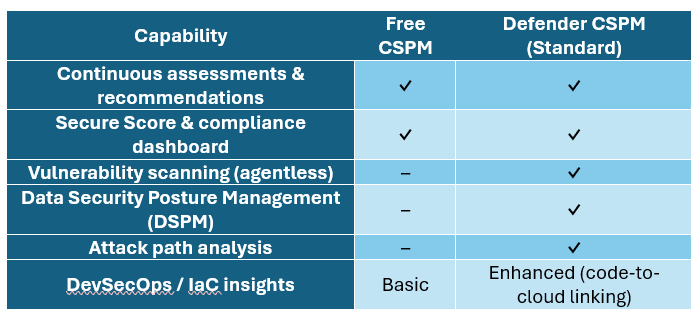
Defender for Cloud’s CSPM continuously assesses your environment, delivering baseline security evaluations, policy compliance checks, and a Secure Score even in the free tier. By upgrading to Defender CSPM (Standard), you unlock advanced features tailored for cloud, data, and AI workloads, including:
- Agentless Vulnerability Scanning: Identifies operating system and software vulnerabilities on servers and containers without the need to deploy agents.
- Attack Path Analysis: Reveals identities and network paths that attackers could exploit.
- Data Security Posture Management (DSPM): Automatically discovers and classifies sensitive data across databases and storage accounts.
- DevSecOps / Infrastructure as Code (IaC) Security: Scans ARM, Bicep, and Terraform templates for misconfigurations, supporting secure DevOps practices.
Defender for Cloud enforces the Microsoft Cloud Security Benchmark by default and supports compliance dashboards (such as PCI, HIPAA, and NIST) through built-in Azure Policy. For those pursuing the DW-310 certification, a strong understanding of CSPM, foundational data warehouse concepts, and SQL tutorial skills ensures a well-rounded approach to cloud security and data management.
Workload Protection (CWPP) and Application Security
Defender for Cloud offers robust threat detection across Azure, hybrid, and multicloud environments. Its key protections include:
- Servers (VMs): Defender for Servers Plan 2 enables Just-In-Time (JIT) access, file integrity monitoring, and endpoint detection through Microsoft Defender for Endpoint.
- Containers (AKS): Defender for Containers scans images and deploys a runtime agent to Kubernetes nodes, safeguarding pipeline orchestration workloads.
- Storage Accounts: Monitors blob access and identity threats, protecting data lake landing zones and ETL staging areas.
- Databases: Supports Azure SQL, PostgreSQL, MySQL, and Cosmos DB with vulnerability assessments and alerts for SQL injection attempts.
- App Service & APIs: Monitors Azure Web Apps, serverless functions, and API Management gateways for runtime anomalies and security events.
AI and Threat Protection
Microsoft Defender for Cloud now extends protection to Azure AI services by automatically discovering Azure OpenAI, Azure Machine Learning, and Cognitive Services. It checks these resources for risks such as open access or missing encryption. The AI Threat Protection feature monitors requests in real time, identifying issues such as prompt injection, data leakage, and model tampering. This enables teams to secure AI workloads from data ingestion through final model deployment.
“Security is not a layer added after the data pipeline is built; it must be embedded from data warehouse basics all the way to AI model deployment.”
Implementation Steps
To implement Defender for Cloud, enable the relevant plans in the Azure Portal under Environment Settings. Essential steps include:
- Apply Azure Policy initiatives to enforce encryption, HTTPS, and endpoint protection across all resources.
- Onboard all virtual machines, AKS clusters, and databases, and auto-provision agents wherever supported.
- Enable DSPM to scan and label sensitive data in storage accounts and SQL databases.
- Utilize RBAC and Privileged Identity Management (PIM) to enforce least-privilege identity controls.
- Route Defender alerts to Microsoft Sentinel and automate responses using Logic App playbooks.
- Integrate Infrastructure as Code (IaC) scanning into CI/CD pipelines (e.g., Azure DevOps or GitHub Actions) to detect misconfigurations before deployment.
Sentinel and Data Lake Integration
Defender for Cloud integrates seamlessly with Microsoft Sentinel and its security Data Lake. Once onboarded, all Defender alerts and logs are stored in this centralized data lake. Users can perform threat hunting by running Kusto queries directly from the Defender portal, searching across Defender, Sentinel, and other security sources. For teams familiar with SQL tutorials and data engineering, Kusto Query Language (KQL) will be intuitive, as it shares a declarative, set-based approach.
Building Cloud Resilience
Microsoft Defender for Cloud provides end‑to‑end security for cloud, data, AI, and applications by unifying posture management and advanced threat protection. By enabling Defender everywhere, continuously improving Secure Score, enforcing least privilege with MFA and JIT access, automating remediation through Azure Policy, integrating with Microsoft Sentinel, and upskilling teams in data and ETL fundamentals, organizations can achieve a resilient, scalable security posture from data pipelines to AI deployments.
Upskill Your Teams with Enterprise-Ready Tech Training Programs
- Team-wide Customizable Programs
- Measurable Business Outcomes
About CloudThat


WRITTEN BY Nikita Khandal
Nikita Khandal is a Research Associate specializing in cloud security, identity, and AI technologies. With experience in cloud computing, cybersecurity, and software development, she has supported and trained learners across Azure and Microsoft Security fundamentals. Holding certifications like AZ‑900, AI‑900, SC‑900, MS‑900, SC‑200, and SC‑300, she brings strong technical depth and practical insights to every learning experience. Known for simplifying complex concepts through hands‑on, real‑world examples, Nikita blends clarity and relevance in her teaching. Her passion for AI‑driven security and continuous learning shapes her unique approach to skill development.


 PREV
PREV











Comments