

 Login
Login

 September 24, 2026
|
Voiced by Amazon Polly |
Why Do Organizations Need Modern Data Architectures Today?
Data has become one of the most valuable assets for modern organizations. Businesses generate enormous volumes of structured, semi-structured, and unstructured data from applications, websites, IoT devices, customer interactions, and operational systems. To effectively use this data, organizations require a flexible and scalable framework that can support analytics, machine learning, and artificial intelligence.
A modern data architecture provides this foundation by integrating storage, processing, governance, analytics, and AI capabilities into a unified ecosystem. Unlike traditional architectures that often rely on separate systems for data warehouses, data lakes, and analytics platforms, modern architectures focus on interoperability, scalability, and governance.
As organizations increasingly adopt cloud-native technologies and AI-driven applications, data architectures must evolve to support growing performance demands, real-time processing requirements, and stronger governance controls. The result is a platform that enables business teams, analysts, data scientists, and AI systems to access trusted data efficiently while maintaining security and compliance.
Start Learning In-Demand Tech Skills with Expert-Led Training
- Industry-Authorized Curriculum
- Expert-led Training
Why Are Modern Data Architectures Important for Business Growth?
Modern data architectures play a critical role in helping organizations adapt to changing business demands. Traditional systems often struggle to manage rapidly increasing data volumes and diverse workloads. They can create silos, increase operational complexity, and slow down innovation.
A modern architecture helps address these challenges by:
- Supporting large-scale data storage and processing.
- Enabling data-driven decision-making across departments.
- Improving data accessibility and collaboration.
- Reducing unnecessary data movement and duplication.
- Enhancing governance, security, and compliance.
- Supporting AI, machine learning, and advanced analytics initiatives.
Organizations can also adopt different architectural patterns based on their needs instead of committing to a single approach. For example, businesses may combine data lakes, data warehouses, lakehouses, and data mesh principles to meet specific operational and analytical requirements.
Ultimately, modern architectures provide the agility required to support evolving business strategies while delivering reliable insights from data. Organizations modernizing their data ecosystems should also invest in developing AI and analytics capabilities. The Data Science and AI Specialist Program provides hands-on exposure to machine learning, AI, and modern analytics practices that support enterprise transformation initiatives.
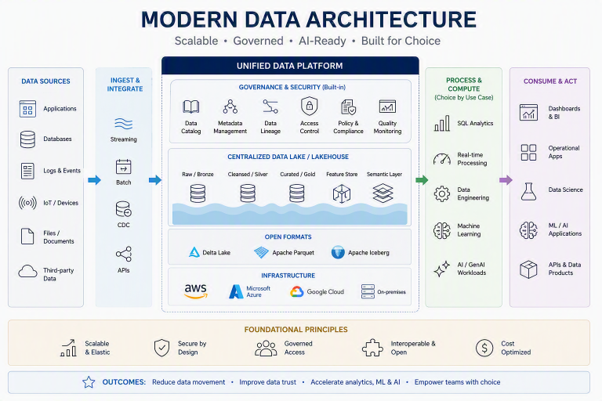
Fig 1: Modern data architecture enables scalable analytics, governance, and AI-driven business growth.
What Is a Data Lakehouse and Why Is It Gaining Popularity?
A data lakehouse combines the flexibility of a data lake with the management and performance capabilities traditionally associated with data warehouses. This hybrid approach allows organizations to store and analyze structured, semi-structured, and unstructured data within a single platform.
The lakehouse model offers several benefits:
- Unified storage and analytics capabilities.
- Reduced data duplication.
- Improved data governance.
- Support for business intelligence and reporting.
- Compatibility with machine learning and AI workloads.
- Enhanced scalability for growing data volumes.
A commonly used design approach within lakehouses is the medallion architecture pattern. This pattern organizes data into multiple layers that reflect increasing levels of quality and business readiness:
- Bronze Layer
The bronze layer contains raw or minimally processed data collected directly from source systems.
- Silver Layer
The silver layer stores cleaned, validated, and standardized data. Quality checks and transformations are typically applied here.
- Gold Layer
The gold layer contains highly refined, curated datasets optimized for business reporting, analytics, and AI applications.
By organizing data in this manner, organizations can improve data quality while maintaining traceability from source to consumption.
How Does Data Mesh Transform Data Ownership?
Data mesh decentralizes data ownership and encourages domain-driven responsibility because, as organizations grow, centralized data teams often struggle to manage every dataset and business domain effectively.
Under a data mesh model, teams that generate and understand data become responsible for managing it as a product. Rather than relying exclusively on a central data team, departments such as marketing, sales, finance, or operations create and maintain their own data products.
Key principles of data mesh include:
- Domain-oriented ownership.
- Data as a product.
- Self-service data platforms.
- Federated governance.
This approach promotes faster innovation because domain teams can make decisions closer to the business context. At the same time, centralized governance frameworks ensure consistency, security, and compliance across the organization.
Data mesh can be especially valuable for large enterprises operating across multiple business units and geographic locations. However, successful implementation requires clear governance standards and strong collaboration between business and technical teams.
How Can Organizations Design an AI-Ready Data Architecture?
Artificial intelligence depends heavily on data quality, accessibility, and governance. Even the most advanced AI models cannot produce reliable outcomes if the underlying data is inconsistent, incomplete, or poorly governed.
An AI-ready data architecture should focus on several critical elements:
- Data Quality
Organizations must ensure that data is accurate, complete, consistent, and current. Strong quality controls help improve reliability across analytical and AI workloads.
- Data Governance
Governance frameworks establish policies for access control, compliance, privacy, and security. These frameworks help maintain trust in data assets.
- Metadata Management
Metadata enables users to understand where data originates, how it has been transformed, and how it should be used.
- Data Lineage
Lineage tracking provides visibility into the movement and transformation of data throughout the ecosystem, supporting auditing and troubleshooting efforts.
- Accessibility and Discoverability
Teams should be able to easily locate and access datasets through catalogs, search tools, and standardized documentation.
- Support for Structured and Unstructured Data
AI applications increasingly rely on diverse data types, including documents, images, audio, videos, and sensor data. Modern architectures must support all these formats effectively.
When these elements are combined, organizations create a strong foundation for deploying predictive analytics, generative AI solutions, recommendation engines, and intelligent automation systems. Building an AI-ready data platform also requires skilled professionals who understand data engineering, governance, and cloud-native analytics. Data Engineering on AWS training helps teams develop practical expertise in designing, building, and managing scalable data pipelines.
What Are the Core Components of a Modern Data Architecture?
Although implementation details vary across organizations, most modern data architectures include several common components.
- Data Ingestion
Data ingestion pipelines collect information from multiple sources, including applications, databases, APIs, IoT devices, and third-party systems.
- Scalable Storage
Cloud-based storage systems provide cost-effective scalability while supporting diverse data formats.
- Data Processing
Processing engines transform raw data into usable information through batch, streaming, or real-time processing methods.
- Metadata and Data Catalogs
Catalogs improve discoverability and help users understand available datasets, governance policies, and ownership information.
- Governance and Security
Governance capabilities enforce data quality standards, security policies, regulatory compliance requirements, and access controls.
- Analytics Platforms
Analytics tools allow users to generate reports, dashboards, and business insights from trusted datasets.
- AI and Machine Learning Services
Integrated AI services enable organizations to develop, train, deploy, and monitor machine learning models and intelligent applications.
These components work together to create a connected environment where data can support reporting, forecasting, analytics, automation, and AI initiatives.
How Should Organizations Modernize Their Data Architecture?
Modernization should begin with business objectives rather than technology selection. Organizations often achieve better results when they focus first on the outcomes they want to deliver.
A practical modernization strategy typically includes:
- Defining business goals and success metrics.
- Assessing current data systems and workflows.
- Identifying critical use cases and priorities.
- Evaluating data quality and governance gaps.
- Selecting suitable architecture patterns.
- Implementing modernization in phases.
Instead of replacing every legacy system immediately, organizations should adopt an incremental approach. Existing warehouses, operational databases, and data lakes can continue delivering value while newer capabilities are gradually introduced.
This phased strategy reduces risk, controls costs, and allows teams to learn and adapt throughout the transformation process.
Additionally, modernization should include investments in people and skills. Data engineers, architects, analysts, and AI practitioners all play essential roles in ensuring that technology investments translate into business value.
What Does the Future Hold for Modern Data Architectures?
The future of modern data architecture is increasingly focused on interoperability, governance, automation, and AI readiness.
Several trends are shaping next-generation architectures:
- Greater adoption of lakehouse platforms.
- Increased use of open data formats.
- Cross-cloud and hybrid-cloud integrations.
- Real-time processing and analytics.
- AI-native data platforms.
- Automated governance and observability.
- Intelligent data management powered by machine learning.
Organizations are moving beyond architectures designed solely for reporting and analytics. Modern platforms must now support generative AI applications, intelligent agents, automated decision-making systems, and advanced predictive capabilities.
As data ecosystems continue to evolve, successful architectures will balance innovation with governance, ensuring that data remains secure, reliable, and accessible across the enterprise.
How Can Organizations Build a Lasting Data Foundation?
The most effective modern data architecture is not necessarily the one built with the newest technologies. Instead, it is the architecture that successfully aligns business goals, governance requirements, analytics capabilities, and AI initiatives.
By combining scalable storage, efficient processing, strong governance, interoperable technologies, and skilled teams, organizations can create a future-ready data foundation. Such a foundation enables them to adapt to changing market demands, embrace emerging technologies, and maximize the value of their data investments for years to come.
Upskill Your Teams with Enterprise-Ready Tech Training Programs
- Team-wide Customizable Programs
- Measurable Business Outcomes
About CloudThat
FAQs
1. What is the difference between a data lake and a data lakehouse?
ANS: – A data lake primarily stores large volumes of raw data, while a data lakehouse combines the flexibility of a data lake with the management, governance, and performance capabilities of a data warehouse.
2. Is data mesh suitable for every organization?
ANS: – No. Data mesh is most beneficial for large organizations with multiple business domains and complex data ecosystems. Smaller organizations may achieve better results with centralized data management models.
3. Why is data governance important in modern data architectures?
ANS: – Data governance ensures data quality, security, compliance, and consistency. It helps organizations maintain trust in their data while reducing operational and regulatory risks.
4. How does a modern data architecture support AI initiatives?
ANS: – Modern data architectures provide governed, discoverable, high-quality data that AI models require for training, inference, and decision-making, while supporting both structured and unstructured data sources.
5. What should organizations prioritize when modernizing their data architecture?
ANS: – Organizations should prioritize business outcomes, data quality, governance, scalability, and incremental modernization over adopting new technologies alone.


WRITTEN BY Vivek Kumar
Vivek Kumar is a Senior Subject Matter Expert at CloudThat, specializing in Cloud and Data Platforms. With 11+ years of experience in IT industry, he has trained over 2000 professionals to upskill in various technologies including Cloud and Full Stack Development. Known for simplifying complex concepts and hands-on teaching, he brings deep technical knowledge and practical application into every learning experience. Vivek's passion for technology reflects in his unique approach to learning and development.


 PREV
PREV












Comments