

 Login
Login

 September 23, 2026
|
Voiced by Amazon Polly |
Overview
Maintenance teams often have useful information spread across training videos, PDFs, equipment records, and parts systems. Finding the right detail during a repair can take time.
A video-to-SOP approach turns useful video content into structured procedures that technicians can search through RAG. AWS services such as Amazon S3, Amazon Bedrock, and DynamoDB can support storage, processing, and retrieval, with a chat or voice interface for access.
Introduction
Imagine a technician replacing a damaged seal on an industrial pump. The procedure may be explained in a 20-minute training video, but finding the exact step while working on the equipment is not always practical.
Instead, the technician can ask, “How do I replace the seal on Pump Model X?” The system searches the available maintenance content and returns the relevant steps, precautions, and part details.
Amazon Bedrock handles the language processing, while embeddings and RAG help connect the question with the right maintenance content
Ready to lead the future? Start your AI/ML journey today!
- In- depth knowledge and skill training
- Hands on labs
- Industry use cases
Why This Matters
Maintenance knowledge is not always stored in one place. Some information is in videos and manuals, while other details may come from equipment records or experienced technicians.
Common problems include:
- Long videos take time to search.
- Older SOPs may not match current procedures.
- Equipment-specific information can be difficult to locate.
- Parts and maintenance records may be stored separately.
- Less common repairs may require help from experienced staff.
Making this information searchable does not replace existing documentation. It gives technicians a quicker way to find it.
Common Challenges
The quality of the system depends on the source material. Videos may contain background noise, unclear audio, or loosely explained steps. Documents can also be incomplete or outdated.
There are technical considerations as well, including AWS permissions, data coming from multiple systems, and differences between older procedures and current practices. Source material should be checked before it is added to the knowledge base.
Key Components to Track
Once the system is running, teams need to know whether it is actually useful.
Important areas to monitor include:
- SOP coverage: Which equipment and procedures are documented?
- Retrieval quality: Does the search return the correct SOP section?
- Response quality: Does the answer stay within approved information?
- Content freshness: How current is the retrieved procedure?
- Maintenance results: Are repair time, repeat failures, or first-time fixes changing?
CloudWatch can handle operational monitoring, while DynamoDB can store application data and technician feedback. Alerts can be added for failed processing jobs and other defined issues.
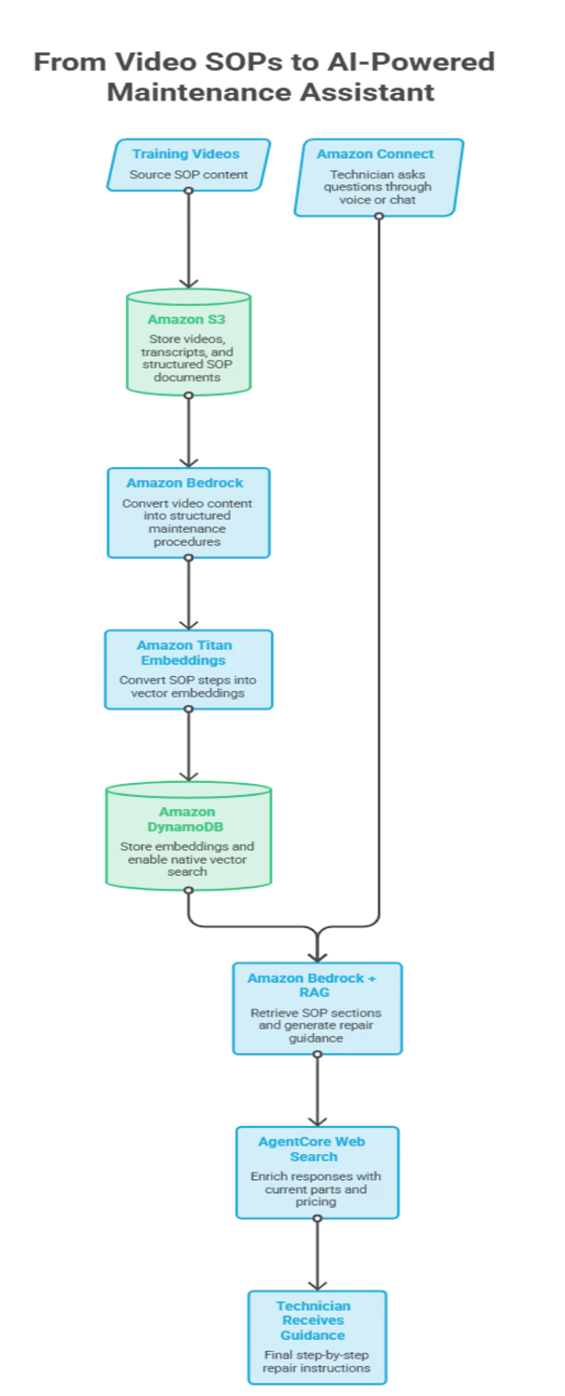
AWS Architecture for Video SOP to AI Agent
Training videos and documents are stored in Amazon S3 and processed into structured SOP content. Amazon Bedrock handles language-related tasks, while important SOP sections are converted into embeddings for semantic retrieval. DynamoDB can store the resulting content and metadata, depending on the search design.
When a technician asks a question, RAG retrieves the relevant information, and Bedrock generates the response from that content. Amazon Connect can provide voice-based access, while other systems can supply details such as parts availability.
Maintenance Playbook Example
Consider a pump maintenance team with videos covering inspection, seal replacement, cleaning, and troubleshooting. The useful information from these videos is converted into searchable procedures.
A technician can ask, “What steps should I follow to replace the seal on Pump Model X?” The assistant retrieves the relevant procedure, including the part number and, when available, safety precautions.
If the same questions repeatedly produce poor results, the team can check whether the related SOP is missing, outdated, or incomplete.
Continuous Feedback Loop
Maintenance procedures change when equipment, parts, or processes are updated, so the knowledge base needs regular maintenance.
A typical workflow is:
- New videos or documents are stored in S3.
- The content is converted into structured SOPs.
- The updated procedure is reviewed.
- New embeddings are created, and the knowledge base is updated.
- Technicians use the assistant and provide feedback.
- Poor or outdated results are reviewed and corrected.
AWS Step Functions and Lambda can manage different stages of the workflow, while Bedrock handles language-processing tasks. Safety-critical procedures should still be reviewed and approved by the responsible team.
Best Practices on AWS
Keep SOPs updated and versioned, test the system with questions technicians actually ask, and store enough metadata to trace a response back to its source. Monitor failed processing and retrieval jobs, review technician feedback, and use IAM permissions to control access.
These practices also make troubleshooting easier by indicating whether an issue originated in the source data, the retrieval process, or the generated response.
Future of AI-Powered Maintenance
The same approach can support more than basic SOP questions. A maintenance assistant could summarise completed repairs, help during service calls, connect procedures with required parts, or retrieve previous repair records. Maintenance procedures could also be combined with sensor and equipment data to provide more context when investigating recurring problems. As these systems become part of daily maintenance work, keeping the underlying information accurate and up to date will remain important.
Conclusion
Training videos contain useful maintenance knowledge, but finding a specific step can take time. Converting that content into structured SOPs and connecting it to a RAG-based assistant makes the information easier to access. AWS services such as S3, Bedrock, DynamoDB, Lambda, and Amazon Connect can support different parts of the workflow.
The result still depends on accurate source material, reliable retrieval, proper versioning, and human review. Keeping these areas under control is what makes the system useful for everyday maintenance work.
Upskill Your Teams with Enterprise-Ready Tech Training Programs
- Team-wide Customizable Programs
- Measurable Business Outcomes
About CloudThat
FAQs
1. Why convert video SOPs into AI-powered playbooks?
ANS: – Technicians usually need a specific instruction rather than an entire training video. Converting useful video content into searchable SOPs makes those instructions easier to find during maintenance.
2. What should teams monitor in an AWS-based maintenance playbook system?
ANS: – Teams should check whether the required SOPs are available, whether the right information is retrieved, how technicians respond to the answers, and where gaps or outdated information exist in the knowledge base.
3. How does RAG help maintenance teams?
ANS: –

- AI Agents
- AI Automation
- AI Workflow
- Amazon Bedrock
- Automation
- AWS bedrock
- Claude
- Document Automation
- Generative AI
- Industrial AI
- Knowledge Base
- Large Language Models
- LLM
- Machine Learning
- Maintenance Playbooks
- predictive maintenance
- RAG
- Retrieval Augmented Generation
- Standard Operating Procedures
- Video SOPs

WRITTEN BY Kirubanithi Annamalai
Generating response Copilot said: Kirubanithi Annamalai is a Senior Research Associate specializing in Artificial Intelligence, Machine Learning, Deep Learning, and Intelligent Automation. He has experience in developing AI-driven solutions, building scalable machine learning systems, and implementing automation frameworks to solve business challenges across engineering and cybersecurity domains. Passionate about emerging technologies, he focuses on delivering innovative solutions that drive business value.


 PREV
PREV



Comments