

 Login
Login

 September 24, 2026
|
Voiced by Amazon Polly |
An AI model can be accurate when it enters production and become less reliable months later. Production conditions change: user behavior, input data, business processes, and the environment around the model.
In technical delivery and enterprise AI discussions, teams often invest heavily in pre-production evaluation but spend less time defining how they will know when the model begins to behave differently in production.
That is where AI model drift becomes important.
A March 2026 NIST report describes post-deployment monitoring as crucial because real-world conditions can produce unexpected AI behavior that controlled pre-deployment evaluation cannot fully capture.
The practical goal is not simply to deploy an AI model successfully, but to detect meaningful changes early enough to investigate and respond.
Start Learning In-Demand Tech Skills with Expert-Led Training
- Industry-Authorized Curriculum
- Expert-led Training
What Is AI Model Drift?
AI model drift occurs when changes in production conditions cause a model’s inputs, predictions, or performance to differ from its established baseline.
Three types are especially useful:
- Data drift occurs when the distribution or characteristics of incoming data change.
- Prediction drift occurs when the distribution of model outputs changes.
- Performance drift occurs when measurable model quality declines against actual outcomes.
According to Microsoft Azure Machine Learning Model Monitoring and AWS Model Quality Documentation, production monitoring can include data drift, prediction drift, data quality, feature-attribution drift, and model performance.
The important lesson from implementation is that drift does not necessarily mean the model is broken. It means something has changed enough to warrant investigation.
Which Signals Should You Monitor First?
Start with four signals: input data, model outputs, model quality, and operational behavior.
Teams often make the mistake of monitoring only accuracy. That works when reliable ground-truth labels arrive quickly, but many enterprise use cases lack immediate labels.
A stronger model monitoring strategy tracks:
- Changes in input distributions and data quality
- Changes in prediction distributions
- Task-specific performance metrics
- Latency, errors, traffic, and other operational signals
Google’s production ML guidance recommends monitoring serving data for drift and tracking model-quality metrics after deployment. For labeled workloads, Amazon SageMaker documentation describes comparing predictions with actual ground-truth labels to measure model quality over time.
How Do You Know Whether a Change Is Significant?
You need a baseline and a threshold; otherwise, a drift alert is just a number without context.
A useful baseline can include representative validation data, expected feature distributions, model-quality metrics, and acceptable operating ranges.
Azure Machine Learning, for example, supports statistical comparisons using metrics including Jensen-Shannon Distance, Population Stability Index, Wasserstein Distance, and Kolmogorov-Smirnov tests.
However, statistical change alone should not determine the response. A small change in a low-risk recommendation system may be acceptable, while the same change in a fraud-detection or compliance workflow could require immediate review.
The right threshold is therefore a business-risk decision as much as a statistical one.
Can You Automate AI Model Drift Detection?
Yes, but automation should detect and escalate drift, not blindly retrain every model.
Amazon SageMaker Model Monitor supports continuous or scheduled monitoring, alerts, and monitoring across data quality, model quality, bias drift, and feature-attribution drift.
A practical production workflow is:
Monitor → Detect → Investigate → Validate → Remediate → Re-evaluate → Redeploy
A drift alert could indicate genuine model degradation, a temporary anomaly, a broken upstream data pipeline, or legitimate changes in business behavior.
Retraining should therefore be an informed remediation decision, not an automatic reaction to every alert.
How Can Teams Detect Drift Before It Becomes Expensive?
Build drift detection into the AI lifecycle before production and assign clear ownership for every alert.
A practical approach is:
- Establish the baseline.
Record the model version, reference dataset, important features, quality metrics, and acceptable thresholds.
- Capture production signals.
Collect relevant inputs, outputs, feedback, timestamps, and operational telemetry while applying privacy and governance controls.
- Monitor continuously.
Track data drift, prediction behavior, model quality, and operational signals together.
- Define escalation thresholds.
Decide what constitutes an observation, warning, or business-critical event.
- Close the loop.
Investigate the cause, retrain or remediate where appropriate, validate the updated model, and retain rollback capability.
This approach aligns with NIST’s 2026 guidance, which emphasizes post-deployment monitoring to understand how AI systems behave under changing real-world conditions.
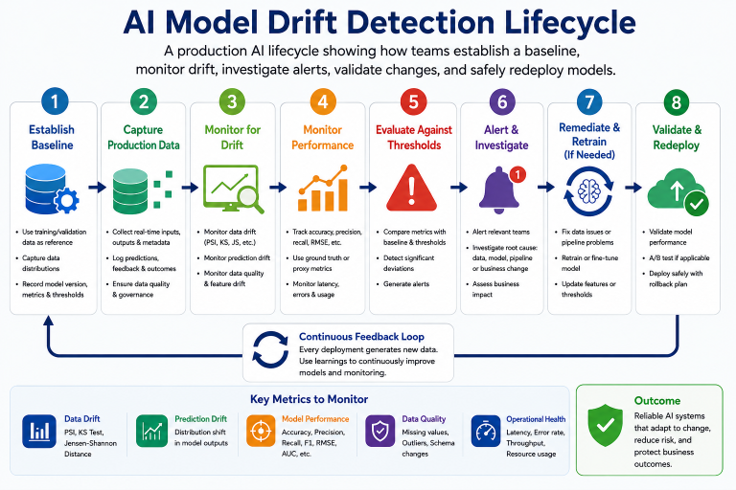
Fig 1: A production AI lifecycle showing how teams establish a baseline, monitor drift, investigate alerts, validate changes, and safely redeploy models.
Why Is AI Observability Becoming Essential?
AI observability extends monitoring from “Is the system running?” to “Is the AI still behaving as expected?”
This distinction matters as AI becomes embedded in customer-facing applications, automation, decision support, and business workflows. NIST’s 2026 research highlights post-deployment monitoring as a critical practice, as real-world AI behavior can change in response to dynamic inputs and other deployment conditions.
For organizations building AI capabilities, developing these operational skills is as important as selecting the model itself. Structured programs such as the AI & Machine Learning Certification Course can help teams build practical foundations for modern AI and ML adoption.
Detect Drift Before Impact
AI model drift is not simply a machine learning problem. It is an operational risk.
A model can remain available, pass infrastructure health checks, and still become less effective for the business. Teams that detect the change early can investigate before poor predictions lead to customer complaints, financial losses, or compliance issues.
The key question is not:
“Is our AI model working today?”
It is:
“What signal will tell us when it stops working well enough for our business?”
Upskill Your Teams with Enterprise-Ready Tech Training Programs
- Team-wide Customizable Programs
- Measurable Business Outcomes
About CloudThat
FAQs
1. What is AI model drift?
ANS: – AI model drift occurs when production conditions change enough to affect a model’s inputs, outputs, or performance relative to its established baseline.
2. What is the difference between data drift and performance drift?
ANS: – Data drift means the input distribution changes. Performance drift means the model’s effectiveness against its intended task declines.
3. Does every drift alert require retraining?
ANS: – No. A drift signal should first be investigated to determine its cause. Retraining is appropriate only when the model no longer represents the current production environment or business requirement.
4. How often should models be monitored?
ANS: – There is no single frequency for every model. Monitoring cadence should reflect the model’s risk, rate of change, data volume, and business impact.


WRITTEN BY Rohit Tiwari
Rohit Tiwari is a Senior Subject Matter Expert (SME) at CloudThat, specializing in Multi-Cloud Infrastructure, Solutions Architecture, DevOps and Generative AI. A Microsoft Certified Trainer (MCT) and Google Cloud Authorized Trainer (GCI), Rohit is recognized among the Top 100 MCT Quality Award winners (January 2025) for excellence in All Courses and Microsoft Data & AI Courses. With 19+ years of global experience in training, software development, and quality assurance, he has trained over 20,000 professionals globally across Azure, AWS, GCP, and modern cloud-native architectures. He holds 65+ industry certifications, in Azure, AWS, GCP, Oracle Cloud (OCP), and in Databricks, demonstrating his unmatched expertise in cloud infrastructure design, security, and cost optimization. Known for simplifying complex multi-cloud and AI concepts with hands-on, real-world insights, Rohit brings deep technical expertise and practical application into every learning experience. His passion for mentoring and building transformative cloud learning journeys reflects in his dedication to enabling professionals and enterprises to innovate with confidence.


 PREV
PREV




Comments