

 Login
Login


 September 21, 2026
|
Voiced by Amazon Polly |
Every L&D leader knows this moment. You walk into a budget review with a 95% completion rate and glowing feedback forms, feeling fairly confident, and the CFO looks up and asks one simple question: ‘What did we actually get for this money?’ And just like that, the whole conversation changes.
Finance leaders don’t think in engagement scores or smiley-face surveys. They think in dollars, margins, and payback periods. If you want your training budget approved, protected, or even expanded, you have to speak their language. That is exactly what proving training ROI is about, translating learning outcomes into numbers a CFO can act on. In this blog, let’s break down the financial metrics that actually convince finance leaders, and how to present the business impact of your training the way a CFO expects to see it.
Start Learning In-Demand Tech Skills with Expert-Led Training
- Industry-Authorized Curriculum
- Expert-led Training
Why CFOs Push Back on Training Budgets
It’s not that finance leaders don’t value learning. It’s that most L&D teams have never given them a reason to see training as an investment rather than an expense. According to a recent McKinsey Global L&D survey referenced by eLearning Industry, only 8% of organizations actually measure the business impact of their learning programs. That means the vast majority of training budgets get approved on faith, not data, and faith rarely survives a tight budget cycle.
When a CFO sees a request without clear financial metrics attached, the easiest thing to do is cut it, simply because no one can prove what would actually be lost. So, the responsibility is really on us, the L&D and training teams, to walk into that room with the numbers already worked out.
What Finance Leaders Actually Want to See
A CFO doesn’t want to hear that engagement was high or that learners loved the course. What a CFO wants to know is simple: what did we spend, what did we get back, and how do you know? and finally, its business impact. Findings compiled from LinkedIn’s Workplace Learning Report by InfluenceFlow show that a majority of L&D leaders admit they struggle to prove the impact of training to their executives, not because the impact isn’t real, but because it was never captured in financial terms in the first place.
Metrics That Actually Convince a CFO
Here are the numbers that move the conversation from ‘nice to have’ to ‘must fund’.
- Training ROI, the formula finance already trusts: The simplest way to calculate it is ROI = ((Benefits of Training – Cost of Training) / Cost of Training) x 100. Once you present training using the same formula finance uses for every other investment, the credibility gap disappears almost instantly.
- Productivity and Performance Gains: Track output, error rates, or sales numbers before and after training, and show the difference and its business impact. A CFO trusts a before-and-after chart far more than a satisfaction score.
- Retention and Turnover Savings: Replacing an employee is expensive, and CFOs know this well. PayPal once calculated that cutting employee turnover by just 1% would save the company close to $500,000 a year through better productivity and lower hiring costs. That is exactly the kind of financial metrics that get a CFO’s attention.
- Time-to-Competency: The faster a new hire or a reskilled employee reaches full productivity, the faster they start contributing to revenue. Shrinking this timeline is a direct, measurable business impact that finance leaders can plot right against cost.
- Business Impact Tied to Real KPIs: Sales teams with focused upskilling have shown noticeably higher conversion rates, and customer service teams have meaningfully reduced ticket resolution times after targeted training. When training numbers move alongside business numbers, the case practically builds itself.
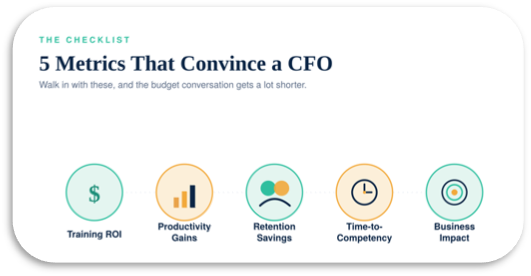
Fig 1: An Illustration showing the various metrics that convince a CFO.
How to Present These Numbers to a CFO
Don’t lead with the training, lead with the business problem it solved. Instead of saying ‘we trained 200 employees,’ say ‘we cut onboarding time by three weeks, which freed up real productivity hours.’ Keep the metrics dashboard simple, one page, three or four numbers, always shown alongside cost. And never present a single metric in isolation, a CFO wants to see the whole picture: cost, benefit, and timeline, side by side.

Fig 2: An Illustration showing the comprehensive dashboard during the meeting with a CFO.
Prove Learning Business Value
Proving training ROI isn’t about impressing finance leaders with learning metrics. It’s about connecting training outcomes to the business results that matter most. When organizations measure improvements in productivity, retention, time-to-competency, and other business KPIs, training becomes easier to evaluate alongside any other strategic investment.
Many organizations are also adopting structured frameworks to better align learning initiatives with business goals and track outcomes over time. Whether through internal methodologies or established approaches.
At the end of the day, a CFO doesn’t fund training for the sake of training. They fund initiatives that deliver measurable value, reduce risk, and support growth. The stronger the connection between learning and business outcomes, the stronger the case for continued investment.
Upskill Your Teams with Enterprise-Ready Tech Training Programs
- Team-wide Customizable Programs
- Measurable Business Outcomes
About CloudThat


WRITTEN BY Shahab M
Shahab Muhammed is the Vertical Head of Power BI Team at CloudThat, specializing in Power BI & Data Analysis trainings. With 10 years of experience in training industry, he has trained over 5000 professionals to upskill in technologies like Power BI, Excel and other Power Platform technologies. With an industry experience as a BI Consultant, he brings deep technical knowledge and practical application into every learning experience. Shahab's passion for training and development reflects in his unique approach to learning and development.


 PREV
PREV











Comments