

 Login
Login


 September 3, 2026
|
Voiced by Amazon Polly |
Overview
The arrival of Claude 4 Sonnet on Amazon Bedrock enables teams to enhance existing generative AI applications and prepare for the retirement of earlier Claude 3.5 Sonnet versions.
Applications such as chatbots, document analysis, coding assistants, and enterprise knowledge systems may need changes before moving to the newer model. A successful migration involves more than replacing a model ID, it also requires reviewing prompts, tool usage, reasoning settings, performance, cost, and safety behavior.
This article highlights the major changes and provides a practical approach for moving existing Bedrock workloads to Claude 4 Sonnet.
Pioneers in Cloud Consulting & Migration Services
- Reduced infrastructural costs
- Accelerated application deployment
Claude 3.5 Sonnet vs. Claude 4 Sonnet
Claude 4 Sonnet introduces improvements that can affect both application design and model behavior.
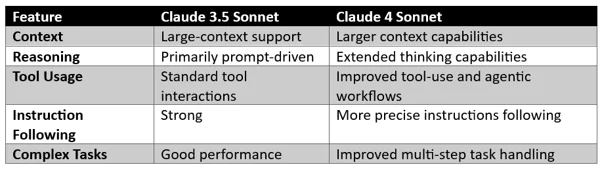
These differences mean that existing applications should be tested rather than assuming that the new model will behave exactly like the previous one.
What Should You Check Before Migrating?
- Confirm Model Availability
First, verify that Claude 4 Sonnet is available in the AWS Region where your application runs. Check the required model access and any applicable AWS or Anthropic terms before beginning the migration.
If the model is unavailable in the current Region, evaluate supported cross-Region inference options.
- Review Your API Integration
If your application uses InvokeModel, update the model configuration to the appropriate Claude 4 Sonnet model identifier.
Applications using the Converse API may require fewer structural changes, but tool definitions and model-specific parameters should still be reviewed.
Do not assume that every tool supported by Claude 3.5 will behave identically with Claude 4.
- Revisit Your Prompts
Model behavior can change between versions. Claude 4 may follow instructions more strictly and may produce different response lengths or styles compared with Claude 3.5 Sonnet.
Review prompts that depend heavily on:
- Specific response formats
- Persona instructions
- Output length
- Multi-step reasoning
- Tool invocation
- XML or structured input
Clear instructions and well-separated input sections can make migration more predictable.
- Evaluate Extended Thinking
One important capability to evaluate is extended thinking.
It can be valuable for complex tasks that require planning, analysis, or multiple reasoning steps. However, additional reasoning can affect both latency and token usage.
For simple requests, enabling advanced reasoning may provide little benefit. Therefore, use it selectively based on the workload.
- Test Tool Integrations
Applications that depend on tools or agentic workflows should receive special attention.
Review tool names, schemas, supported operations, and error handling. If your application uses specialized tools such as code editors or document-processing tools, verify that their definitions are compatible with the new model.
Migration Examples
Legal Document Analysis
A legal application may previously have split large contracts into smaller sections due to context limitations. With larger context capabilities, more of the document can potentially be processed together.
For complex legal analysis, extended thinking can also be evaluated to determine whether it improves the quality of the final result.
AI Tutoring Application
An educational assistant may use detailed prompts to guide their responses. After migration, the model’s instruction-following behavior may change the tone or length of responses.
Testing different system prompts can help maintain the desired teaching style while keeping answers clear and concise.
Code Review Assistant
A code-review system may need to understand relationships between multiple files or modules. A larger context can make it easier to provide the model with related code and dependencies.
Tool use can also support workflows involving code analysis, formatting, testing, or documentation.
Recommended Migration Process
A controlled migration reduces the risk of unexpected behavior.
Step 1: Identify Existing Workloads
List every application currently using Claude 3.5 Sonnet. Record the prompts, tools, expected outputs, latency requirements, and important business scenarios.
Step 2: Enable Claude 4 Access
Confirm model availability, permissions, and Region support before modifying production workloads.
Step 3: Update the Integration
Change the model configuration and review API parameters, tool definitions, and error-handling logic.
Step 4: Test Existing Prompts
Run representative prompts against both models. Pay attention to response quality, formatting, length, and instruction adherence.
Step 5: Measure Performance
Compare the models using metrics such as:
- Accuracy
- Response quality
- Latency
- Token usage
- Cost
- Safety behavior
- Tool-call reliability
Step 6: Roll Out Gradually
Instead of switching every application at once, start with a controlled rollout. Shadow testing, A/B testing, or a canary deployment can help identify issues before full adoption.
Step 7: Monitor After Migration
Continue monitoring the application after deployment. Production traffic can reveal prompt, latency, cost, or tool-integration issues that may not appear during testing.
Conclusion
Moving from Claude 3.5 Sonnet to Claude 4 Sonnet can provide significant benefits, particularly for applications requiring stronger reasoning, larger context, and advanced tool-based workflows.
However, a model upgrade should be treated as an application migration rather than a simple model-ID replacement. Reviewing prompts, API integrations, tools, performance, cost, and safety behavior is essential.
A structured approach, assess, update, test, deploy, and monitor, allows teams to adopt Claude 4 Sonnet while minimizing disruption to existing Amazon Bedrock applications.
Drop a query if you have any questions regarding Claude, and we will get back to you quickly.
Empowering organizations to become ‘data driven’ enterprises with our Cloud experts.
- Reduced infrastructure costs
- Timely data-driven decisions
About CloudThat
FAQs
1. Do existing Claude 3.5 prompts need to be rewritten?
ANS: – Not necessarily. Many prompts may continue to work, but changes in response style, instruction-following, or tool behavior can necessitate prompt adjustments.
2. Should extended thinking be enabled for every request?
ANS: – No. It is better suited to complex reasoning and planning tasks. Simpler requests may not benefit enough to justify additional latency or token usage.
3. What should I test during migration?
ANS: – Test response quality, latency, cost, safety behavior, formatting, prompt adherence, and tool-calling behavior using representative workloads.


WRITTEN BY Manjunath Raju S G
Manjunath Raju S G works as a Research Associate at CloudThat. He is passionate about exploring advanced technologies and emerging cloud services, with a strong focus on data analytics, machine learning, and cloud computing. In his free time, Manjunath enjoys learning new languages to expand his skill set and stays updated with the latest tech trends and innovations.


 PREV
PREV












Comments