

 Login
Login


 September 3, 2026
|
Voiced by Amazon Polly |
Introduction
AI agents can take longer to complete tasks than conventional serverless functions because they may reason through multiple steps, invoke tools, or interact with external services. When an AWS Lambda function calls an Amazon Bedrock AgentCore agent synchronously, it remains active while waiting for the agent to finish.
Asynchronous invocation provides a more efficient alternative. The caller starts the agent, releases its compute resources, and allows the workflow to continue when the agent returns a result. AWS highlights three patterns for implementing this approach: Step Functions task-token callbacks, direct Step Functions integration, and Lambda durable functions.
Pioneers in Cloud Consulting & Migration Services
- Reduced infrastructural costs
- Accelerated application deployment
Why Asynchronous Invocation Matters?
A synchronous workflow typically follows:
AWS Lambda → AgentCore → Wait → Agent response → Lambda continues
During the waiting period, AWS Lambda may perform no useful work while remaining active. For long-running agent tasks, this can make the architecture less efficient.
With an asynchronous design, the caller only performs the work required to start the agent. The workflow then waits without holding an active AWS Lambda execution.
The objective is simple: start the agent, release the caller, and resume the workflow when the result is available.
A Typical Serverless Workflow
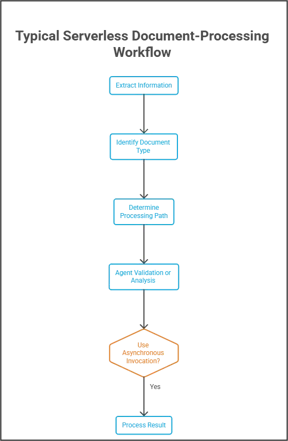
Consider a document-processing application:
- AWS Lambda extracts information from an uploaded document.
- Another Lambda identifies the document type.
- Step Functions determine the processing path.
- An AgentCore agent validates or analyzes the document.
- The workflow processes the agent’s result.
The agent-validation stage is where asynchronous invocation can improve the architecture. Instead of keeping Lambda active while the agent works, the workflow can pause and resume after completion.
Pattern 1: Step Functions Task-Token Callback
The first approach uses a Step Functions task token.
Step Functions invokes a dispatcher Lambda using waitForTaskToken. The Lambda receives the token, starts the AgentCore agent, and returns immediately.
Step Functions then wait. When the agent completes its task, a callback invokes the required Lambda action, which uses SendTaskSuccess with the task token. Step Functions resumes execution and passes the result to the next state.
Flow:
Step Functions → Lambda → AgentCore → Callback → Step Functions
This pattern is useful when Lambda needs to perform custom processing before or after the agent invocation.
Pattern 2: Direct Step Functions Integration
If no custom Lambda logic is needed, the dispatcher can be removed.
Step Functions can invoke AgentCore directly through an AWS SDK service integration. Once the agent returns its result, Step Functions passes the output to the next workflow state.
Flow:
Step Functions → AgentCore → Step Functions
This is the simplest approach for workflows that primarily need orchestration. It also eliminates the additional Lambda invocation from the architecture.
Pattern 3: Lambda Durable Functions
A third option is Lambda durable functions.
Durable functions allow developers to implement workflows in code while maintaining execution state across pauses. When the workflow reaches the AgentCore invocation, it can wait for the agent’s callback without continuously consuming compute.
After the agent completes, the workflow resumes from its saved state.
This approach is useful when developers prefer code-based orchestration and need to manage more complex asynchronous workflows.
Comparing the Approaches
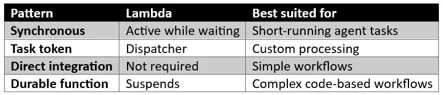
The main advantage of the asynchronous approaches is that the caller compute does not need to remain active during the agent’s processing time.
Production Considerations
Asynchronous agent workflows should be designed with reliability in mind.
- Timeouts: Configure appropriate workflow timeouts to prevent executions from waiting indefinitely.
- Session management: Use stable session identifiers so retries and callbacks remain associated with the correct agent interaction.
- Observability: Distributed tracing and logging can help identify whether delays originate in the workflow, AgentCore, or downstream services.
- Failure handling: Define retry, timeout, and failure paths instead of assuming every agent invocation will complete successfully.
- Lightweight dispatching: When a dispatcher Lambda is required, keep it focused on preparing and initiating the agent request.
Choosing the Right Pattern
The best pattern depends on the amount of custom logic required.
Choose task-token callbacks when Lambda must perform additional processing around the agent call. Choose direct Step Functions integration when the workflow can be handled entirely through orchestration. Choose durable functions when complex asynchronous logic is easier to maintain as application code.
For short-running tasks, synchronous invocation may still be sufficient. As agent processing becomes longer or more variable, asynchronous execution becomes increasingly valuable.
Conclusion
AI agents can introduce long and unpredictable processing times into serverless applications. Keeping a Lambda function active throughout that period can result in inefficient use of compute resources.
Amazon Bedrock AgentCore can be integrated asynchronously using Step Functions task tokens, direct service integration, or Lambda durable functions. These patterns allow the workflow to wait for an agent without unnecessarily holding active caller compute.
By selecting the appropriate pattern and implementing reliable timeouts, session management, tracing, and failure handling, organizations can build more efficient and scalable serverless AI pipelines.
Drop a query if you have any questions regarding Amazon Bedrock AgentCore, and we will get back to you quickly.
Empowering organizations to become ‘data driven’ enterprises with our Cloud experts.
- Reduced infrastructure costs
- Timely data-driven decisions
About CloudThat
FAQs
1. Why should asynchronous AgentCore calls be used?
ANS: – Asynchronous AgentCore calls prevent the calling compute resource from remaining active while the agent processes the request.
2. Which pattern can invoke AgentCore without using Lambda?
ANS: – Direct Step Functions integration can invoke AgentCore without requiring a separate Lambda function.


WRITTEN BY Daniya Muzammil
Daniya works as a Research Associate at CloudThat, specializing in backend development and cloud-native architectures. She designs scalable solutions leveraging AWS services with expertise in Amazon CloudWatch for monitoring and AWS CloudFormation for automation. Skilled in Python, React, HTML, and CSS, Daniya also experiments with IoT and Raspberry Pi projects, integrating edge devices with modern cloud systems.


 PREV
PREV











Comments