

 Login
Login


 September 3, 2026
|
Voiced by Amazon Polly |
Not long ago, interacting with Artificial Intelligence meant issuing simple voice commands or using chatbots that followed predefined scripts. Today, AI can draft emails, generate code, summarize lengthy reports, translate languages, create images, and even assist in scientific research.
Whether you’re asking ChatGPT to explain a complex concept, using Microsoft Copilot to summarize a meeting, or leveraging GitHub Copilot to write code, you’re interacting with one of the most transformative technologies in modern computing, Large Language Models (LLMs).
Their capabilities often seem almost magical. They understand context, generate remarkably human-like responses, and adapt to an astonishing variety of tasks without being explicitly programmed for each one.
Start Learning In-Demand Tech Skills with Expert-Led Training
- Industry-Authorized Curriculum
- Expert-led Training
What Exactly Is a Large Language Model?
A Large Language Model (LLM) is a deep learning model trained on massive amounts of text to understand, predict, and generate human language. Unlike traditional NLP models built for specific tasks, LLMs are general-purpose models capable of answering questions, generating content, translating languages, writing code, and more.
The term “Large” refers to both the vast training datasets and the billions of parameters that enable these models to learn complex language patterns and contextual relationships. Instead of storing information like a database, LLMs generate responses by predicting the most likely next token based on the input they receive.
From Traditional NLP to Large Language Models
Language AI has evolved dramatically over the past few decades.
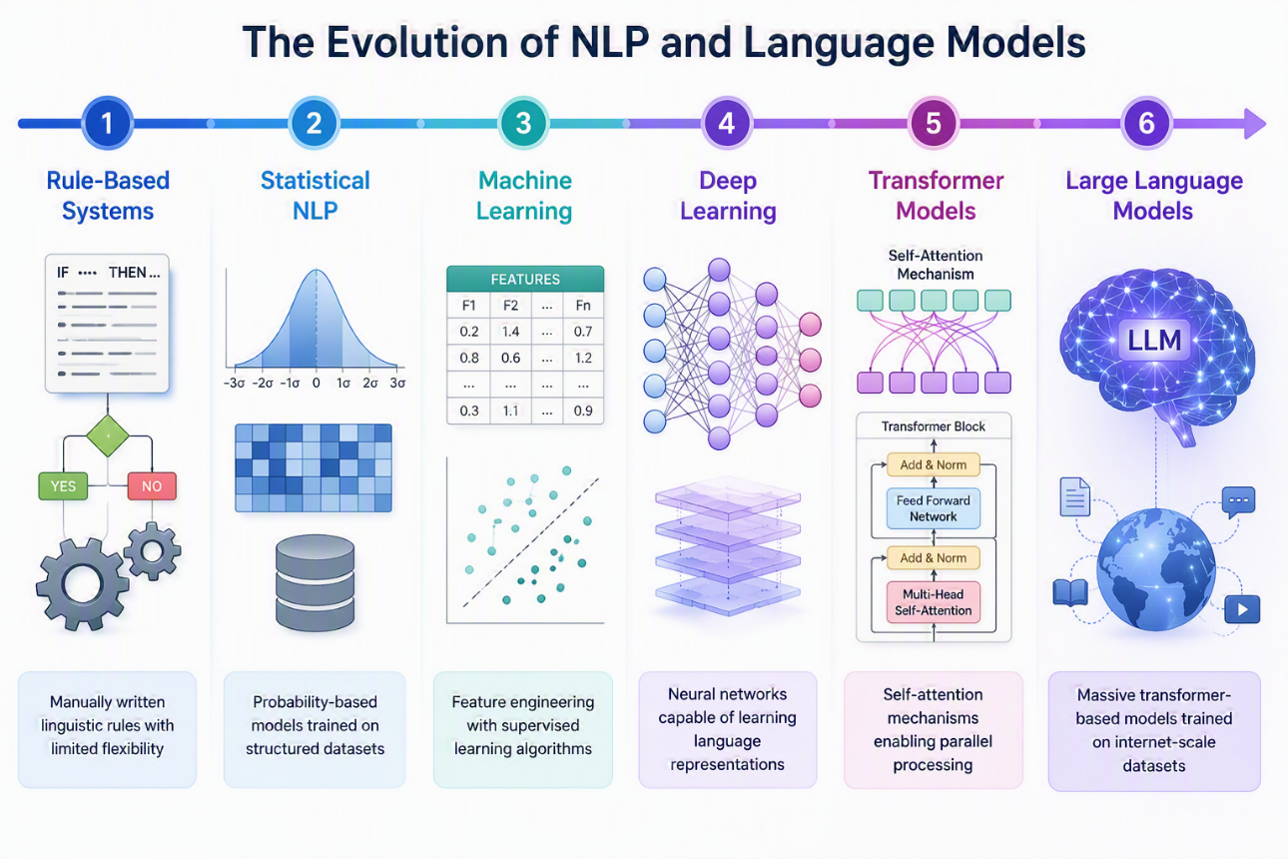
Fig 1: The evolution of NLP from rule-based systems to large language models.
Earlier NLP systems relied on handcrafted rules and struggled with context and ambiguity. The introduction of the Transformer architecture in 2017 revolutionized language processing by enabling models to analyze entire sequences simultaneously. Today, leading LLMs such as GPT, Llama, Claude, Gemini, and Mistral are all built on this breakthrough.
The Building Blocks That Make LLMs Intelligent
Although LLMs appear highly sophisticated, their intelligence emerges from several foundational concepts working together.
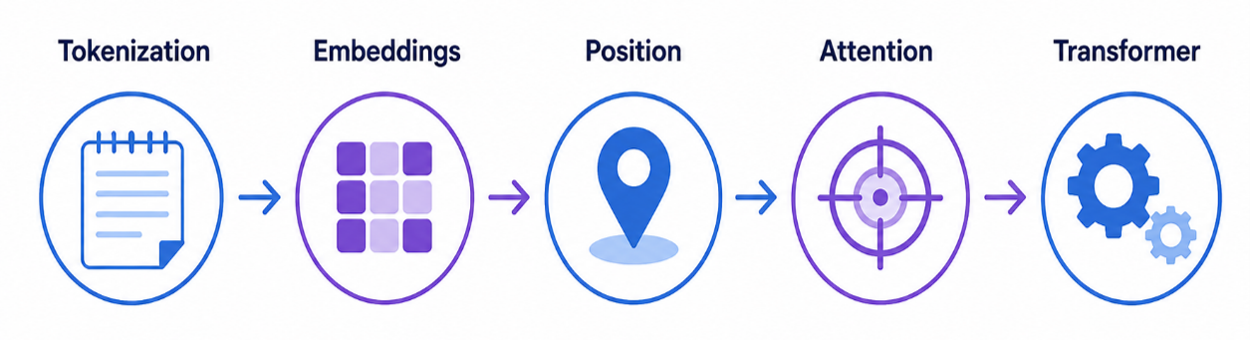
Fig 2: Core building blocks that enable large language models to understand and generate language.
- Tokenization – Breaking Language into Learnable Units
Before an LLM can understand text, it first breaks the input into smaller units called tokens. These may represent words, sub-words, or even characters, depending on the tokenizer. This approach allows the model to process language efficiently, handle unfamiliar words, and convert every prompt into a format it can understand.
- Embeddings – Giving Meaning to Words
LLMs cannot interpret words directly; they work with numbers. Embeddings convert each token into a numerical vector that captures its semantic meaning. As a result, words with similar meanings or contexts are placed closer together in the vector space, enabling the model to understand relationships between concepts rather than relying on exact word matches.
- Positional Encoding – Understanding Word Order
Since transformers process all tokens simultaneously, they need a way to identify each token’s position within a sentence. Positional encoding provides this information, helping the model distinguish between sentences that contain the same words but convey different meanings because of their order.
- Self-Attention – Focusing on What Matters
One of the biggest breakthroughs in modern AI is the self-attention mechanism. Instead of treating every word equally, it enables the model to identify which words are most relevant to a sentence’s context. This allows LLMs to capture long-range dependencies, maintain context across conversations, and generate more accurate and coherent responses.
- Transformer Architecture – The Engine Behind LLMs
The Transformer architecture brings together embeddings, positional encoding, self-attention, and deep neural networks into a highly efficient framework for language understanding. Unlike earlier sequential models, transformers process entire sentences in parallel, making them faster, more scalable, and better suited to complex language tasks.
How Large Language Models Learn
Training an LLM involves three key stages:
Pre-training: The model learns language patterns by predicting the next or missing token from massive text datasets, enabling it to understand grammar, context, reasoning, and general knowledge.
Fine-tuning: The pre-trained model is further trained on domain-specific datasets to improve performance for specialized tasks such as healthcare, finance, customer support, or legal document analysis.
Reinforcement Learning from Human Feedback (RLHF): Human reviewers evaluate the model’s responses, helping it generate outputs that are more accurate, helpful, and aligned with human expectations.
Real-World Applications Across Industries
Large Language Models are transforming nearly every industry.
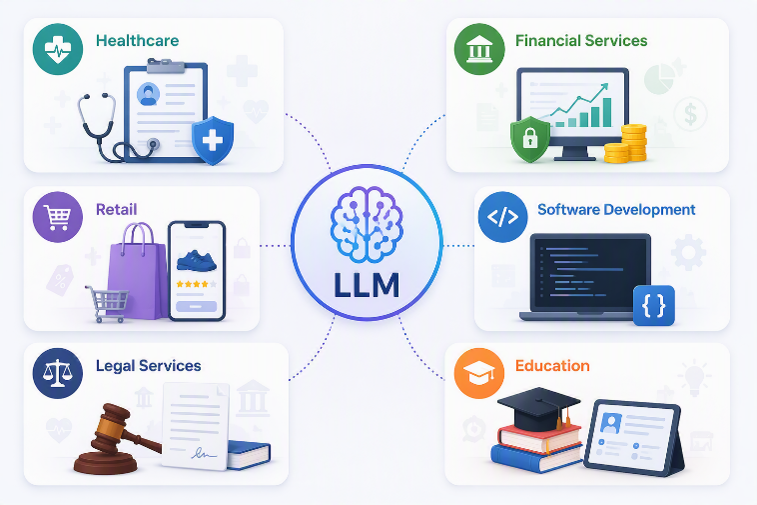
Fig 3: How large language models are transforming industries.
These applications continue expanding as organizations integrate LLMs into their business workflows.
Challenges Every AI Professional Should Understand
While LLMs are powerful, they have important limitations. They can produce hallucinations (factually incorrect responses), inherit biases from training data, and raise privacy and security concerns when handling sensitive information. Additionally, training and deploying LLMs requires significant computational resources, and every model has a limited context window. Understanding these challenges is essential for building reliable and responsible AI solutions.
What’s Next Beyond LLMs?
AI is evolving beyond standalone language models. Retrieval-Augmented Generation (RAG) enhances responses by retrieving up-to-date external information. AI agents can plan and execute multi-step tasks using tools and APIs, and multimodal models process text, images, audio, and video together. These innovations are transforming AI from conversational assistants into intelligent, task-oriented systems.
Building Practical LLM Skills
Understanding how LLMs work is only the first step. Organizations increasingly seek professionals who can design, deploy, and govern AI solutions responsibly.
Developing practical skills in prompt engineering, Retrieval-Augmented Generation (RAG), vector databases, AI orchestration frameworks, and cloud-native AI services can help professionals build production-ready Generative AI applications.
Training programs aligned with industry needs, such as Generative AI programs and Microsoft Azure AI Engineer courses, combine strong conceptual foundations with hands-on labs, helping learners bridge the gap between experimentation and real-world implementation.
The Future of LLMs
Large Language Models are redefining how we build and interact with AI. Their capabilities stem not just from their scale, but from the combination of tokenization, embeddings, transformers, self-attention, and advanced training techniques. For AI professionals, understanding these fundamentals is essential to building reliable, responsible, and production-ready AI solutions. As Generative AI continues to evolve, a strong foundation in LLM concepts will be key to staying ahead in the rapidly changing AI landscape.
Upskill Your Teams with Enterprise-Ready Tech Training Programs
- Team-wide Customizable Programs
- Measurable Business Outcomes
About CloudThat


WRITTEN BY Najmusseher
Najmusseher is a Subject Matter Expert in Azure AI/ML at CloudThat and a Research Scholar in Computer Science specializing in Artificial Intelligence and Deep Learning. With a strong academic background and a passion for innovation, her research focuses on AI-powered EEG-based seizure classification, driving impactful healthcare applications. Her passion for teaching reflects in her unique approach to learning and development. She has delivered training sessions and lectures to over 1000+ participants, ranging from students to industry professionals, combining technical expertise with an engaging teaching style. Najmusseher has published nine research papers, serves as a reviewer for reputed journals indexed in the Web of Science, and contributed a healthcare brain dataset to the UCI Machine Learning Repository. Her journey reflects a blend of academic rigor and practical industry expertise, making her a recognized contributor in Python, Data Science, AI and Deep Learning.


 PREV
PREV








Comments