

 Login
Login


 August 24, 2026
|
Voiced by Amazon Polly |
Introduction
Every AWS environment accumulates security findings faster than teams can triage them. AWS Security Hub flags thousands of issues daily, Amazon GuardDuty surfaces threat signals around the clock, and AWS IAM policies silently drift toward over-permission with every sprint. The bottleneck is not detection, AWS already detects comprehensively, it is interpretation, prioritization, and response. A Gen AI Security and Compliance Agent closes that gap. It reads the same findings a security engineer would, but correlates them across services, scores them against your environment context, maps them to compliance frameworks, and recommends precise remediation, all before a human finishes opening the console. This guide covers the problem, the architecture, and the guardrails that ensure safe auto-remediation.
Pioneers in Cloud Consulting & Migration Services
- Reduced infrastructural costs
- Accelerated application deployment
What Is a Gen AI Security & Compliance Agent?
A traditional security tool is a set of rules that flags a public Amazon S3 bucket as high severity and missing MFA as medium. It fires an alert, leaving interpretation to a human. A Gen AI agent keeps those rules but adds a reasoning layer: it ingests findings from AWS Security Hub, Amazon GuardDuty, Amazon Inspector, AWS IAM Access Analyzer, AWS Config, AWS CloudTrail, and Macie, then uses a foundation model to interpret their meaning together. A rule tells you something is wrong; the agent tells you why it matters in your environment, what an attacker could chain it with, which compliance controls it violates, and what to do next. For pre-approved, low-risk scenarios, it fixes the issue autonomously; for everything else, it generates an Infrastructure-as-Code patch and waits for human approval. Because dangerous actions always require a human, it is a high-value, controlled entry point for generative AI in security operations.
Core Capabilities with AWS Scenarios
Contextual Risk Scoring
Raw severity is generic, a public Amazon S3 bucket is always HIGH regardless of what it holds. The agent rescores every finding against environment context: asset criticality (production versus development, internet-facing versus internal), data sensitivity (PII, financial, public), exploitability (public exploit available, network reachable), and compensating controls (WAF, segmentation, MFA). A public bucket containing PII with no WAF scores 95 out of 100; the same finding on intentionally public static assets scores 25. An unpatched critical CVE drops to 40 when the instance sits in a private subnet behind an ALB and WAF. An IAM user without MFA escalates to 85 when that user holds the Admin policy and has active API keys. Every score includes reasoning, attack path, business impact, and a recommended SLA.
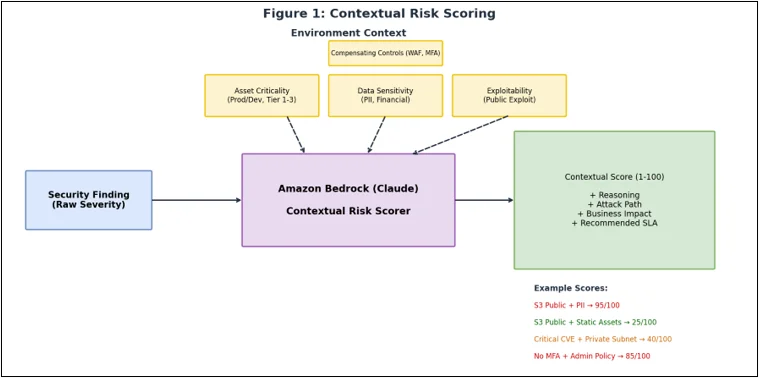
Figure 1. Contextual risk scoring transforms raw severity into environment-aware priority using asset, data, and control context.
Attack Path Analysis
Individual findings rarely tell the full story. The agent maps how findings chain together into exploitable paths. Consider: a public S3 bucket contains Lambda deployment packages; those packages hold hardcoded database credentials; those credentials connect to an RDS instance with 2.4 million customer records. Individually, each finding might be of medium severity. Chained, the agent scores this 98 out of 100 and explains that an unauthenticated attacker can download the packages, extract credentials, and access production customer data in three steps, requiring no privileges. The path engine queries the finding store for related resources, builds a dependency graph, and prompts the LLM to identify chains—turning three separate pages into one critical alert that names the actual risk.
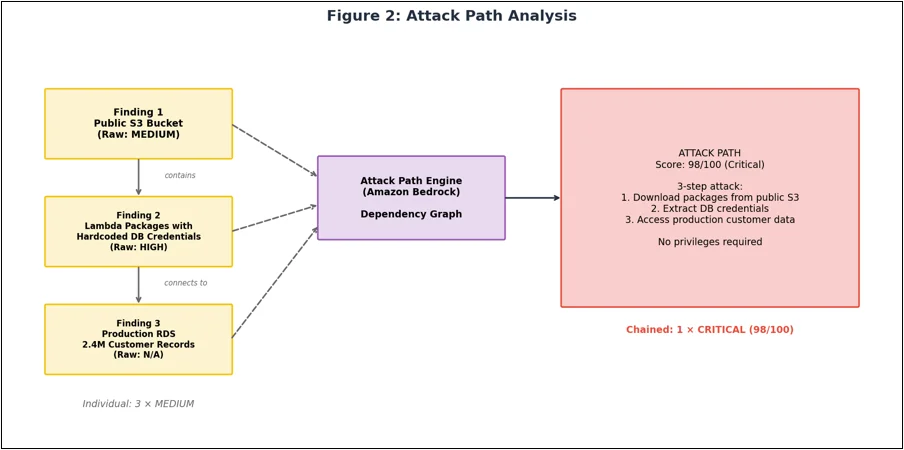
Figure 2. Attack path chaining three medium-severity findings into a single critical exploitable path.
Compliance Mapping and Audit Evidence
Every finding is automatically mapped to applicable controls across CIS AWS Foundations Benchmark v3.0, NIST 800-53 Rev 5, SOC 2, ISO 27001:2022, MeitY Cloud Security Guidelines, and CERT-IN advisories. The agent provides the control ID, a description of how the finding violates it, and an evidence statement formatted for auditors. On demand, it generates compliance reports, overall score with trend, per-section breakdown, top remediations with control IDs, or formal audit evidence packages with control objective, implementation description, evidence artifacts with timestamps and ARNs, and pass/fail conclusion. Compliance posture stays continuously current rather than a stale point-in-time snapshot produced weeks before an audit.
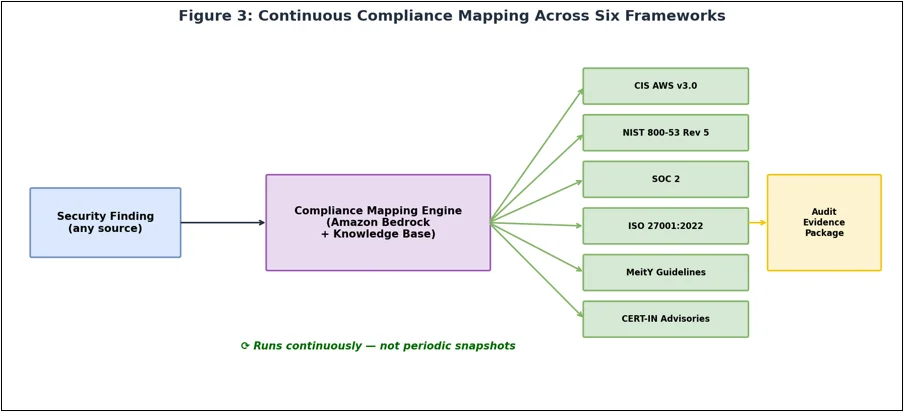
Figure 3. Continuous compliance mapping keeps posture current across six frameworks simultaneously.
Threat Intelligence Correlation
External threats move faster than manual mapping allows. The agent connects CERT-IN advisories, the NVD CVE database, AWS Security Bulletins, and MITRE ATT&CK updates with internal state: asset inventory, software bill of materials, network topology, and live configuration. When a new CVE drops, the LLM correlation engine immediately checks whether it affects any running software, names the specific resources exposed, verifies compensating controls in place, and recommends a remediation timeline, collapsing hours of manual cross-referencing into a single automated exposure assessment delivered within minutes of publication.
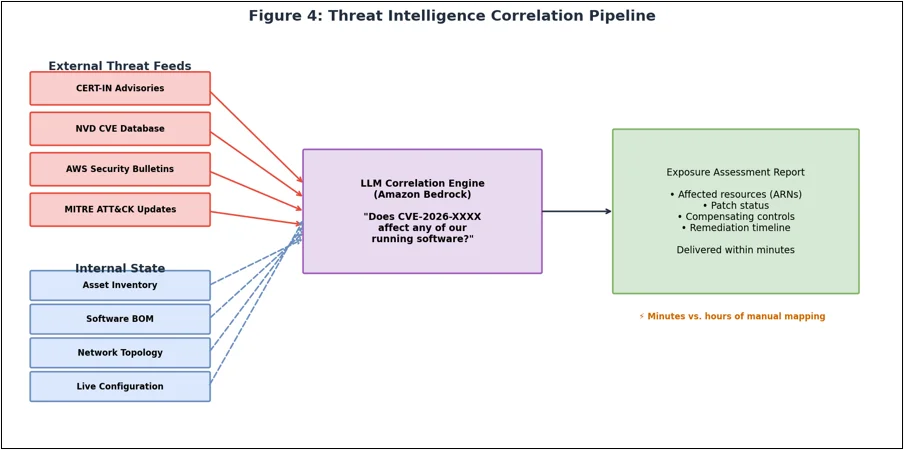
Figure 4. Threat intelligence correlation maps external advisories to internal exposure in near real-time.
AWS Architecture for the Security Pipeline
Security signals from nine AWS services, Security Hub, GuardDuty, Inspector, IAM Access Analyzer, Config, CloudTrail, Macie, VPC Flow Logs, and Trusted Advisor, emit events into Amazon EventBridge. A Lambda normalizer converts every payload to the AWS Security Finding Format and persists it in DynamoDB. Findings route into priority-based SQS queues: Critical for immediate processing, High batched every five minutes, Medium and Low batched hourly. The AI Analysis Engine, powered by Amazon Bedrock with Claude, dequeues findings, enriches them with environment context, and applies contextual scoring, attack path analysis, compliance mapping, and threat correlation. Amazon Bedrock Knowledge Bases grounds every response in CIS Benchmarks, NIST controls, CERT-IN advisories, and organizational playbooks stored in S3 and indexed via OpenSearch Serverless.
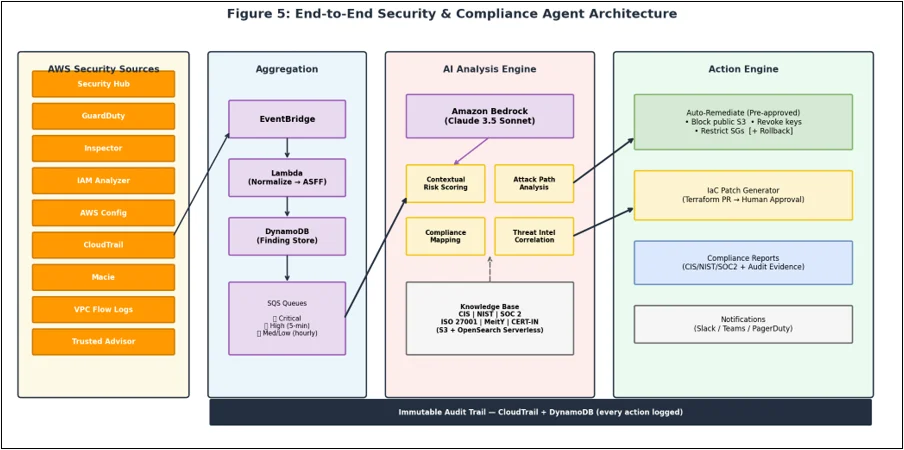
Figure 5. End-to-end architecture from nine security signal sources through AI analysis to tiered remediation.
The Action Engine sits downstream. For pre-approved, low-risk findings, it auto-remediates (block public S3 access, revoke unused keys, restrict open security groups) with mandatory rollback points. For higher-risk findings, it generates Terraform patches and routes them through an approval workflow via Step Functions and Slack/Teams. Every action logs to an immutable CloudTrail trail and DynamoDB audit store.
End-to-End Pipeline Steps
- Security Hub, GuardDuty, Inspector, or Config detects a finding and emits an event to EventBridge.
- Lambda normalizes the payload to ASFF, persists it in DynamoDB, and routes it to a priority-based SQS queue.
- The AI engine dequeues the finding, enriches it with asset context, and invokes Bedrock for contextual risk scoring and attack path analysis.
- Compliance mapping tags the finding against all applicable framework controls; threat correlation checks external feeds for related advisories.
- The Action Engine either auto-remediates (pre-approved, low-risk, with rollback), generates an IaC patch for human review, or produces an advisory — then logs everything to CloudTrail.
Guardrails, KPIs, and Cost
Auto-remediation operates under strict safety boundaries. The agent cannot access secrets or credentials. Only a pre-approved allow-list of low-risk actions can execute autonomously. No single action modifies more than five resources. Every auto-fix creates a rollback point. Critical and high-severity findings always require human approval. The agent cannot approve its own changes. All actions are logged to an immutable trail, and a rate limit caps remediation at 20 actions per hour.
Typical targets: finding triage time under five minutes (from four hours), false-positive rate under ten percent (from forty), mean time to remediate critical findings under four hours (from seventy-two), CIS compliance score above ninety-five percent (from seventy-five), and audit preparation collapsed from two weeks to two days. The combined AWS services typically run a few thousand dollars a month, recovered many times over in reduced breach probability and engineering time saved.
What’s Next
The Security and Compliance Agent is the second pillar in the Gen AI Ops suite. Part 3 covers the Cost Optimization Agent, which reuses the same metrics pipeline and Bedrock reasoning to right-size resources, identify waste, and forecast spend. Together, the monitoring, security, and cost agents form a unified control plane that observes, protects, and optimizes AWS infrastructure with Gen AI reasoning at every layer.
Drop a query if you have any questions regarding Gen AI, and we will get back to you quickly.
Empowering organizations to become ‘data driven’ enterprises with our Cloud experts.
- Reduced infrastructure costs
- Timely data-driven decisions
About CloudThat
FAQs
1. Does this replace AWS Security Hub or Amazon GuardDuty?
ANS: – No, it sits on top of them, adding contextual reasoning and automated response. They remain the detection layer; the agent adds interpretation and action.
2. How does the agent avoid making dangerous changes?
ANS: – Auto-remediation is limited to a strict allow-list with mandatory rollback points. Anything beyond pre-approved low-risk fixes requires human approval. The full reasoning trail is logged for every decision.
3. What if the AI recommendation is wrong?
ANS: – Every recommendation carries a confidence score. Low-confidence or critical findings always escalate to a human. The knowledge base learns from overrides to improve future accuracy.


WRITTEN BY Bineet Singh Kushwah
Bineet Singh Kushwah works as an Associate Architect at CloudThat. His work revolves around data engineering, analytics, and machine learning projects. He is passionate about providing analytical solutions for business problems and deriving insights to enhance productivity. In his quest to learn and work with recent technologies, he spends most of his time exploring upcoming data science trends and cloud platform services, staying up to date with the latest advancements.


 PREV
PREV











Comments