

 Login
Login


 August 19, 2026
|
Voiced by Amazon Polly |
Overview
Model Context Protocol (MCP) is becoming a standard mechanism for integrating AI agents with external applications, APIs, databases, and enterprise tools. Developers do not need to build their own integration layer for each AI-based application, as these capabilities are exposed via MCP servers, where agents can dynamically identify and interact with external tools.
An MCP server might include some sensitive functions such as accessing user information, interacting with internal databases, creating tickets, or modifying cloud instances. The absence of proper authentication and authorization makes them tempt targets for attacks and privilege escalation.
Pioneers in Cloud Consulting & Migration Services
- Reduced infrastructural costs
- Accelerated application deployment
Why Security Is Important for MCP Servers?
A known application with specific credentials usually uses a regular API. MCP introduces a new paradigm in which multiple AI agents and applications can dynamically connect to the server.
Imagine an enterprise AI assistant that interacts with:
- GitHub repositories
- Slack workspaces
- Jira projects
- CRM platforms
- Internal HR databases
Without authentication and authorization, an infected agent could execute malicious actions on those platforms.
Recently, security researchers have found that many remotely accessible MCP servers either expose tools without authentication or have weak OAuth implementations.
Authentication versus Authorization
While often used together, authentication and authorization solve distinct problems.
Authentication
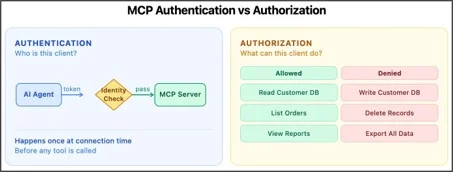
Authentication is the process of verifying the identity of a user, AI agent, or application before granting access to an MCP server. This process is used to answer the following question:
“Who are you?”
With MCP, authentication helps ensure that only authorized clients can connect and make access requests to the available tools. There are many authentication methods, which include:
- OAuth 2.1
- OpenID Connect (OIDC)
- JSON Web Tokens (JWT)
- API Keys (for service-to-service communication)
- Enterprise Identity Providers (Microsoft Entra ID, Okta, Amazon Cognito)
After successful authentication, the client receives an access token that must be included with each subsequent request to the MCP server.
Authorization
Authorization defines what the authenticated user or AI agent can access. This process answers the question:
“What are you allowed to access?”
After verification of the client’s identity, the MCP server will check the permissions of that particular identity prior to allowing access to the tools or resources. Authorization may be done using:
- Role-Based Access Control (RBAC)
- Attribute-Based Access Control (ABAC)
- OAuth scopes and permissions
- Fine-grained tool-level access policies
OAuth 2.1: Recommended Standard
MCP Specification recommends using OAuth 2.1 as an authorization protocol for remote MCP Servers. OAuth provides a standard authorization mechanism for accessing resources without exposing credentials.
Depending on the use case, certain OAuth flows may be suitable:
- Authorization Code + PKCE for AI Assistants (end-user facing)
- Client Credentials Flow for Service-to-Service Authorization
- Dynamic Client Registration for MCP Clients registering themselves
Use of OAuth guarantees access token scoping, limitations, and revocability, which significantly minimize the risk of credential exposure.
Layered Architecture for Authentication
With the increasing number of MCP servers in organizations, independent authentication for each becomes a challenge.
A common pattern in enterprises is to deploy an MCP Gateway to manage authentication and authorization. Instead of managing credentials individually by all agents, the gateway verifies the identity of the caller, implements access policies, and performs secure communication with the MCP servers downstream.
A layered architecture usually involves:
- Authentication Inbound – Authentication of the caller, whether human users or AI Agents.
- Access Control – Defines which MCP servers and tools will be accessible to them.
- Outbound Authentication – Secure interaction between the gateway and downstream services.
Such an approach simplifies and streamlines credential handling while offering better governance and auditing.
Implement Fine-Grained Authorization
Just authentication is not sufficient.
Consider an authenticated developer who requires read-only access to GitHub repositories. If no authorization controls are in place, the same identity will also have the authority to delete repositories and modify the production environment.
Production MCP instances must implement:
- Role-Based Access Control (RBAC)
- Permission at the tool level
- Least privilege
- Authorization at the resource level
- Time-based permissions if needed
Instead of granting access to an MCP instance, grant access only for certain actions.
Common Security Threats
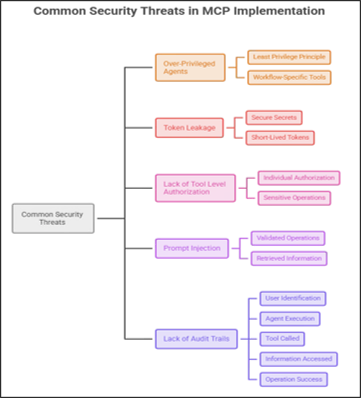
The following security threats are common in MCP implementation.
- Over-Privileged Agents
Allowing each AI agent access to all available tools does not align with the principle of least privilege.
Expose only the tools necessary for a particular workflow.
- Token Leakage
Access tokens must not be included in prompts, logs, or any model context.
Secrets need to be kept secure using vaults or cloud secret managers, while short-lived tokens must be used wherever possible.
- Lack of Tool Level Authorization
A number of MCP servers authenticate users once and then grant access to all exposed tools. Every sensitive operation needs to be authorized individually.
- Prompt Injection
Even after users are authenticated, they can end up executing an unauthorized action by the AI model after following instructions contained in the retrieved information.
Sensitive operations must be validated before being performed.
- Lack of Audit Trails
Without proper auditing, an organization cannot know:
- The user who made the request
- The agent that executed the request
- The tool called by the request
- The information accessed
- The success of the operation
Conclusion
Model Context Protocol is revolutionizing interactions between AI agents and enterprise environments by providing an API that enables tools and services to communicate. With increased connectivity comes increased obligations.
OAuth 2.1, fine-grained authorization, identity management, secure token management, and audit logging are the components with which one can create not just powerful but also secure and ready-for-deployment MCP systems.
Drop a query if you have any questions regarding the Model Context Protocol, and we will get back to you quickly.
Empowering organizations to become ‘data driven’ enterprises with our Cloud experts.
- Reduced infrastructure costs
- Timely data-driven decisions
About CloudThat
FAQs
1. What is authentication in an MCP server?
ANS: – Authentication verifies the identity of a user, AI agent, or application before allowing access to an MCP server. Common methods include OAuth 2.1, OpenID Connect (OIDC), JWT, API keys, and enterprise identity providers.
2. Why is OAuth 2.1 recommended for MCP servers?
ANS: – OAuth 2.1 provides secure, standardized access using short-lived tokens, scoped permissions, and token revocation, reducing the risk of credential exposure and unauthorized access.
3. What is Role-Based Access Control (RBAC) in MCP?
ANS: – RBAC restricts access based on predefined roles, ensuring that users and AI agents can access only the tools and resources required for their responsibilities.


WRITTEN BY Sweata Kumari Rauniyar
Sweata works primarily in the field of cloud computing, with additional expertise in data visualization. She has a strong foundation in cloud technologies and specializes in designing scalable, efficient cloud-based solutions. Skilled in SQL and Python, Sweata leverages these tools to support data-driven applications and create impactful visualizations. Passionate about using cloud technologies to solve real-world problems, she stays updated on emerging tools and trends to continually enhance her expertise and deliver innovative solutions.


 PREV
PREV











Comments