

 Login
Login


 August 14, 2026
|
Voiced by Amazon Polly |
Overview
OpenAI GPT-5.6 Sol, Terra, and Luna are now available to everyone on Amazon Bedrock. This means that OpenAI’s newest models are now on Amazon’s engine for making predictions. The three models are good for things. OpenAI GPT-5.6 Sol is great for hard thinking and problem-solving. OpenAI GPT-5.6 Terra is good for when you need to get things done quickly and accurately. OpenAI GPT-5.6 Luna is perfect for when you need to get things done fast and do not want to spend a lot of money.
This is a deal because it helps Amazon teams access the latest OpenAI models safely and securely. They can use OpenAI GPT-5.6 Sol, Terra, and Luna in parts of the world, and the prices are the same as what OpenAI charges directly.
Pioneers in Cloud Consulting & Migration Services
- Reduced infrastructural costs
- Accelerated application deployment
Introduction
Organizations want to choose models without any hassle. They need reasoning for agent-based workflows, cheaper options for frequently run tasks, and an easy way to control access within AWS. GPT-5.6 on Amazon Bedrock meets this need by offering the Sol, Terra, and Luna tiers through the Bedrock runtime and the Responses API. For teams already working on AWS, this is a way to try out the latest OpenAI models while keeping deployment, billing, and rules within the AWS setup.
Model tiers
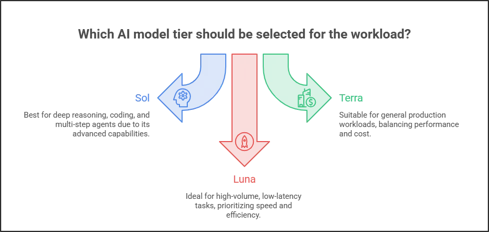
Sol is the model we have for thinking things through. It is great for coding and solving problems. Terra is a choice because it works well and does not cost too much. Luna is the option, and it is really fast, which is good for things that need to happen quickly, like finding the way or summarizing information. Sol, Terra, and Luna all work together so teams can use the model that’s best for what they are trying to do, instead of using the most expensive model for everything.
Why is this launch useful?
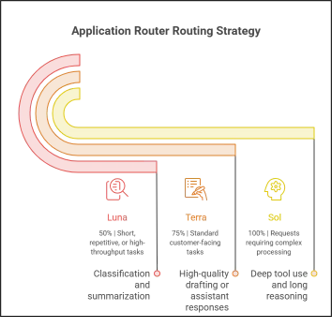
The biggest value of GPT-5.6 on Amazon Bedrock is choice. Using one general model for every task, the team can route difficult reasoning tasks to Sol, everyday production requests to Terra, and bulk or latency-sensitive operations to Luna. That simplifies architecture for multi-agent systems and supports automation, content workflows, and internal assistants that require different levels of intelligence at different steps. AWS also notes that these models are available through Amazon Bedrock’s next-generation inference engine, which is built for performance, security, and reliability.
Access and deployment
OpenAI GPT-5.6 models are accessible through Amazon Bedrock’s console and the Responses API. AWS documentation indicates that Sol is available in US East (N. Virginia) and US East (Ohio), while Terra and Luna are also available in US West (Oregon). The fact that all three models can be reached through a common runtime surface reduces integration work for developers who already standardize on AWS tooling. In practice, that means easier testing, migration, and multi-model routing within the same application.
Pricing and performance
AWS says its pricing is the same as OpenAI’s, and using it counts toward AWS commitments. That matters for companies that handle budgets through AWS purchases or enterprise contracts. In terms of performance, Sol is the choice for reasoning. Terra is a well-rounded model for production, and Luna is the fastest and cheapest option in the group. This structure helps make it easier to save money without sacrificing features where they are needed most.
Best use cases
Sol is best suited for coding assistants. It is also good for analysis. It is useful for agents that need strong reasoning over many steps. Terra fits knowledge assistants. It is suitable for enterprise copilots. It works well for production chat applications. Cost matters in these cases. Luna is a fit for moderation. It is helpful for extraction. It works well for summarization. It is useful for triage. It is good for any workload where speed and efficiency are more important than deep reasoning. Teams can even combine all three in one system. They can choose dynamically based on confidence. They can choose based on context size. They can choose based on the workflow stage.
Conclusion
Since the models can be used through the Amazon Bedrock console and the Responses API, teams can use them without changing how they work on AWS. For companies that want the AI and need to keep things under control, this update is a real improvement.
Drop a query if you have any questions regarding OpenAI, and we will get back to you quickly.
Empowering organizations to become ‘data driven’ enterprises with our Cloud experts.
- Reduced infrastructure costs
- Timely data-driven decisions
About CloudThat
FAQs
1. Which AWS regions are supported?
ANS: – Sol is available in US East (N. Virginia) and US East (Ohio). Terra and Luna are also available in the US West (Oregon).
2. Which model should I choose?
ANS: – Use Sol for deep reasoning and agentic tasks, Terra for balanced production workloads, and Luna for fast, high-volume, cost-sensitive tasks.


WRITTEN BY Nekkanti Bindu
Nekkanti Bindu works as a Research Associate at CloudThat, where she channels her passion for cloud computing into meaningful work every day. Fascinated by the endless possibilities of the cloud, Bindu has established herself as an AWS consultant, helping organizations harness the full potential of AWS technologies. A firm believer in continuous learning, she stays at the forefront of industry trends and evolving cloud innovations. With a strong commitment to making a lasting impact, Bindu is driven to empower businesses to thrive in a cloud-first world.


 PREV
PREV








Comments