

 Login
Login

 August 13, 2026
|
Voiced by Amazon Polly |
Overview
Deploying an AI model is often seen as the last step in a project, but in production, it’s just the start. Once the model is in production, it has to handle real data, shifting user behavior, changing business rules, and the constraints of cloud deployment. AWS focuses not only on model accuracy, feature pipeline health, and endpoint performance but also on data quality and visibility throughout the Machine Learning process. With effective monitoring, teams can spot issues early, ensuring that business outcomes are not impacted and AI solutions remain dependable.
Pioneers in Cloud Consulting & Migration Services
- Reduced infrastructural costs
- Accelerated application deployment
Introduction
A demand forecasting model might pass tests, but in practice, promotions, supply delays, and shifting customer behavior can quickly change its accuracy. If left unmonitored, it can negatively affect inventory, service, and revenue. AWS provides tools that help teams spot problems in their environments early and respond proactively. Tools like CloudWatch, SageMaker Model Monitor, Lambda, and EventBridge are among AWS’s offerings.
Why Monitoring Matters?
AI models do not remain fixed after deployment due to ongoing changes in data and business conditions. Key reasons monitoring is essential include:
- Late data in Amazon S3.
- Broken ETL jobs in AWS Glue.
- Higher latency on SageMaker endpoints.
- Business rule changes without retraining.
- Changes in input data that lower prediction quality.
Monitoring enables teams to see these changes clearly and understand how the model is performing in production.
Common AWS Production Challenges
Production AI systems often encounter a mix of data and infrastructure problems. Common issues include:
- Data drift, where input data differs from training data.
- Concept drift, where the relationship between inputs and predictions changes.
- Missing values, duplicate records, and schema mismatches.
- Failed workflow executions.
- Delayed files or broken ingestion jobs.
- IAM permission problems.
- Noisy or incomplete logs.
These issues can lead to reduced accuracy, delayed decisions, and adverse business impacts if left unmonitored.
Key Metrics to Track
A solid monitoring setup should include both ML metrics and operational metrics in the cloud. Track these metrics:
- Model accuracy, using MAE, RMSE, or MAPE.
- Data quality, including missing values, invalid ranges, duplicate records, and schema drift.
- Prediction distribution to catch spikes, flat forecasts, or unusual patterns.
- Pipeline health, including ingestion success, ETL duration, processing failures, and endpoint latency.
- Business KPIs, such as stockouts, inventory use, forecast accuracy, and service level.
In AWS, these signals can be displayed in Amazon CloudWatch dashboards, sent as custom metrics, and linked to Amazon SNS alerts so the right team can address issues quickly.
AWS Monitoring Architecture
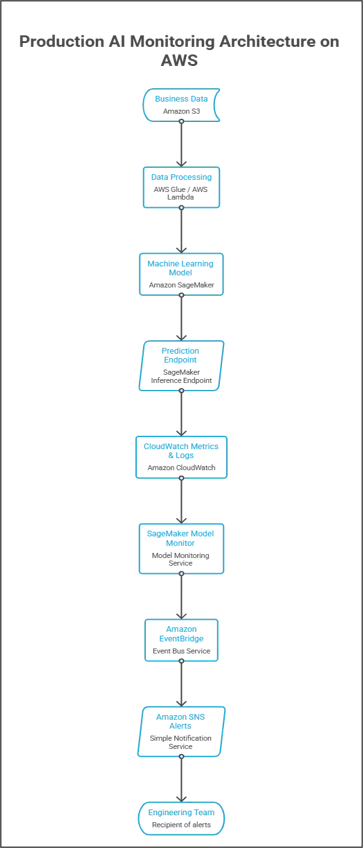
A practical AWS monitoring architecture typically includes several layers. The usual flow is:
- Data arrives in Amazon S3.
- AWS Glue, AWS Lambda, or Step Functions process the data.
- Amazon SageMaker trains and deploys the model.
- Inference logs and performance signals go to CloudWatch.
- SageMaker Model Monitor compares live data to a baseline.
- AWS CloudTrail logs configuration and access changes.
- AWS EventBridge triggers workflows when thresholds are breached.
- Amazon SNS sends alerts to the appropriate teams.
This establishes an event-driven monitoring loop that is scalable, auditable, and easier to maintain.
Retail Forecasting Example
Consider a retail demand-forecasting system that generates daily replenishment recommendations. The pipeline retrieves sales history, inventory data, and product details from Amazon S3, processes this information through AWS Glue, and sends predictions through a SageMaker model endpoint.
Monitoring should check:
- Each store’s data arrives on time.
- The schema remains consistent.
- Input features stay within expected ranges.
- Forecast outputs are realistic for each product and location.
- Forecast error remains within acceptable limits.
- Alerts trigger if a store file fails to arrive.
Amazon CloudWatch alarms and EventBridge rules can notify teams before inventory decisions are affected.
Continuous Feedback Loop
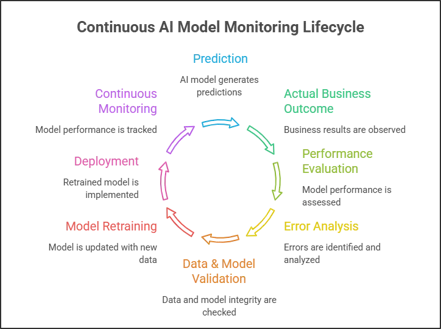
Monitoring is most valuable when it leads to proactive action. A production AI system should follow a continuous cycle: predictions are made, actual sales are recorded, error is calculated, thresholds are reviewed, and the model is retrained if necessary.
On AWS, this can be automated using:
- AWS Step Functions for coordination.
- AWS Lambda for event-driven logic.
- Amazon S3 for storing actual results.
- Amazon SageMaker Pipelines for retraining workflows.
- Amazon SageMaker Model Registry for version control.
Human review remains important, especially when business rules change, or model outputs directly impact inventory and revenue.
Best Practices on AWS
Effective monitoring relies on visibility, version control, and clear responsibilities. Best practices include:
- Create dashboards for technical and business metrics.
- Adjust alerts carefully to reduce false alarms.
- Track every model version, dataset version, and feature transformation.
- Enable logging for infrastructure and permission changes.
- Centralize logs from your ML and data pipeline services.
- Specify monitoring thresholds with business stakeholders.
These practices improve monitoring effectiveness and make it easier to take action.
Future of Monitoring
Monitoring is becoming more automated and intelligent. AWS systems are increasingly using real-time alerts and streaming data, while automated retraining helps address model drift. As LLMs and AI agents become more common, monitoring output quality, safety, and reliability will be just as important as model training.
Conclusion
For retail forecasting and other AI production cases, this level of monitoring turns a model from a one-time project into a lasting business asset.
Drop a query if you have any questions regarding AI models, and we will get back to you quickly.
Empowering organizations to become ‘data driven’ enterprises with our Cloud experts.
- Reduced infrastructure costs
- Timely data-driven decisions
About CloudThat
FAQs
1. Why do AI models require monitoring after deployment?
ANS: – Production data, user behavior, and business conditions change over time. Monitoring helps detect drops in accuracy, data issues, and infrastructure failures before they affect business decisions.
2. What should teams monitor in an AWS-based AI system?
ANS: – They should monitor model accuracy, data quality, feature distribution, endpoint latency, pipeline failures, Amazon CloudWatch alarms, and business KPIs. Together, these signals provide a complete view of production health.


WRITTEN BY Kirubanithi Annamalai
Generating response Copilot said: Kirubanithi Annamalai is a Senior Research Associate specializing in Artificial Intelligence, Machine Learning, Deep Learning, and Intelligent Automation. He has experience in developing AI-driven solutions, building scalable machine learning systems, and implementing automation frameworks to solve business challenges across engineering and cybersecurity domains. Passionate about emerging technologies, he focuses on delivering innovative solutions that drive business value.


 PREV
PREV







Comments