

 Login
Login

 August 21, 2026
|
Voiced by Amazon Polly |
Modern web applications are expected to deliver content instantly, regardless of where users are located. Whether it’s an e-commerce website serving millions of customers, a media platform streaming videos worldwide, or a SaaS application handling global traffic, users expect fast response times with minimal latency. While Amazon CloudFront already accelerates content delivery through its global edge locations, many applications require custom logic to be executed before content reaches the user.
For example, organizations may want to redirect users based on their geographic location, authenticate requests before access to protected content, rewrite URLs, insert security headers, personalize content, or dynamically modify responses. Traditionally, these tasks required routing requests back to an application server, increasing latency and infrastructure costs.
AWS provides two services that allow developers to execute code closer to users: Lambda@Edge and CloudFront Functions. Although both services enable customization at CloudFront edge locations, they are designed for different workloads and offer different capabilities.
Start Learning In-Demand Tech Skills with Expert-Led Training
- Industry-Authorized Curriculum
- Expert-led Training
What is Lambda@Edge?
Lambda@Edge is an extension of AWS Lambda that allows developers to run serverless functions at AWS edge locations in response to CloudFront events. Instead of processing requests in a regional AWS data center, Lambda@Edge executes code closer to end users, reducing latency and improving the user experience.
Lambda@Edge can modify both requests and responses as they pass through CloudFront. Unlike traditional Lambda functions, which execute in a specific AWS Region, Lambda@Edge automatically replicates your function to AWS edge locations worldwide after deployment.
What are CloudFront Functions?
CloudFront Functions is a lightweight serverless compute service built specifically for high-volume HTTP request processing. It is designed to execute extremely small pieces of JavaScript code with microsecond latency.
Rather than supporting full application logic, CloudFront Functions focuses on simple request and response manipulation, such as:
- URL rewrites
- Header manipulation
- Redirects
- Basic authentication
- Cache key normalization
- Security header insertion
How Lambda@Edge Works
When a user sends a request to CloudFront, the request reaches the nearest edge location. Depending on the configured CloudFront event, Lambda@Edge executes before or after CloudFront communicates with the origin.
Lambda@Edge supports four event types:
- Viewer Request
- Origin Request
- Origin Response
- Viewer Response
For example, when a user requests an image, Lambda@Edge can verify authentication during the Viewer Request event. If the user is authorized, CloudFront continues processing the request. During the Origin Request event, Lambda@Edge can modify the request before it reaches the origin server. After the origin returns the content, the function can modify the headers or the response before CloudFront delivers it to the user.
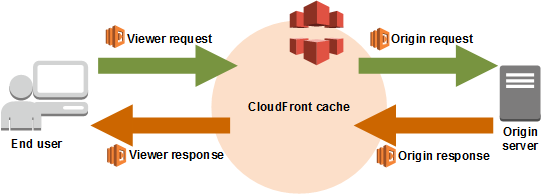
Source: CloudFront events that can trigger a Lambda@Edge function – Amazon CloudFront
This flexibility makes Lambda@Edge suitable for applications requiring advanced business logic at the network edge.
How CloudFront Functions Work
CloudFront Functions execute only during the Viewer Request and Viewer Response phases.
As soon as CloudFront receives a user request, the function executes within the edge location itself before CloudFront checks its cache. Since CloudFront Functions operate in a lightweight JavaScript runtime without external dependencies or network access, execution is extremely fast. After the function completes, CloudFront either serves cached content or forwards the request to the origin.
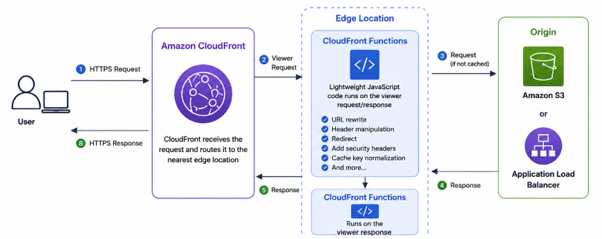
Fig 2: How CloudFront Functions process requests and responses at the edge.
Lambda@Edge vs CloudFront Functions
Although both services execute code at CloudFront edge locations, they solve different problems.
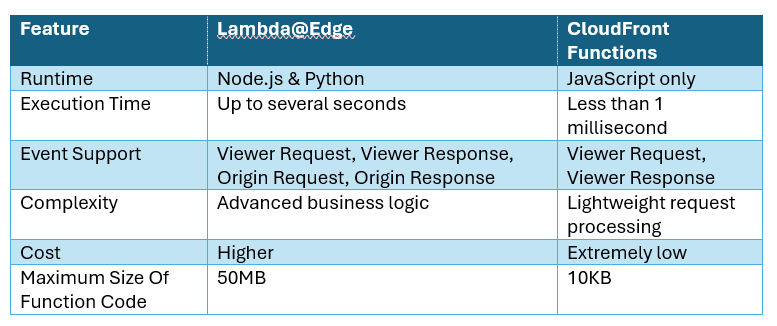
The primary difference is that Lambda@Edge operates like a full serverless compute platform, whereas CloudFront Functions serves as a lightweight request-processing engine optimized for speed.
When Should You Choose CloudFront Functions and Lambda@Edge?
CloudFront Functions is the better choice when applications require very fast execution with minimal logic. General use cases such as URL rewriting, security headers, redirects, and cache optimization
Lambda@Edge is more suitable when applications require advanced processing that cannot be achieved using lightweight JavaScript. Common use cases such as authentication and authorization, dynamic Image processing, and origin selection
Choosing AWS Edge Services
Lambda@Edge and CloudFront Functions both extend the capabilities of Amazon CloudFront by allowing code execution at AWS edge locations, but they are designed for different purposes.
CloudFront Functions excels at ultra-fast, lightweight request processing with minimal cost, making it ideal for URL rewrites, redirects, header manipulation, and cache optimization. Lambda@Edge, on the other hand, provides a full-featured serverless environment capable of executing complex business logic, authenticating users, integrating with AWS services, and dynamically modifying content. Understanding these differences in AWS edge services helps architects to build faster, more scalable, and cost-efficient applications on AWS.
Upskill Your Teams with Enterprise-Ready Tech Training Programs
- Team-wide Customizable Programs
- Measurable Business Outcomes
About CloudThat


WRITTEN BY Mahek Tamboli
Mahek is a Senior Subject Matter Expert at CloudThat, specializing in AWS Architecting. With 13 years of experience in IT and education industry, she has trained over 2000 professionals/students to upskill in hardware, network, MCSA, RHCSA and multi cloud. She is an authorized trainer for AWS and GCP. Known for simplifying complex concepts and delivering interactive and hands-on sessions, she brings deep technical knowledge and practical application into every learning experience. Mahek passion for continuous learning reflects in her unique approach to learning and development.


 PREV
PREV












Comments