

 Login
Login


 August 21, 2026
|
Voiced by Amazon Polly |
In today’s digital landscape, users expect websites and applications to load instantly, regardless of their geographic location. As businesses expand globally, reducing latency while maintaining security and scalability becomes increasingly important.
Amazon CloudFront, AWS’s global Content Delivery Network (CDN), delivers content from edge locations worldwide, ensuring low latency and high availability. However, many applications require lightweight customization of HTTP requests and responses before they reach the origin or the end user.
CloudFront Functions is a serverless edge computing service that enables developers to execute lightweight JavaScript code at CloudFront edge locations with ultra-low latency. It allows organizations to modify requests and responses, improve cache efficiency, enhance security, and personalize user experiences, all without managing servers.
This blog explains how CloudFront Functions enhances CloudFront distributions, explores its core concepts, architecture, common use cases, and why it is becoming the preferred choice for lightweight edge processing.
Start Learning In-Demand Tech Skills with Expert-Led Training
- Industry-Authorized Curriculum
- Expert-led Training
Key Benefits of CloudFront Functions
Organizations adopt CloudFront Functions for several advantages:
- Ultra-Low Latency – Executes code in less than one millisecond at edge locations.
- High Scalability – Processes millions of requests per second globally.
- Improved Cache Efficiency – Normalizes requests to increase cache hit ratios.
- Cost-Effective – Lower pricing compared to Lambda@Edge for lightweight workloads.
- Enhanced Security – Add or modify security headers before responses reach users.
- Simple Deployment – Functions are deployed globally with CloudFront distributions.
- Minimal Operational Overhead – No infrastructure or server management required.
Understanding Core Concepts
- What are CloudFront Functions?
CloudFront Functions is a lightweight serverless compute service that runs JavaScript code at AWS edge locations.
It enables developers to customize HTTP requests and responses without contacting the origin server.
Typical operations include:
- URL rewriting
- Header manipulation
- HTTP redirects
- Basic authentication
- Cache key normalization
- Request validation
Unlike Lambda@Edge, CloudFront Functions are optimized specifically for lightweight processing with extremely low execution latency.
- Edge Locations
CloudFront Functions execute at CloudFront edge locations worldwide.
Instead of sending requests to the origin server for simple processing, the function executes closer to users, resulting in:
- Reduced latency
- Faster response times
- Lower origin load
- Better user experience
- Viewer Events
CloudFront Functions can execute only during two CloudFront events:
- Viewer Request – Before CloudFront checks the cache.
- Viewer Response – Before CloudFront returns the response to the client.
This makes them ideal for request-and-response customization.
- JavaScript Runtime
CloudFront Functions use a lightweight JavaScript runtime optimized for speed.
Developers can:
- Read request information
- Modify HTTP headers
- Rewrite URLs
- Redirect requests
- Generate simple responses
Since network access is not allowed, execution remains extremely fast.
How CloudFront Functions Enhance CloudFront (Step-by-Step)
Step 1: Create a CloudFront Distribution
Create or use an existing Amazon CloudFront distribution to deliver content globally.
Step 2: Develop the Function
Write lightweight JavaScript code to perform operations such as:
- URL rewriting
- Header modification
- Redirects
- Authentication
- Cache optimization
Step 3: Test the Function
Use the CloudFront Functions testing console to validate:
- Request processing
- Response modifications
- Error handling
- Performance
Step 4: Publish the Function
After testing, publish the function.
Publishing creates an immutable version that can be associated with CloudFront behaviors.
Step 5: Associate with CloudFront Behavior
Attach the function to one of the supported events:
- Viewer Request
- Viewer Response
CloudFront automatically deploys the function globally.
Step 6: Monitor and Optimize
Monitor execution using:
- Amazon CloudWatch metrics
- CloudFront monitoring
- AWS CloudTrail for configuration auditing
Review metrics to optimize performance and cache efficiency.
Real-World Use Cases
- URL Rewriting
Automatically rewrite URLs without changing the origin.
Example:
/products
↓
/store/products
Useful for website migrations and SEO-friendly URLs.
- HTTP Header Manipulation
Modify or add headers such as:
- Security headers
- Cache-Control
- Content Security Policy
- CORS headers
This improves application security and browser compatibility.
- HTTP Redirects
Redirect users based on:
- Country
- Device type
- Language
- Requested URL
Examples include:
- HTTP to HTTPS redirects
- Country-specific websites
- Mobile website redirects
- Cache Key Normalization
Increase cache hit ratios by:
- Removing unnecessary query strings
- Normalizing cookies
- Standardizing request headers
Higher cache efficiency reduces origin traffic and improves performance.
- Lightweight Authentication
Implement simple authentication mechanisms such as:
- API key validation
- Token verification
- Request filtering
Requests can be rejected before reaching the origin server.
Architecture Overview
A typical CloudFront Functions architecture consists of:
- Users accessing the application globally
- Amazon CloudFront distribution
- CloudFront Functions executing at edge locations
- CloudFront cache
- Origin server (Amazon S3, Application Load Balancer, Amazon EC2, or API Gateway)
- Amazon CloudWatch for monitoring
- AWS CloudTrail for auditing
The CloudFront Functions architecture below minimizes latency while allowing request and response customization without increasing origin load.
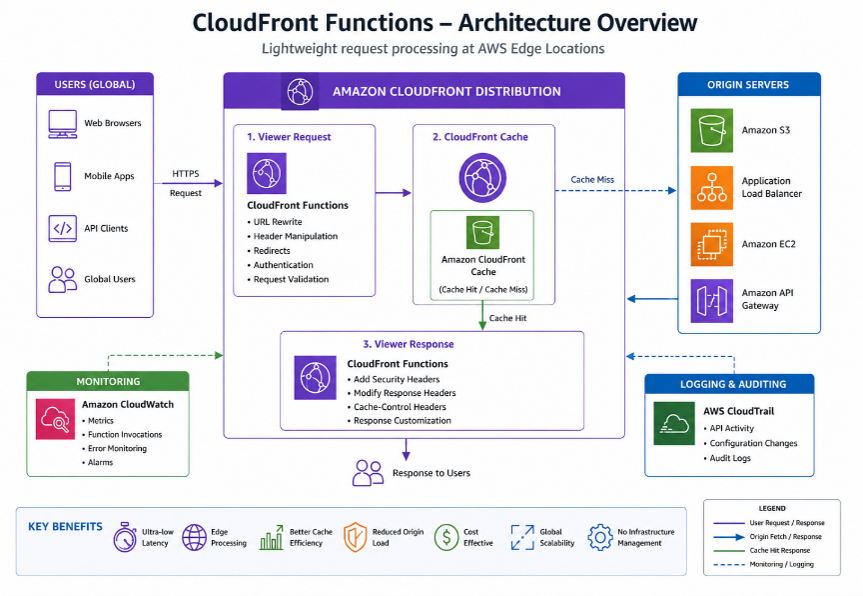
Fig 1: CloudFront Functions architecture for low-latency edge request processing.
Why Organizations Choose CloudFront Functions
Compared to traditional origin-based request processing, CloudFront Functions provides:
- Faster request processing
- Lower latency
- Improved cache performance
- Reduced origin server load
- Lower operational costs
- Global scalability
- Simplified deployment
- Enhanced security through edge-based request validation
Organizations prefer CloudFront Functions because they provide a lightweight, scalable, and cost-effective way to customize CloudFront behavior at the edge.
Limitations
CloudFront Functions are intentionally lightweight and have some limitations:
- Supports only JavaScript runtime.
- No network access.
- Cannot call external APIs.
- Cannot access the request body.
- Limited execution time (less than 1 ms).
- Supports only Viewer Request and Viewer Response events.
For advanced processing such as API calls, authentication with external identity providers, image manipulation, or request body inspection, Lambda@Edge is the better choice.
Optimizing Edge Performance
CloudFront Functions is a powerful serverless edge computing service that enables developers to execute lightweight JavaScript code directly at Amazon CloudFront edge locations. By processing requests and responses closer to users, it significantly reduces latency, improves cache efficiency, enhances security, and lowers operational costs.
With capabilities such as URL rewriting, header manipulation, redirects, and cache optimization, CloudFront Functions is an ideal solution for high-volume, low-latency workloads. While it is designed for lightweight request processing, it complements services like Lambda@Edge for more advanced edge computing scenarios.
For organizations seeking to optimize content delivery and provide faster, more responsive user experiences, CloudFront Functions offers a scalable, cost-effective, and easy-to-manage solution that enhances the overall CloudFront experience.
Upskill Your Teams with Enterprise-Ready Tech Training Programs
- Team-wide Customizable Programs
- Measurable Business Outcomes
About CloudThat


WRITTEN BY Avinash Singh Bundela
Avinash Singh Bundela is a Subject Matter Expert at CloudThat, specializing in AWS Architecting / AWS DevOps and AWS Security. With 14 years of experience in Training and Consultancy, he has trained over 10000+ professionals/students to upskill in Multiple Technologies. Known for simplifying complex concepts and delivering interactive hands-on sessions, he brings deep technical knowledge and practical application into every learning experience. Avinash’s passion for continuous learning reflects in his unique approach to learning and development.


 PREV
PREV












Comments