

 Login
Login


 August 10, 2026
|
Voiced by Amazon Polly |
Overview
Modern organizations generate massive volumes of real-time data from applications, IoT devices, websites, and business systems. Processing this continuous stream of data requires a scalable, reliable, and fully managed streaming platform. This is where Amazon Managed Streaming for Apache Kafka (Amazon MSK) comes into the picture.
Amazon MSK is a fully managed Apache Kafka service that simplifies the deployment, management, and scaling of Kafka clusters on AWS. While MSK is powerful on its own, its real strength lies in how seamlessly it integrates with other AWS services such as AWS Glue, AWS Lambda, and Amazon Redshift. Together, these services enable organizations to build end-to-end real-time data pipelines with minimal operational overhead.
This blog explores how Amazon MSK works with these AWS services and how businesses can leverage the integration to build modern streaming analytics solutions.
Pioneers in Cloud Consulting & Migration Services
- Reduced infrastructural costs
- Accelerated application deployment
Understanding Amazon MSK
Amazon MSK eliminates the complexity of managing Apache Kafka infrastructure. AWS takes care of provisioning brokers, patching, monitoring, scaling, and ensuring high availability.
Organizations commonly use Amazon MSK for:
- Real-time event streaming
- Log aggregation
- IoT data ingestion
- Clickstream analytics
- Fraud detection
- Change Data Capture (CDC)
- Microservices communication
Instead of manually maintaining Kafka clusters, teams can focus on building data-driven applications.
Architecture Overview
The following diagram illustrates a common streaming architecture that uses Amazon MSK, AWS Glue, AWS Lambda, and Amazon Redshift.
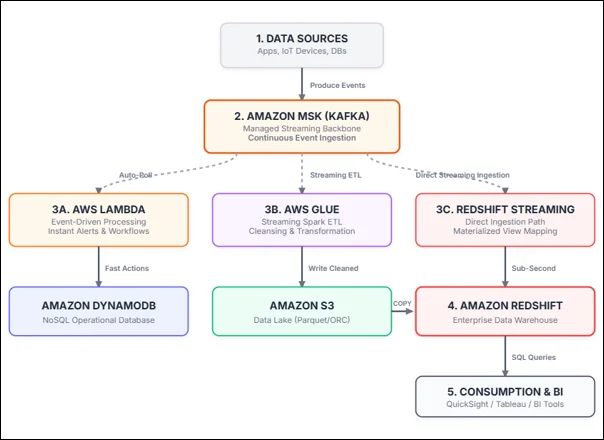
Amazon MSK + AWS Lambda
AWS Lambda can directly consume events from Amazon MSK without requiring dedicated consumer applications.
Whenever new messages are published to Kafka topics, Lambda automatically polls the topic and invokes a function to process the incoming records.
Typical use cases include:
- Sending notifications
- Validating incoming data
- Updating DynamoDB tables
- Triggering downstream workflows
- Calling external REST APIs
- Fraud detection logic
Benefits
- No server management
- Automatic scaling
- Event-driven architecture
- Pay only for execution time
- Low operational overhead
For example, an e-commerce website can publish every order to an MSK topic. Lambda immediately processes the order, validates payment, updates inventory, and sends confirmation emails—all in real time.
Amazon MSK + AWS Glue
Streaming data usually arrives in raw formats that require cleansing and transformation before analytics.
AWS Glue Streaming ETL can continuously consume Kafka messages from Amazon MSK and perform operations such as:
- Data cleansing
- Schema mapping
- Filtering invalid records
- Data enrichment
- Aggregations
- Format conversion
Glue supports Apache Spark Structured Streaming, making it ideal for processing high-volume event streams.
Common Workflow
- Read events from Amazon MSK.
- Apply Spark transformations.
- Validate records.
- Enrich data with reference datasets.
- Write transformed data to Amazon S3 or Amazon Redshift.
This enables organizations to build near real-time ETL pipelines without managing Spark clusters.
Benefits
- Serverless ETL
- Auto scaling
- Continuous streaming jobs
- Native Spark support
- Integration with Glue Data Catalog
Amazon MSK + Amazon Redshift
Streaming data becomes valuable when it is available for analytics.
Amazon Redshift supports streaming ingestion, allowing organizations to query near real-time data arriving from Amazon MSK.
Instead of waiting for scheduled batch jobs, data can be continuously loaded into analytical tables.
Typical analytical scenarios include:
- Sales dashboards
- Website traffic analytics
- Financial transactions
- Customer behavior analysis
- Operational monitoring
Business Intelligence tools like Amazon QuickSight or Tableau can then connect to Redshift to provide live dashboards.
Benefits
- Low-latency analytics
- High-performance SQL queries
- Massive parallel processing
- Scalable data warehouse
- Faster business insights
Key Benefits of the Integration
Integrating Amazon MSK with AWS Glue, Lambda, and Amazon Redshift provides several advantages:
- Real-time processing: Process events as they arrive instead of relying on batch jobs.
- Reduced operational effort: Fully managed services eliminate the need for infrastructure management.
- Scalability: Automatically scale based on workload.
- Cost optimization: Pay only for the resources consumed.
- Improved data quality: Transform and validate streaming data before storage.
- Faster insights: Enable near real-time analytics for business decisions.
- High availability: AWS-managed services provide built-in fault tolerance and reliability.
Conclusion
Together, these services form a scalable, serverless, and highly efficient streaming data architecture that reduces operational complexity while enabling organizations to unlock real-time insights. Whether you’re building IoT platforms, financial transaction systems, customer analytics, or operational monitoring solutions, the combination of Amazon MSK, AWS Glue, AWS Lambda, and Redshift provides a robust foundation for modern data engineering.
Drop a query if you have any questions regarding Amazon MSK, and we will get back to you quickly.
Empowering organizations to become ‘data driven’ enterprises with our Cloud experts.
- Reduced infrastructure costs
- Timely data-driven decisions
About CloudThat
FAQs
1. Can AWS Lambda directly consume messages from Amazon MSK?
ANS: – Yes. AWS Lambda supports Amazon MSK as an event source and automatically invokes Lambda functions when new Kafka messages are available.
2. Does AWS Glue support streaming data from Amazon MSK?
ANS: – Yes. AWS Glue Streaming ETL can continuously read data from Amazon MSK, transform it with Apache Spark, and write it to destinations such as Amazon S3 or Amazon Redshift.
3. Why use Amazon Redshift with Amazon MSK?
ANS: – Amazon Redshift enables near real-time analytics by ingesting streaming data from Amazon MSK, allowing organizations to build dashboards and perform SQL-based analytics on continuously arriving data.


WRITTEN BY Anusha
Anusha works as a Subject Matter Expert at CloudThat. She handles AWS-based data engineering tasks such as building data pipelines, automating workflows, and creating dashboards. She focuses on developing efficient and reliable cloud solutions.


 PREV
PREV











Comments