

 Login
Login


 July 29, 2026
|
Voiced by Amazon Polly |
Introduction
Confused about which cloud computing certification to pursue first? Most professionals spend 3 to 6 months training for certifications, costing ₹25,000 to ₹1,15,000, depending on depth and vendor focus.
Entry-level certifications (AWS Cloud Practitioner, Azure Fundamentals) take 4 to 8 weeks, while advanced architect-level certifications demand 6 months of structured learning with hands-on labs.
The path isn’t one-size-fits-all. Your career stage, current tech skills, and industry focus determine whether you start with foundational cloud concepts or jump straight into AWS Solutions Architect territory. What matters most is choosing training that combines theory with 50 to 60 percent hands-on labs, real-world case studies, and direct access to certified instructors who’ve actually built what they’re teaching.
No Job After Graduation? Cloud Engineering is Your Answer
- Beginner Friendly
- 92% Placement Rate
- Live Instructor-Led
Why Cloud Certifications Actually Matter for Your Career
Let’s be direct: cloud certifications open doors your resume alone can’t.
A hiring manager sees two candidates with similar experience. One has a degree and strong projects. The other has a degree, strong projects, and an AWS Solutions Architect Professional certification. That second candidate signals something specific: they know the AWS ecosystem deeply enough to design production systems at scale. They’ve studied enterprise patterns. They’ve learned from people who build systems for Fortune 500 companies.
Certifications work because they’re a proxy for knowledge when a hiring manager can’t sit down and quiz you on architecture decisions for six hours. They say, “This person has been validated by a vendor who has every incentive to keep standards high.”
Consider another angle: compensation. A 2024 industry report shows cloud-certified professionals earn 15 to 25 percent more than non-certified peers in the same role. Some certifications add even more. An AWS Certified Solutions Architect Professional often commands salaries ranging from ₹20 to ₹35 lakhs annually, depending on company size and location. That’s not chump change.
But the real value lies deeper. Every certification worth taking forces you to think about systems end-to-end. Not just how a database works in isolation, but how it fits into a resilient architecture. Not just EC2 instances, but landing zones, identity management, disaster recovery, and cost optimization. You emerge from structured certification training with frameworks, not just facts. Those frameworks make you dangerous in the best way.
The catch is this: bad training ruins the advantage. If you take a course that’s all lectures and no real labs, you’ll pass the exam but forget 70 percent of what you learned within three months. Real learning requires doing. Building things. Breaking things. Fixing them. That’s what separates cloud practitioners who get hired from those who have a badge and little else.
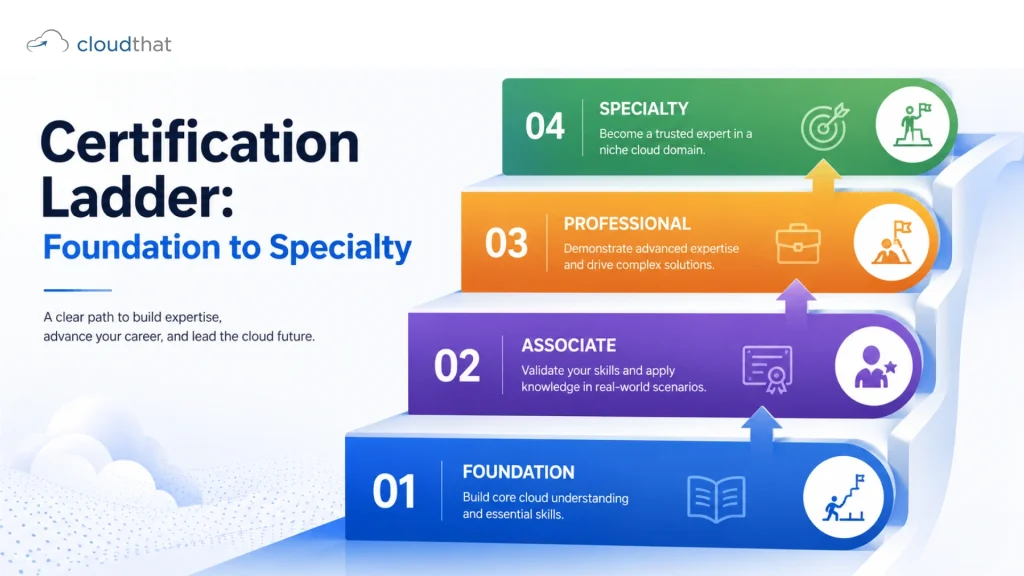
The Certification Ladder: From Cloud Practitioner to Enterprise Architect
Think of cloud certifications as a ladder, not a web. You don’t jump from the ground to the penthouse. Each rung builds on the one below.
Level 1: Foundational (Weeks 4-8 of study)
Start here if you’ve never touched cloud infrastructure. Certifications like AWS Cloud Practitioner or Azure Fundamentals teach the vocabulary and broad concepts. They answer questions like “What’s a VPC?” “How does auto-scaling work?” “Why would I use managed services over building everything myself?” These aren’t shallow. They establish mental models you’ll build on for years.
Who takes these: Career switchers, IT professionals moving from on-premises infrastructure, students entering the industry.
Level 2: Associate (Weeks 8-12 of study)
Now you’re hands-on. AWS Certified Developer Associate or Azure Administrator Certification forces you to actually use cloud services. You’re deploying applications, managing identities, configuring networks. You’re writing scripts, understanding CI/CD pipelines, troubleshooting real scenarios. This is where certifications stop being theoretical.
Who takes these: Junior engineers, infrastructure specialists moving toward cloud, professionals seeking their first cloud-native role.
Level 3: Professional (Weeks 12-24 of study)
This is where most people hit a wall. AWS Solutions Architect Professional demands you understand not just how to use services, but when to use them, when not to, and why your choices matter. You’re designing systems that cost money, handle millions of transactions, and keep businesses running 24/7. The questions aren’t “Can you deploy this?” They’re “Design a multi-region architecture that handles 100,000 concurrent users while minimizing costs and ensuring sub-100ms latency.”
Who takes these: Senior engineers, architects, team leads moving into design roles.
Level 4: Specialty (Variable study time, depends on specialization)
Now you’re diving deep into specific domains. Machine Learning specializations teach you Bedrock, SageMaker, and the neural networks behind GenAI systems. Security specializations teach you IAM frameworks, encryption strategies, and compliance architecture. DevOps specializations teach infrastructure-as-code, CI/CD pipelines, and production observability.
Who takes these: Specialists building moats in specific areas, engineers supporting enterprise systems at scale.
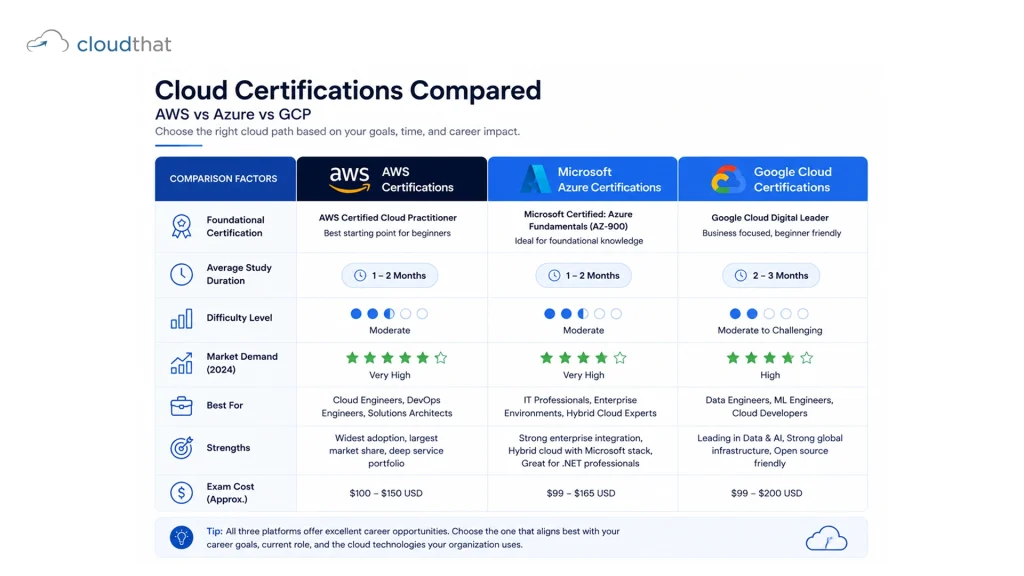
AWS Certification Path for Working Professionals
AWS owns the enterprise cloud market. That’s not hype. AWS has nearly 32 percent of the global cloud infrastructure market share. If you’re training for a cloud career, AWS certifications are the gravitational center.
The AWS Learning Continuum goes like this:
Step 1: AWS Cloud Practitioner
Eight weeks of study cover fundamental AWS services, the shared responsibility model, and how cloud infrastructure differs from on-premises systems. This isn’t a technical deep dive. It’s a competency check that you understand cloud economics, AWS’s global infrastructure, and why companies migrate to the cloud. Most people study 20 to 30 hours. The exam costs $100 (roughly ₹8,300).
Step 2: Choose Your Path
After Cloud Practitioner, you split. Developers pursue Developer Associate. Infrastructure folks pursue SysOps Administrator Associate. Architects who want breadth pursue Solutions Architect Associate. Pick based on your day-to-day work. If you write code, go Developer. If you manage infrastructure, go SysOps. If you’re designing systems, go Architect. Start with AWS Training & Certification to explore which path aligns with your role.
Step 3: The Professional Leap
Solutions Architect Professional is the next big milestone. It assumes you already know AWS deeply. Now you’re designing systems where your decisions cascade. You choose between RDS and DynamoDB based on access patterns and consistency requirements. You architect data lakes. You design disaster recovery strategies. You optimize for cost. The study load jumps dramatically. Most people invest 12 to 24 weeks.
Step 4: Specializations
AWS offers specialty certifications in Machine Learning, Advanced Networking, Security, Database Specialties, and others. These let you own a vertical. An engineer with AWS Certified Machine Learning Specialty signals they can take raw data and transform it into deployed models using SageMaker, Bedrock, and AWS’s AI/ML stack.
Why AWS first? Three reasons. First, AWS has the broadest market adoption. Companies training you expect AWS knowledge. Second, AWS certifications are technically rigorous. The exams are genuinely hard. Passing one means you know something. Third, AWS certification paths are well-established. You know what you’re getting into.
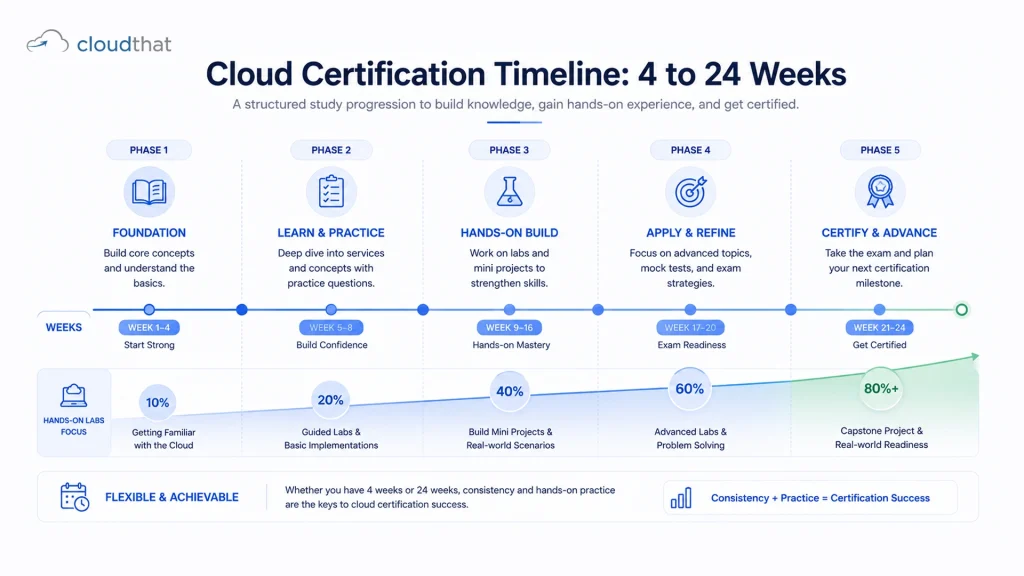
Azure Certification Path for Enterprise Environments
Azure owns enterprise. Microsoft’s installed base is enormous. Companies running on-premises Windows infrastructure have natural pathways to Azure. That’s real market gravity.
The Azure Certification Journey looks different than AWS, mainly because Azure skews toward enterprise environments.
Step 1: Azure Fundamentals (AZ-900)
Similar to AWS Cloud Practitioner, this covers basic Azure services and the value proposition. Four to six weeks of study. But here’s where Azure differs: many enterprises pay for their employees to take this as an onboarding step. If you work at a company that uses Azure, this certification often receives company support.
Step 2: Administrator or Developer
Azure Administrator Certification (AZ-104) is the practical follow-up. You’re configuring virtual machines, managing storage, setting up networking, and understanding identity and access management. This path suits infrastructure professionals. If you’re writing applications, Azure Developer Associate (AZ-204) teaches you how to build cloud-native apps using Azure services.
Step 3: Azure Solutions Architect
Azure Solutions Architect Expert (AZ-305) is the professional certification. You’re designing enterprise solutions. When would you use Azure Virtual Machines versus Azure Container Instances? How do you architect data solutions for a company managing petabytes of data? What identity and access strategies work for multinational enterprises? The depth rivals AWS Professional certs, but the context is more enterprise-focused.
Step 4: Specialized Paths
Azure Data Engineer, Azure Solutions Architect Specialty in Governance and Compliance, and others let you own specific domains. Data professionals often pursue the Azure Data Engineer role, especially if their companies use Azure Synapse for data warehousing or Databricks for advanced analytics.
Why choose Azure? If your employer uses Microsoft technologies (Dynamics, Office 365, Active Directory), Azure credentials compound that knowledge. Azure certs are also slightly more approachable for professionals who’ve worked in enterprise environments before. The mental models align better.
Google Cloud Certifications: The Flexible Alternative
Google Cloud has gained traction in startups, data-heavy companies, and organizations betting on AI infrastructure. Its certification path is leaner than AWS or Azure, which makes it both more accessible and slightly less visible in traditional enterprise environments.
Google Cloud Associate Cloud Engineer
The entry point for hands-on cloud work. You’re managing cloud resources, deploying applications, and configuring networking. Six to eight weeks of preparation. The exam is practical and fair. If you’re considering multi-cloud careers, Google Cloud certifications are valuable. Google Cloud’s strengths in data analytics (BigQuery), AI/ML (Vertex AI), and containerization (Kubernetes, which Google created) make it attractive for specific use cases.
Google Cloud Professional Data Engineer
If your work focuses on data pipelines, warehousing, and analytics, this specialization is potent. BigQuery is genuinely excellent for analytical queries. The certification teaches you how to architect data solutions on Google Cloud. Studies show data engineers with this cert command premium compensation in companies betting on data-driven decision-making.
Google Cloud Professional Cloud Architect
Similar positioning to AWS Solutions Architect or Azure Solutions Architect, but positioned for companies optimizing for different trade-offs. Google Cloud excels at managing costs, especially if you’re running containerized workloads or analytics at scale. The certification teaches those optimization strategies.
Why Google Cloud? If you’re in a startup ecosystem, data analytics, or AI/ML-focused work, Google Cloud credentials strengthen your portfolio. For traditional enterprises, AWS and Azure still dominate. For specific niches, Google Cloud certifications punch above their weight.
DevOps and Specialization Certifications That Bridge the Gap
Cloud certifications don’t stop with vendor-specific paths. DevOps specializations open a parallel career ladder.
AWS Certified DevOps Engineer Professional
DevOps engineers build the bridges between development and production. They design CI/CD pipelines. They automate infrastructure. They monitor systems at scale. This certification assumes you already know AWS deeply. The exam focuses on infrastructure-as-code, deployment strategies, monitoring, and operational excellence. Most people pursue this after Solutions Architect Associate or Developer Associate.
Kubernetes and Container Certifications
The Certified Kubernetes Administrator (CKA) and the Certified Kubernetes Application Developer (CKAD) are vendor-neutral but essential if you’re working with containerized systems. They’re technically rigorous and globally recognized. A year ago, containers were “nice to have.” Now they’re baseline in companies running microservices. These certifications prove you understand orchestration, networking, and stateful systems in containerized environments.
Machine Learning and GenAI Specializations
The AI & ML Certification Course teaches you SageMaker, model deployment, and real-world ML patterns. This is specialized but increasingly essential. Companies building GenAI applications need engineers who understand model fine-tuning, retrieval-augmented generation (RAG), and the responsible integration of LLMs. These certifications are still evolving, but they command significant premiums.
How Hands-On Labs Change Everything
This is the moment most people get training wrong.
You can buy a ₹5,000 course that teaches AWS concepts through slideshows and quizzes. You’ll probably pass the exam. You’ll also forget most of it within three months.
Here’s why: our brains are wired to learn through doing. Reading about VPCs teaches you vocabulary. Actually configuring a VPC, deliberately misconfiguring one, seeing it break, and fixing it embeds knowledge in muscle memory. It’s the difference between reading about swimming and jumping into water.
The best certification courses dedicate 50 to 60 percent of time to hands-on labs. You’re not just watching someone click buttons in the AWS console. You’re sitting in a lab environment, building systems, making mistakes, and learning from them. You’re configuring auto-scaling groups, watching them work, then changing the configuration to see how the behavior changes. You’re building Lambda functions that fail and debugging the failures.
Real labs teach troubleshooting. Slideshows teach syntax. Only troubleshooting sticks.
When evaluating certification courses, ask: “What percentage of this is hands-on labs?” If the answer is “Well, they walk you through labs,” that’s weak. If the answer is “You spend half your time in a lab environment building real things,” that’s strong.
The cost difference is real. Generic online courses cost ₹5,000 to ₹15,000. Comprehensive programs with deep hands-on labs cost ₹40,000 to ₹1,15,000. The difference isn’t the logo. It’s the depth of learning and job readiness you walk away with.
Why CloudThat Is the Best Choice for Beginner to Advanced Cloud Certification
Your college degree alone won’t cut it in cloud. Not because you’re unprepared. But because the cloud landscape moves faster than a quarterly earnings announcement. New services launch every week. Architecture patterns shift. Best practices evolve. Your traditional IT knowledge is valuable, but it’s not enough. Employers aren’t looking for people who understand cloud theory from a textbook. They’re hunting for people who’ve built things in cloud environments, solved actual problems, and carry credentials that prove it.
That’s where cloud computing certification courses come in. They’re not just badges to collect on LinkedIn. They’re compressed lessons from people who’ve sat in war rooms during migrations, designed systems that handle millions of transactions, and spent years learning the hard way so you don’t have to.
But here’s the catch: not every certification deserves your time or money. Some are too shallow. Others assume knowledge you don’t have yet. Some promise everything but deliver overpriced lectures with no real hands-on experience. You could waste months on the wrong path, or you could take a structured route that actually gets you hired.
This guide shows you exactly what cloud certification courses exist, which one matches where you are right now, and how to pick training that actually sticks.
CloudThat’s Proven Advantage
CloudThat isn’t just another cloud training company. It operates differently.
CloudThat is an AWS Premier Tier Training Partner. That matters. Most training companies are resellers. CloudThat has worked alongside AWS for years, building curricula that mirror how AWS itself teaches. That positioning means your training isn’t outdated six weeks after launch. It evolves as AWS evolves.
The math is simple: CloudThat has trained over 1.1 million professionals across 30 countries. That’s not a vanity metric. That volume creates feedback loops. When patterns emerge about where learners struggle, CloudThat updates training. When new services launch, they’re integrated quickly. You’re not studying on yesterday’s playbook.
But the real differentiator is depth. CloudThat offers 35+ AWS courses bundled in the AWS Mastery Pass, which combines breadth (cloud practitioner through professional architect certifications) with depth (DevOps, Machine Learning, Security, and specialty tracks). For ₹1,14,900 annually, you get unlimited access to instructor-led training, hands-on labs, and completion certificates. Most people either cherry-pick certifications (expensive and fragmented) or buy generic learning platforms (cheap but shallow). CloudThat splits the difference: comprehensive and guided.
The instructor model matters too. CloudThat’s trainers aren’t contract lecturers. They’re practicing cloud consultants. They run migrations for enterprise clients. They design production systems. They debug real problems. When your instructor describes database optimization strategies, they’re not reading from a script. They’re telling you what worked when they optimized a system handling 500,000 queries per second.
Consider the corporate angle. If your employer is thinking about upskilling teams, CloudThat’s Capability Development Framework transforms employees into billable cloud engineers in 30 to 60 days. The framework includes skill assessments, custom learning pathways, hands-on labs with real-world scenarios, and post-training support. Companies like Deloitte and Protiviti have used it to take fresh engineers from “cloud confused” to “project-ready” without the usual six-month ramp.
For organizations working on cutting-edge GenAI solutions, CloudThat’s GenAI Innovation Center combines training with hands-on consulting to accelerate AI capabilities alongside your team’s upskilling.
Explore the AWS Mastery Pass and Azure Mastery Pass to compare their cost per course. Investigate the corporate training options if your organization is considering team upskilling. And take advantage of job-ready programs, such as the Cloud and DevOps Expert Program, if you’re targeting specific roles.
Choosing Your First Certification Without Wasting 6 Months
The biggest mistake people make: picking a certification because it sounds impressive, not because it matches their current work.
If you’ve never worked with cloud and code daily, the AWS Developer Associate seems logical. But if your background is in infrastructure, the Solutions Architect Associate role is often better. If you manage systems, SysOps Administrator fits. Pick based on your actual job, not on certification prestige.
Second mistake: skipping foundational certifications. Jumping straight to Solutions Architect Professional is tempting. It’s also a path to burnout. Foundational certs (Cloud Practitioner, Administrator) teach vocabulary and core concepts. Professional certs assume you already know those deeply. Skip the foundation, and you’ll struggle with the professional exam, spending 24 weeks studying material that should have taken 4 weeks at the foundation level.
Third mistake: underestimating preparation time. If you work full-time and study evenings, budget 4 to 6 months for professional-level certifications, not 6 to 8 weeks. It’s better to over-prepare than to fail an exam and lose morale plus exam fees. Most exam costs range from $100 to $300. Retaking them costs real money.
Fourth mistake: thinking the exam is the end goal. It’s not. The goal is capability. After certification, your muscle memory should let you design systems, troubleshoot problems, and make architecture tradeoffs without consulting documentation. If you can’t do those things, the certification is theater.
Here’s your actual roadmap based on your role:
If you’re a developer: Cloud Practitioner, then Developer Associate, then Solutions Architect Associate if you want breadth.
If you’re infrastructure/operations: Cloud Practitioner, then Administrator, then SysOps Administrator Professional, then Solutions Architect Associate.
If you’re moving into architecture: Cloud Practitioner, then your role-specific Associate cert, then Solutions Architect Professional.
If you’re specializing: Foundation cert, role-specific Associate, then your specialization.
Don’t rush. Don’t skip levels. Progress in a way that lets material compound. Check the training calendar to find the next batch that matches your timeline.
Conclusion
Cloud computing certification courses aren’t about collecting badges. They’re about building competency in the fastest-growing infrastructure domain. The right path takes you from “I’ve heard of AWS” to “I design production systems that handle scale.” The wrong path wastes your time and money without building anything meaningful.
Your first step isn’t picking the fanciest certification. It’s matching your current role to a certification that deepens what you already do. Developer? Go Developer Associate. Infrastructure? Go Administrator. Architect-track? Go Solutions Architect. Progress steadily through hands-on labs and real-world practice.
Ready to start your cloud certification journey? Explore the AWS Mastery Pass, which bundles career-focused certifications with 35+ courses and hands-on labs, or browse the Cloud and DevOps Expert Program if you’re targeting specific cloud engineering roles.
Key Takeaways:
- Cloud certifications prove you’ve invested in structured learning and validated knowledge, not just that you’ve tinkered with cloud services.
- The certification ladder goes Foundation, Associate, Professional, Specialty. Don’t skip levels trying to save time; you’ll end up more confused.
- AWS dominates enterprise adoption and certification value, but Azure suits Microsoft shops and Google Cloud excels in data and AI niches.
- Hands-on labs determine real learning; courses without significant lab time fail you later, even if you pass exams.
- Study timelines range from 4 weeks for foundational certs to 24 weeks for professional certs; plan accordingly alongside your job.
- Beginner professionals should start with Cloud Practitioner or Administrator roles first to build vocabulary before jumping to Advanced paths.
- Your job determines your path: developers go Developer Associate, infrastructure folks go Administrator, architects go Solutions Architect.
- Certification costs scale from ₹25,000 for foundational to ₹1,15,000 for comprehensive programs including labs and ongoing access.
- Real value comes from capability after certification, not the badge itself; troubleshoot actual problems, not just pass exams.
- Post-certification, your job readiness depends on hands-on practice building systems, not memorizing facts for the exam.
Already in IT? Switch to Cloud & Earn 55% More
- Weekend Batches
- Dedicated Career Support
- Official AWS Labs
About CloudThat
FAQs
1. Can I pass AWS certifications with just online courses and practice exams?
ANS: – Yes, but with caveats. Self-study works if you’re disciplined, already have infrastructure experience, and invest 4 to 6 months. Most people learn better with structured courses that include instructor feedback and hands-on lab guidance. Online courses alone work. Structured courses with labs work better.
2. How much do cloud certification courses cost?
ANS: – Entry-level certifications cost ₹25,000 to ₹40,000 for comprehensive training. Professional-level certifications range from ₹60,000 to ₹1,15,000 for the full course including labs. Subscription models like the AWS Mastery Pass at ₹1,14,900 annually give you access to 35+ courses, which works out to roughly ₹3,300 per certification if you take 35 of them over a year.
3. How long does it take to prepare for a cloud certification?
ANS: – Foundational (Cloud Practitioner, Administrator): 4 to 8 weeks. Associate-level: 8 to 12 weeks. Professional-level: 12 to 24 weeks. This assumes 8 to 10 hours of study per week alongside your job.
4. Do employers really care about cloud certifications?
ANS: – Yes, but in context. Certifications open doors when combined with project experience. A certification, plus a demonstrated ability to design or troubleshoot cloud systems, signals real capability. A certification alone, without the demonstrated skills, is a badge.
5. Is hands-on lab experience really necessary?
ANS: – Absolutely. Hands-on labs teach troubleshooting and build muscle memory. Theory teaches concepts. Real lab work teaches judgment. Most job interviews will include troubleshooting scenarios. You only handle those confidently if you’ve practiced failing and fixing.
6. Should I get certified in multiple clouds (AWS, Azure, GCP) or go deep in one?
ANS: – Go deep in one for your first two certifications. Expertise in one cloud is more valuable than surface knowledge across three. After professional certification in your primary cloud, branching to others is easier because the underlying principles transfer.
7. What's the difference between instructor-led and self-paced training?
ANS: – Instructor-led lets you ask questions, get immediate feedback, and work through confusing concepts in real time. Self-paced lets you learn on your schedule. Most people learn best with blended approaches: some self-paced study plus instructor-led sessions for tough concepts.

WRITTEN BY Himisha Raval
Himisha Raval is a Digital Marketing Manager at CloudThat with a strong command of search engine optimization, web analytics, link building, and content strategy. She brings a data-driven approach to digital marketing, helping IT companies strengthen their online presence, improve search rankings, and generate consistent leads across channels. Beyond execution, she plays an active role in ideation, campaign strategy, and website performance optimization. Outside of work, she balances her analytical side with a love for travel, nature painting, and dancing.


 PREV
PREV











Comments