

 Login
Login

 July 29, 2026
|
Voiced by Amazon Polly |
Introduction
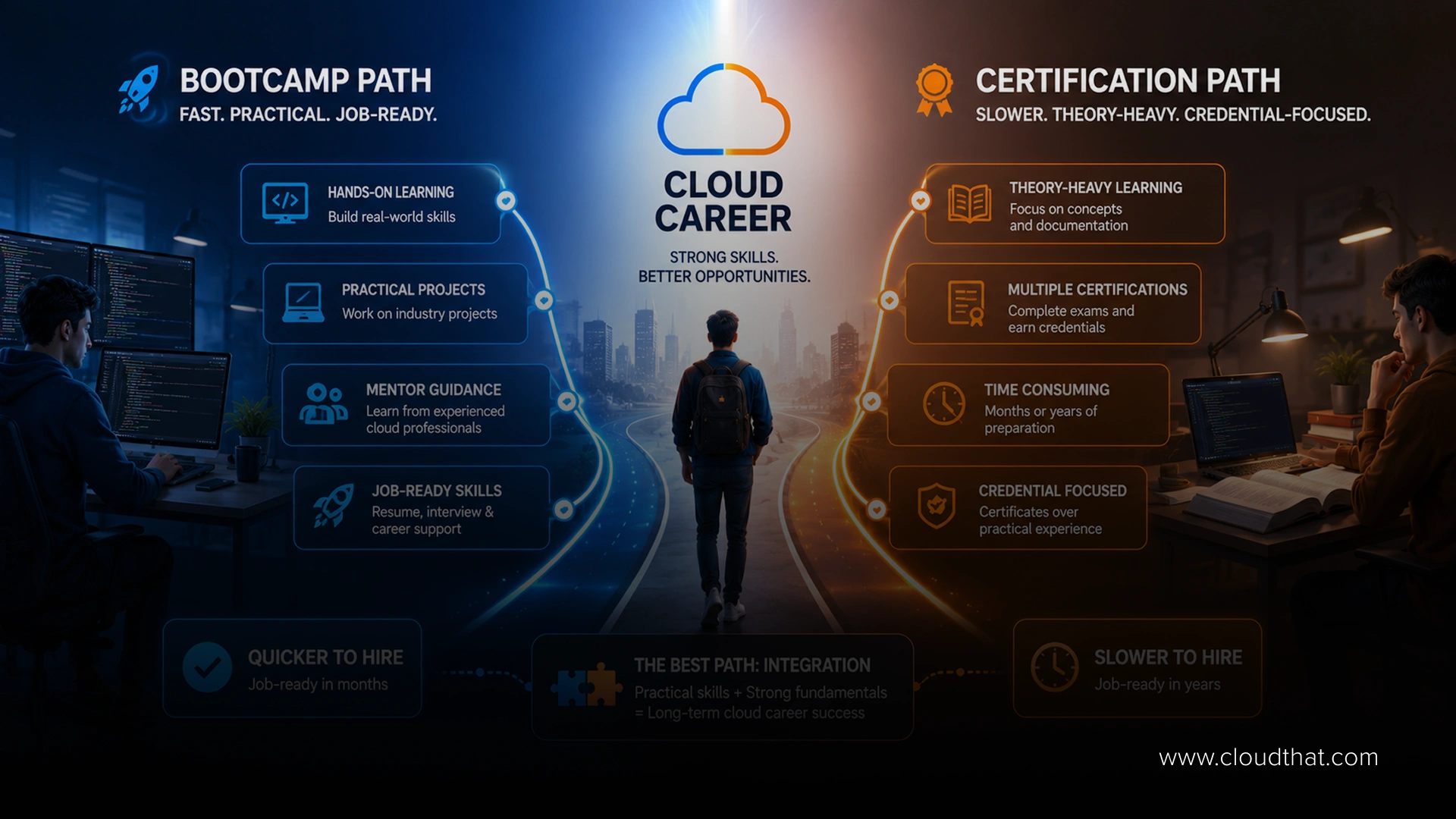
A cloud engineering bootcamp gives you hands-on project experience and a focus on job placement in 3-4 months. A certification program teaches more in-depth theoretical knowledge and validates industry expertise, but it takes longer and doesn’t guarantee employment. The real answer depends on your situation. If you’re starting from zero and need a job fast, bootcamp wins. If you have some experience and want to level up credibility, certification wins. If you want both depth and practical skills, you need a hybrid approach. This blog breaks down what employers actually care about and which path gets you hired faster.
You’re staring at two paths. One bootcamp promises to get you a cloud job in 12 weeks. One certification program promises employer credibility in 6 months of study. Both cost money. Both take time. Both promise careers.
Which one actually works?
Here’s what complicates the answer: They’re measuring success differently. A bootcamp measures success by “Did you get a job?” A certification program measures success by “Can you pass an exam?” These aren’t the same thing.
Employers measure success differently still. They care about: “Can this person solve real problems, write infrastructure code, and handle production issues?” A bootcamp graduate might have built more projects. A certified engineer might have deeper theoretical knowledge. Neither guarantees they can actually do the job.
Let’s cut through the marketing and talk about what actually matters for getting hired.
No Job After Graduation? Cloud Engineering is Your Answer
- Beginner Friendly
- 92% Placement Rate
- Live Instructor-Led
What’s a Cloud Engineering Bootcamp Actually?
A cloud engineering bootcamp is an intensive, project-focused program that runs 8-16 weeks full-time or 24-32 weeks part-time. The structure is: learn concepts quickly, build projects immediately, get job placement help at the end.
Bootcamps are designed around a single outcome: getting you hired. Everything is optimized for that. The curriculum covers the essentials (Linux, AWS, DevOps) without going deep. Labs are project-based. You’re building a CI/CD pipeline by week 4. You’re deploying applications by week 8. By week 12, you’re interviewing.
The promise is speed. Get skilled. Get hired. Move on.
The reality? Bootcamps vary wildly. Some are rigorous. Some are just teaching cloud console clicking. Some have job placement support. Some just say they do. The quality difference between a $8,000 bootcamp and a $16,000 bootcamp is often massive.
What Does a Certification Program Actually Teach?
A certification program like AWS Solutions Architect, AWS DevOps Engineer, or AWS Cloud Operations Engineer is exam-focused. You study for 3-6 months, pass an exam, and get a credential that says “I know this stuff.”
Certifications are comprehensive. The AWS Solutions Architect exam covers deep topics: VPC design, security patterns, cost optimization, disaster recovery, multi-region architecture. You’re not just clicking buttons. You’re understanding why you click buttons.
The promise is credibility. An AWS certification is recognized globally. Employers respect it. It’s proof you cleared a bar.
The reality? Passing an exam doesn’t guarantee you can build production systems. You might memorize all the right answers and still struggle when you’re debugging a live deployment at 2 AM. You might understand the theory but not know how to actually implement it.
The Speed Comparison: How Fast Can You Get Hired?
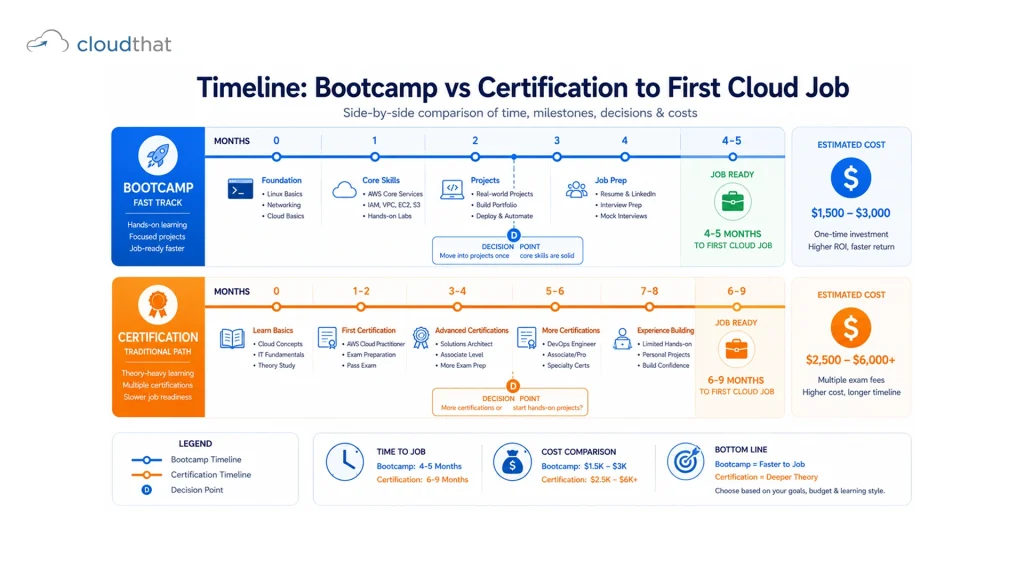
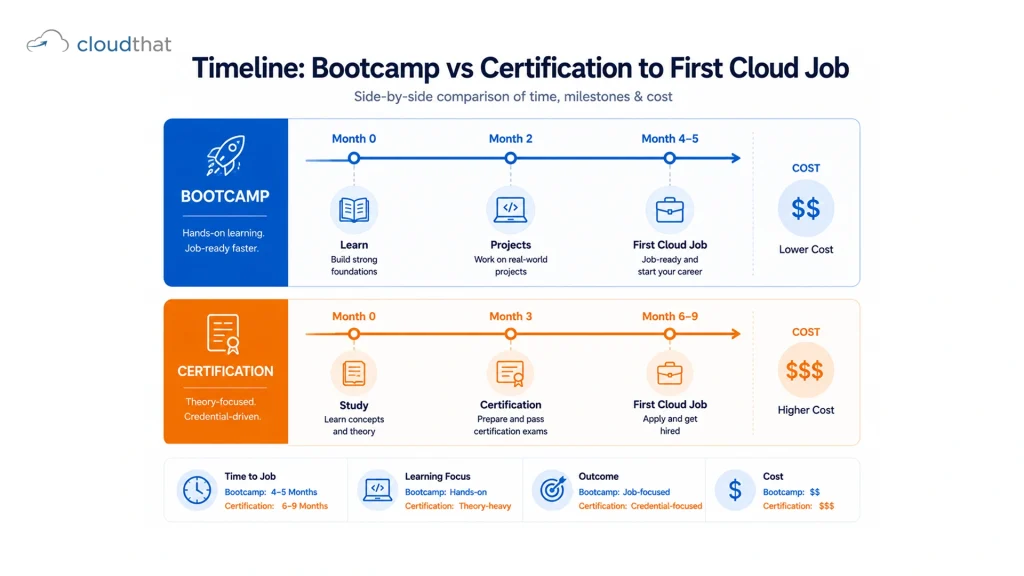
Bootcamp: 12-16 weeks to graduation, then 2-8 weeks of job search. Average time to first offer: 4-5 months from start.
Certification: 3-6 months of study, then job search. Average time to first offer: 6-9 months.
Bootcamp wins on speed. But here’s what matters: A bootcamp graduate gets hired for entry-level roles. A certified engineer might get hired for mid-level roles or move into roles that specifically require certification.
Speed matters only if the jobs exist. In the cloud engineering market, there are more entry-level jobs than mid-level jobs. So bootcamp wins on sheer job availability.
But compensation matters too. An entry-level cloud engineer from a bootcamp starts at 10-12 LPA in India. A mid-level engineer with a certification starts at 16-18 LPA. That’s a 50% difference.
The question becomes: Would you rather get hired in four months at lower pay, or take nine months and start at higher pay?
Job Readiness: What Employers Actually Care About
Here’s where it gets honest.
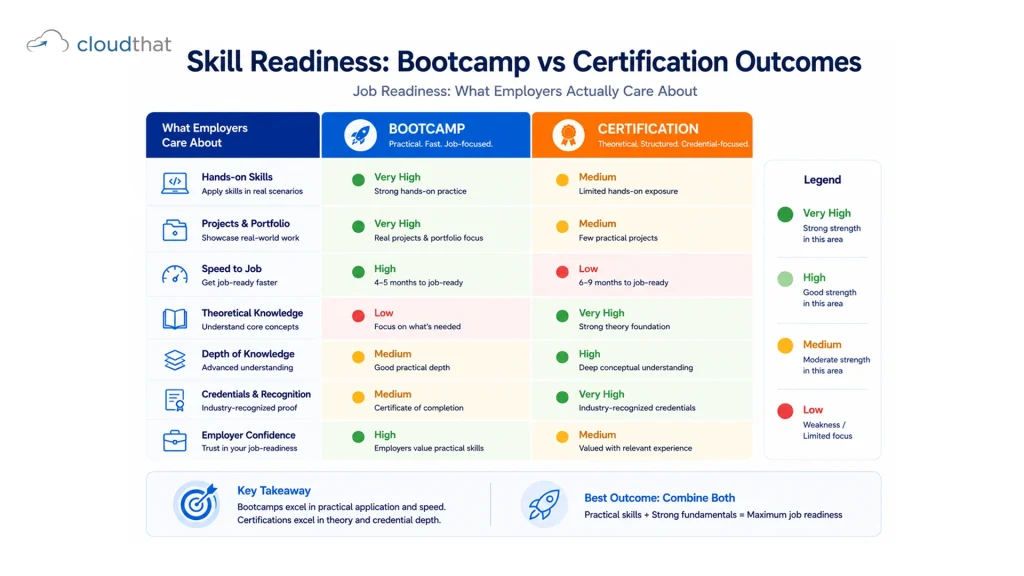
Employers don’t care if you completed a bootcamp or passed a certification. They care about: Can you write infrastructure code? Can you troubleshoot when systems fail? Can you understand security implications? Can you optimize costs? Can you work in their existing systems?
Bootcamp graduates usually win on the first one: infrastructure code. They’ve written more of it. They know how to deploy things.
Certified engineers usually win on the second and third: troubleshooting and security. They’ve studied failure scenarios and security patterns deeply.
Neither usually wins on the last two without on-the-job experience.
The real measure of job readiness is: Have you built something real with your own hands and handled what happens when it breaks? Bootcamps structure this in. Certifications don’t.
Cost and Time Investment: The Real Calculation
Bootcamp: $8,000-$16,000, 12-16 weeks full-time, or 24-32 weeks part-time. Opportunity cost if full-time: you’re not working, so you’re losing 4-5 months of salary.
Certification: $3,000-$5,000 in exam fees and study materials, 3-6 months of part-time study. You can work while studying. No opportunity cost.
The actual cost calculation: Bootcamp might cost $16K plus $40K in lost salary (if you were making $120K annually). That’s $56K. Certification costs $5K, and you keep working.
But the bootcamp grad gets a job paying 12 LPA. The cert-only candidate might not get hired for months longer because they lack hands-on projects.
The better question: How do you get both speed and depth without choosing?
The Hidden Truth About Both Paths
Here’s what neither bootcamp nor certification marketing tells you.
Most bootcamps oversell job placement. They might claim 90% job placement rates. What they don’t say: “Within six months,” “Including referral jobs through alumni networks,” or “Only for students who completed the full program.” Actual hiring is messier.
Most certification programs undersell the effort required. They show glossy exam pass rates. What they don’t show: How many people studied for six months and still failed the exam. Or how many passed the exam but couldn’t actually solve real problems.
The truth is, bootcamps and certifications are not opposites. They’re complementary. Bootcamp gives you hands-on skills and projects. Certification validates knowledge and creates credibility. Ideally, you’d do both.
But realistically, most people have time and money for one. So the question becomes which one has better ROI for you specifically.
Entry-level, no experience, need a job fast: Bootcamp. Some experience, want to level up credibility: Certification. Want to actually get skilled and hired: Something that combines both.
Why CloudThat’s Approach Outperforms Bootcamp-Only or Cert-Only Training
Here’s where the market reality separates from bootcamp and certification marketing.
CloudThat isn’t a bootcamp. But it’s not a traditional certification program either. It combines the structure and rigor of certification programs with the hands-on project focus of bootcamps. That’s a different value proposition entirely.
The Capability Development Framework takes you from zero to job-ready in 12-16 weeks, similar to a bootcamp timeline. But instead of just projects, you’re learning the depth of AWS certifications. You’re not rushing through theory. You’re understanding it deeply. Pre-training skill assessments ensure you’re not wasting time on the basics. Post-training support extends beyond the program, as the job doesn’t end when the course does.
The Job Ready Cloud Operations Engineer Program specifically bridges this gap. It’s structured around job readiness, which means you’re learning what employers actually ask for in interviews and on day one. You’re building real projects, yes, but you’re also understanding the certification-level knowledge that separates hireable engineers from technically okay engineers.
For serious learners who want both speed and depth, CloudThat’s approach wins. You get bootcamp-style hands-on learning and certification-style comprehensive knowledge. You get job placement support, which bootcamps promise. You get recognized credentials, which certifications promise. You get both outcomes in the same program.
The AWS Mastery Pass covers all the certifications you need (Solutions Architect, DevOps, Cloud Operations) plus hands-on labs in live AWS environments. This isn’t exam prep. This is learning to actually build.
Conclusion
You don’t have to choose between bootcamp and certification. That’s a false choice created by programs that do one thing.
The better question is: What combination of hands-on learning, comprehensive knowledge, and credential recognition will get me hired fastest and set me up for long-term career growth?
That answer requires a program that teaches like a bootcamp, covers depth like a certification, and bridges the gap between both. The Job Ready Cloud Operations Engineer Program and AWS Mastery Pass from CloudThat do exactly that. You get hands-on labs in live AWS environments, comprehensive certification preparation, and job readiness support.
The market doesn’t care whether you learned from a bootcamp or a certification program. The market cares whether you can solve problems on day one. Choose training that develops both skills and credentials.
Key Takeaways
- Cloud engineering bootcamps help you get hired in 4-5 months, with hands-on project experience and job placement support.
- Certification programs take 6-9 months, teach deeper knowledge, create global credibility, but don’t guarantee employment.
- Bootcamp graduates usually have stronger hands-on skills. Certified engineers usually have stronger theoretical knowledge.
- Speed to job matters, but job quality and starting salary do as well. Bootcamp wins on speed; certification wins on starting compensation.
- The real cost of bootcamp includes the opportunity cost of lost salary if you study full-time. Certification lets you work and earn while studying.
- Job readiness isn’t just about what you learned. It’s about solving real problems, handling failures, and understanding business implications.
- Neither bootcamp nor certification alone is complete. The best outcome combines hands-on learning with comprehensive knowledge validation.
- Bootcamp job placement rates are often overstated. Not everyone graduates and gets hired. Actual placement rates are 60-75%, not 90%+.
- Certification exam pass rates don’t reflect job readiness. You can pass the exam and still struggle on the job.
- The ideal path combines bootcamp-style project learning with certification-style comprehensive knowledge in an integrated program.
- Choose bootcamp if you need speed and have no experience. Choose certification if you have experience and want credibility. Choose an integrated program if you want both.
Already in IT? Switch to Cloud & Earn 55% More
- Weekend Batches
- Dedicated Career Support
- Official AWS Labs
About CloudThat
FAQs
1. Can I do a bootcamp and then get certified after I land a job?
ANS: – Absolutely. Many bootcamp graduates do this. They get hired, work for 6-12 months, then pursue certification to level up. It’s a valid path.
2. Is a bootcamp worth it if I'm part-time and working a full-time job?
ANS: – Part-time bootcamps are brutal. You’re working 40 hours, then bootcamp another 20-25 hours. That’s 65 hours a week for 6 months. Most people burn out. A certification program is more sustainable part-time.
3. Do employers care about which bootcamp?
ANS: – Yes. Some bootcamps are known by tech companies. Some are completely unknown. It matters less than the projects you’ve built, but employer recognition of your program helps.
4. Will a certification guarantee me a job?
ANS: – No. A certification validates knowledge but doesn’t guarantee employment. You still need to interview well, show real projects, and demonstrate problem-solving ability.
5. Should I do bootcamp or certification if I already have some tech background?
ANS: – Certification usually makes more sense. You have fundamentals. You need credibility and deeper knowledge. A bootcamp would feel repetitive.
6. How much more do certified engineers make than bootcamp graduates?
ANS: – Early career, the difference is smaller (maybe 2-3 LPA). After three years, certified engineers who kept learning typically make 30-40% more because they have both credentials and experience.
7. Is bootcamp or certification more respected by FAANG companies?
ANS: – FAANG cares more about what you can build and solve than how you learned it. But certified engineers have a slight edge for interviews because they’ve studied the interview frameworks companies use.
8. Can I do both bootcamp and certification simultaneously?
ANS: – Theoretically, yes. Practically, it’s overload. Most people do bootcamp first (get job), then certification (level up).

WRITTEN BY Himisha Raval
Himisha Raval is a Digital Marketing Manager at CloudThat with a strong command of search engine optimization, web analytics, link building, and content strategy. She brings a data-driven approach to digital marketing, helping IT companies strengthen their online presence, improve search rankings, and generate consistent leads across channels. Beyond execution, she plays an active role in ideation, campaign strategy, and website performance optimization. Outside of work, she balances her analytical side with a love for travel, nature painting, and dancing.


 PREV
PREV











Comments