

 Login
Login


 June 23, 2026
|
Voiced by Amazon Polly |
Introduction
Authentication is one of the most important aspects of modern web applications. Every day, users trust applications with sensitive information, financial transactions, and personal data. While building a login page may seem straightforward, creating a secure authentication system that can withstand real-world threats requires careful planning and architecture.
Many tutorials focus only on login and signup functionality, but production-grade authentication involves much more. It includes secure password storage, token management, authorization, session handling, monitoring, and protection against common security vulnerabilities.
In this article, we’ll explore how React, Node.js, JWT, and PostgreSQL can be used to build secure authentication systems and discuss key lessons learned from production environments.
Pioneers in Cloud Consulting & Migration Services
- Reduced infrastructural costs
- Accelerated application deployment
Authentication Is More Than Login and Signup
Authentication is often misunderstood as simply validating usernames and passwords. In reality, it is an entire security lifecycle that includes:
- User Registration
- Email Verification
- Password Management
- Session Creation
- Authorization
- Token Renewal
- Logout
- Security Monitoring
A secure authentication system must answer two questions:
Who is the user?
and
What is the user allowed to access?
Without proper controls, applications become vulnerable to unauthorized access and privilege escalation attacks.
A Modern Authentication Architecture
A scalable authentication system separates responsibilities across different layers.
React Frontend
The frontend handles:
- Login and Registration Forms
- Protected Routes
- Session Awareness
- User Experience
The frontend should never be responsible for security decisions.
Node.js Backend
The backend manages:
- Credential Verification
- Token Generation
- Authorization Checks
- Session Validation
All sensitive authentication logic should remain on the server.
PostgreSQL Database
The database stores:
- User Accounts
- Password Hashes
- Refresh Tokens
- Security Logs
This separation improves both security and scalability.
Understanding JWT Authentication
JSON Web Tokens (JWT) have become a popular choice for modern applications because they support stateless authentication.
A typical authentication flow looks like:
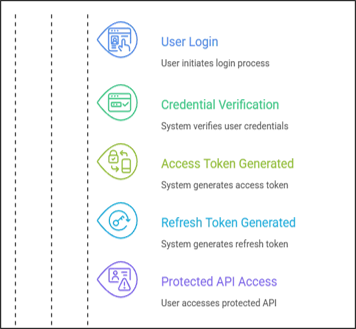
JWT reduces server-side session storage and works well in distributed systems. However, JWT itself is not a security solution. Proper implementation is what determines security.
Access Tokens vs Refresh Tokens
A common mistake is relying on a single JWT token.
Production systems typically use:
Access Token
- Short lifespan
- Used for API requests
- Expires quickly for security
Refresh Token
- Longer lifespan
- Generates new access tokens
- Maintains user sessions
This approach improves user experience while reducing security risks if an access token is compromised.
Why Token Storage Matters?
Many developers store JWT tokens in Local Storage because it is easy to implement.
The problem is that Local Storage is vulnerable to Cross-Site Scripting (XSS) attacks. If malicious JavaScript executes inside the browser, attackers can access stored tokens.
A more secure approach is using:
- HTTP-Only Cookies
- Secure Cookies
- SameSite Policies
Since JavaScript cannot directly access HTTP-Only cookies, token theft becomes significantly more difficult.
Password Security Best Practices
Passwords should never be stored in plain text.
Instead, they should always be:
- Salted
- Hashed
- Securely Verified
Algorithms such as bcrypt are widely used because they make brute-force attacks more difficult.
Even if a database is compromised, properly hashed passwords provide an additional layer of protection.
A good rule is simple:
If passwords are readable in the database, the authentication system is already insecure.
Authentication Security Priorities
A secure authentication system relies on multiple layers of protection.
Key Security Components
Security should never depend on a single mechanism. Strong systems combine multiple layers of defense.
Role-Based Access Control (RBAC)
Authentication verifies identity, but authorization determines permissions.
Most applications have multiple user types:
- Administrator
- Manager
- Employee
- Customer
Role-Based Access Control (RBAC) ensures that users can access only the resources relevant to their role.
Benefits include:
- Better security
- Easier permission management
- Simplified auditing
As applications grow, RBAC becomes essential.
Protecting Against Common Attacks
Production applications must be designed with security in mind.
Brute Force Attacks
Mitigation:
- Rate Limiting
- Account Lockouts
- CAPTCHA
SQL Injection
Protection:
- Parameterized Queries
- ORM Frameworks
- Input Validation
Cross-Site Scripting (XSS)
Protection:
- Input Sanitization
- Output Encoding
- Content Security Policies
Cross-Site Request Forgery (CSRF)
Protection:
- SameSite Cookies
- CSRF Tokens
Layered security significantly reduces risk.
Monitoring and Audit Logging
One of the most overlooked aspects of authentication is monitoring.
Important events to track include:
- Successful Logins
- Failed Logins
- Password Resets
- Token Refreshes
- Account Lockouts
Monitoring helps identify suspicious behavior and potential attacks before they become major incidents.
Authentication without visibility creates security blind spots.
Key Lessons from Production Applications
After implementing authentication systems across multiple projects, several lessons consistently stand out:
- Security Should Be Planned Early
Fixing poor security decisions later is often expensive and risky.
- User Experience Matters
Strong security should not create unnecessary friction for legitimate users.
- Simplicity Is Powerful
Complex custom authentication systems often introduce avoidable vulnerabilities.
- Monitoring Is Essential
You cannot secure what you cannot observe.
- Authentication Is Never Finished
Security threats evolve constantly, requiring continuous improvements.
Conclusion
Authentication is far more than a login page. It is the foundation of application security and user trust.
React, Node.js, JWT, and PostgreSQL provide a strong technology stack for building secure authentication systems, but technology alone is not enough. Success depends on proper architecture, secure token management, password protection, authorization controls, and continuous monitoring.
As applications continue to evolve, authentication will remain one of the most important responsibilities of modern software engineers.
Drop a query if you have any questions regarding React, and we will get back to you quickly.
Empowering organizations to become ‘data driven’ enterprises with our Cloud experts.
- Reduced infrastructure costs
- Timely data-driven decisions
About CloudThat
FAQs
1. Why use JWT instead of traditional sessions?
ANS: – JWT supports stateless authentication, making applications easier to scale across multiple servers.
2. Is Local Storage safe for JWT tokens?
ANS: – For production applications, HTTP-Only Secure Cookies are generally considered safer than Local Storage.
3. What is the difference between Access Tokens and Refresh Tokens?
ANS: – Access Tokens authenticate requests, while Refresh Tokens generate new Access Tokens without requiring users to log in again.


WRITTEN BY Shreya Shah
Shreya Shah is a Frontend Developer II at CloudThat, specializing in building scalable, user-focused web applications. She has a strong emphasis on creating clean, responsive interfaces with seamless integration to cloud-based solutions. Passionate about delivering smooth user experiences, Shreya continuously explores innovative ways to enhance efficiency, quality, and overall product performance.


 PREV
PREV







Comments