

 Login
Login


 June 22, 2026
|
Voiced by Amazon Polly |
Introduction
Artificial Intelligence (AI) is quickly evolving from simple chat-based agents to autonomous agents that can plan, reason, perform tasks, and work with tools. Anthropic’s Claude Opus 4.8 is a huge step forward on this journey, with improved reasoning, long-context understanding, coding, and agentic behavior.
When combined with the Strands Agent framework, Claude Opus 4.8 is a powerful platform for creating intelligent systems that can autonomously execute complex workflows, interact with external tools, retrieve information, make decisions, and deliver results with minimal human intervention.
Pioneers in Cloud Consulting & Migration Services
- Reduced infrastructural costs
- Accelerated application deployment
Objective
In this blog, we discuss the interaction between the Claude Opus 4.8 and the Strands Agent framework for intelligent, agent-driven workflows. It provides a high-level overview of the architecture, execution flow, practical applications, and future possibilities for building autonomous AI systems with Anthropic’s latest model.
Why Claude 4.8?
Claude Opus 4.8 is designed to do complex reasoning, long-context understanding, and tool use better than traditional chat AI systems. This ability to analyze information, plan tasks, and produce accurate responses makes it well suited for agentic applications where AI must perform actions, not just answer questions.
Another great benefit is its integration with external tools and APIs. This enables developers to build systems that can ask questions, handle data, and automate workflows while remaining contextually aware.
Understanding Strands Agent
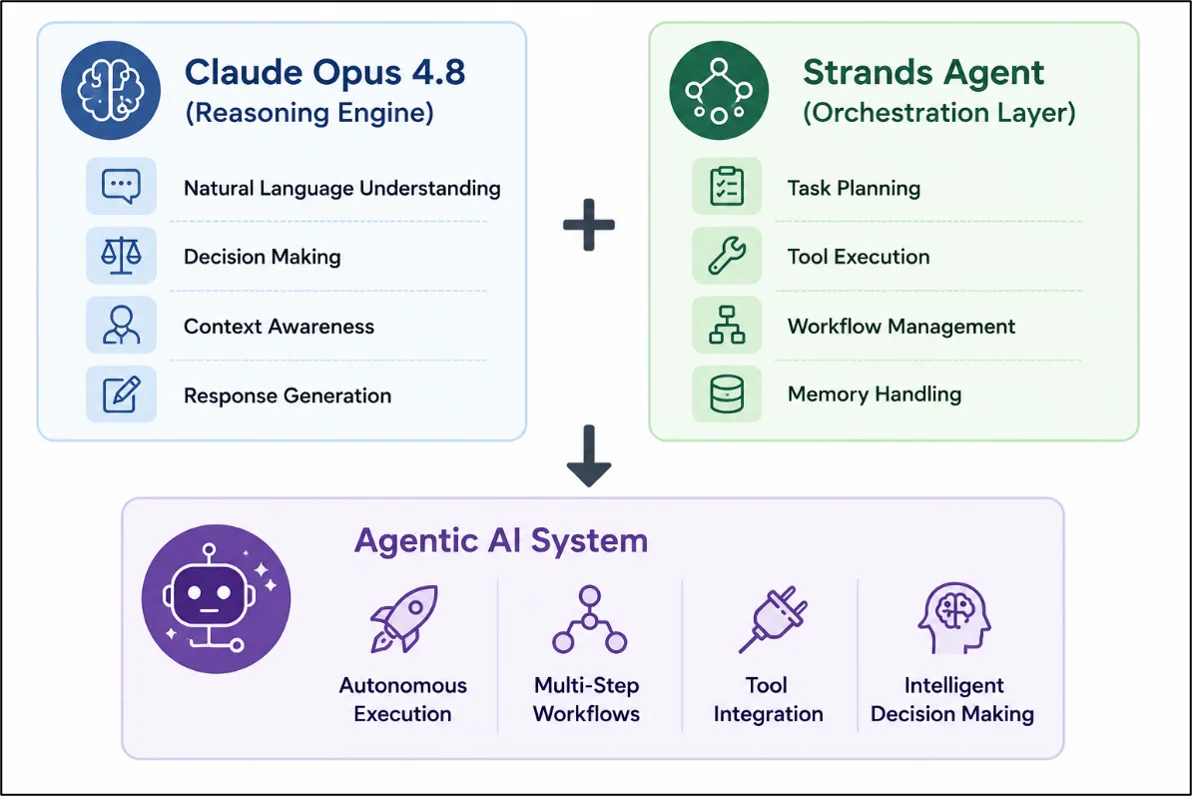
The Strands Agent is the orchestration layer that maps user requests to the underlying AI model and external tools. Instead of just feeding prompts into the language model, Strands Agent handles planning, tool selection, execution, and response generation.
Strands Agent orchestrates these activities so the AI system can perform multi-step tasks, make informed decisions, and handle more complex workflows that would otherwise require significant human intervention.
Why Combine Claude Opus 4.8 with Strand Agent?
Claude Opus 4.8 is very capable of reasoning, problem-solving, and generating human-like responses, but it is not designed to manage complex workflows or coordinate multiple tasks independently. This is where Strands Agent comes into play. Strands Agent is an orchestration layer that enables the model to plan actions, interact with external tools, manage task execution, and maintain workflow continuity.
Organizations can leverage Strands Agent in conjunction with Claude Opus 4.8 to augment the capabilities of traditional conversational AI and to construct intelligent systems capable of executing real-world tasks. Claude Opus 4.8 is the decision making and reasoning engine, and Strands Agent is the translator of those decisions into action steps.
This combination is especially useful for applications that require multi-step reasoning, tool integration, and autonomous execution, providing a strong foundation for next-generation AI-powered solutions.
Real-World Example
Take a market research use case in which a business analyst requires a report on emerging trends in the electric vehicle industry. Rather than manually gathering information from multiple sources, the analyst sends a request to the AI agent.
Following that, the Strands Agent analyzes the request and generates an execution plan. Claude Opus 4.8 takes the objective and identifies the information required to complete the task. The agent then uses external tools to scrape data from websites, reports, and knowledge bases. It takes the data input, and then Claude Opus 4.8 analyzes the results, identifies major trends, and creates a structured summary.
Finally, the agent summarizes the results in a detailed report and presents it to the user. Together, Strands Agent and Claude Opus 4.8 can do in minutes what would normally take hours of manual research.
This example shows how agentic AI systems can optimize workflows, increase productivity, and allow users to focus on decision-making instead of mundane operational tasks.
Workflow Execution
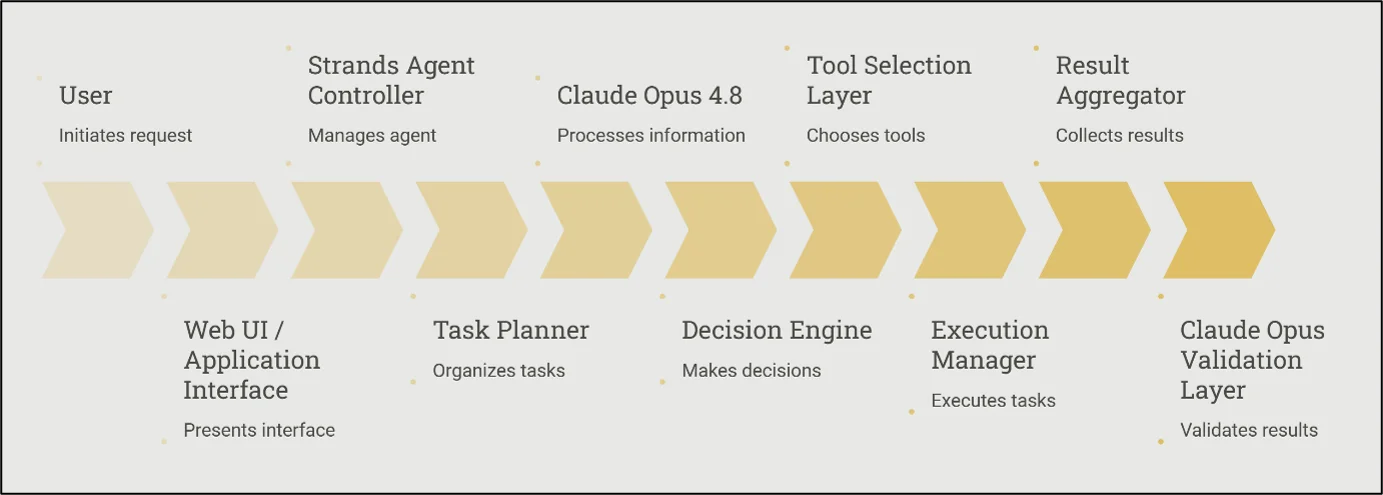
The workflow starts with a user request through an application or interface. The request goes to the Strands Agent, which assesses the goal and determines what needs to be done to achieve it.
The agent framework then invokes the required tools, APIs, or knowledge sources, and the agent performs reasoning and planning using the Claude Opus 4.8. Once all the necessary information has been collected, the results are verified and combined into a final response, which is then sent back to the user.
With this structured execution flow, the system can handle tasks involving multiple actions, data sources, and decisions.
Key Use Cases
- Research Assistance
Conducts web research and summarizes findings in reports.
- Customer Service Rep
Automates ticket management and handles customer queries.
- Coding Assistant
Produces, reviews, and deploys code.
- Business Intelligence Agent
Analyzes enterprise data and creates insights.
- Automation of DevOps
Manage infrastructure and perform operational processes.
- Knowledge Management
Uses and accesses knowledge in the organization.
Future Expansion
Multi-agent Collaboration
Future implementations could involve multiple specialized agents working together. Each agent could be responsible for a specific task, such as research, coding, testing, or reporting.
Long-Term Memory
Introducing persistent memory features would enable agents to recall prior conversations and provide more personalized, context-aware assistance.
Enterprise Integration
Further integration with business platforms, such as CRM, ticketing tools, and collaboration apps, can make agentic AI solutions more useful.
Independent Decision-Making
As agent frameworks develop, systems might be able to handle more complex workflows with minimal human intervention, while still within defined governance boundaries.
Conclusion:
Drop a query if you have any questions regarding Claude Opus, and we will get back to you quickly.
Empowering organizations to become ‘data driven’ enterprises with our Cloud experts.
- Reduced infrastructure costs
- Timely data-driven decisions
About CloudThat
FAQs
1. Why combine Claude Opus 4.8 with Strands Agent?
ANS: – Claude provides intelligence and reasoning, while Strands Agent provides orchestration, execution, and workflow management.
2. Can the agent use external APIs?
ANS: – Yes. The architecture supports integration with APIs, databases, search engines, cloud services, and enterprise applications.
3. Is the system suitable for enterprise applications?
ANS: – Absolutely. The modular architecture supports scalability, governance, security, and integration with enterprise systems.


WRITTEN BY Balaji M
Balaji works as a Research Associate in Data and AIoT at CloudThat, specializing in cloud computing and artificial intelligence–driven solutions. He is committed to utilizing advanced technologies to address complex challenges and drive innovation in the field.


 PREV
PREV












Comments