

 Login
Login


 June 19, 2026
|
Voiced by Amazon Polly |
In 2026, AI tools have evolved beyond simple assistants into integrated systems that actively participate in development workflows. Anthropic’s ecosystem is a clear example of this shift, combining reasoning, coding, and execution into a unified stack.
This combination – Claude AI, Claude Code, and Claude Cowork-forms what can be called a productivity trifecta, enabling teams to move from idea to execution with significantly less manual effort.
Rather than treating AI as a helper, this model embeds intelligence throughout the entire work lifecycle.
Start Learning In-Demand Tech Skills with Expert-Led Training
- Industry-Authorized Curriculum
- Expert-led Training
Understanding the Claude Ecosystem (2026)
Anthropic’s current ecosystem is structured into three layers:
- Claude AI → reasoning, planning, and long-context understanding
- Claude Code → agentic development and multi-file execution
- Claude Cowork → autonomous task execution and workflow automation
This layered design allows teams to move seamlessly from thinking to building to executing.
Claude AI: Persistent Context and Deep Reasoning
Modern Claude AI is designed as a long-context reasoning system capable of handling complex workflows.
Key capabilities include:
- Up to 1M token context window for large-scale analysis
- Persistent memory for retaining user and project preferences
- Strong performance in architecture design, documentation, and planning
This makes Claude ideal for:
- System design and architecture decisions
- Breaking down complex engineering tasks
- Reviewing workflows and logic
Instead of starting from scratch each time, Claude builds continuity across sessions.
Claude Code: Agentic Development in Practice
Claude Code has evolved from a coding assistant into an execution environment capable of handling real development workflows.
Recent capabilities include:
- Multi-file code changes with full repository awareness
- Ultraplan, enabling planning → review → execution workflows
- Auto mode for handling complex tasks with minimal interruption
- Integration with CLI tools, Git, and development environments
This allows developers to:
- Refactor large codebases
- Implement features across services
- Debug and fix issues efficiently
The key difference is that Claude Code operates within your environment rather than as a separate tool.
Claude Cowork: Autonomous Workflow Execution
The most significant shift in 2026 is Claude Cowork, which introduces autonomous task execution.
Cowork enables:
- Scheduled and recurring workflows
- Multi-step task automation
- Project-based organization for long-running work
- Desktop-level interaction through computer use
For example, Cowork can:
- Generate reports automatically
- Organize files based on rules
- Aggregate data from multiple tools
- Execute workflows without continuous supervision
This transforms AI from a reactive assistant into an active collaborator.
How the Productivity Trifecta Works Together
The real value emerges when these three components are used together.
- Claude AI → Planning
Used for:
- Requirement breakdown
- Architecture design
- Workflow definition
- Claude Code → Implementation
Used for:
- Code generation
- Refactoring
- Debugging and execution
- Claude Cowork → Execution
Used for:
- Automation
- Scheduling
- End-to-end workflow completion
This creates a continuous pipeline:
Think → Build → Execute
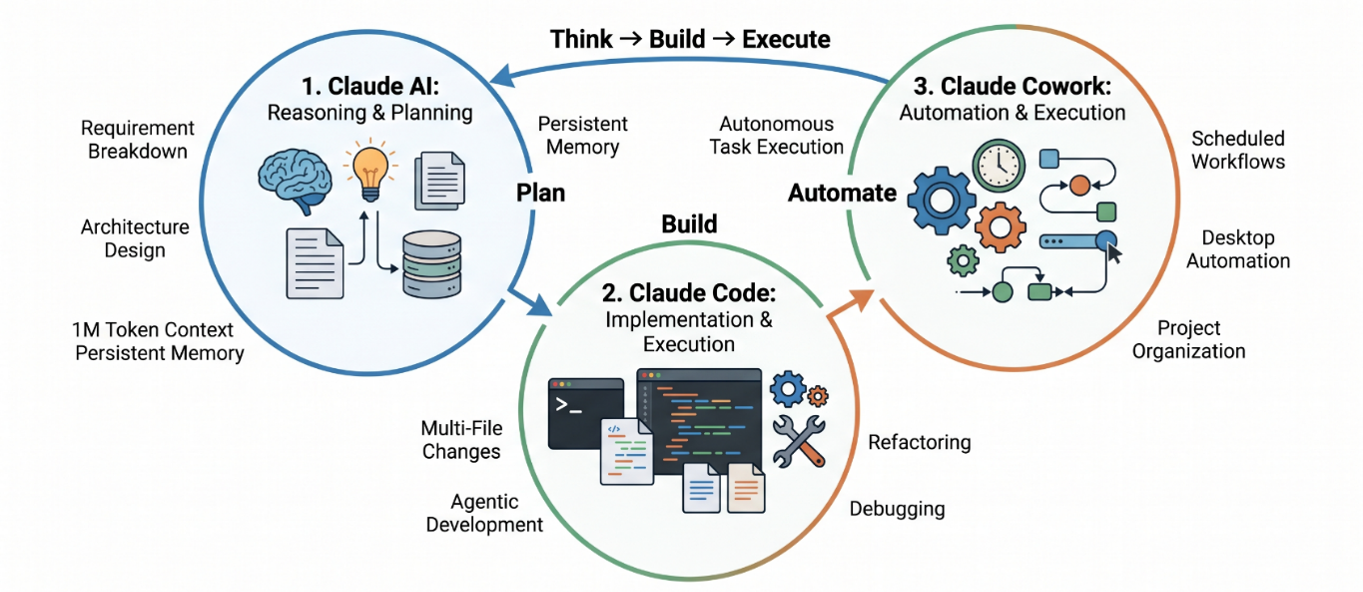
Fig 1: Integrated workflow showing how Claude AI (planning), Claude Code (implementation), and Claude Cowork (execution) operate together.
Where This Model Delivers Maximum Value
The trifecta approach is particularly effective in:
Enterprise DevOps Environments
- Continuous workflows benefit from automation and reduced manual intervention.
Large Codebases
- Long context and multi-file execution improve consistency and reduce errors.
Automation-Heavy Workflows
- Scheduled tasks and autonomous execution reduce repetitive work.
Cross-Team Collaboration
- Shared workflows and consistent outputs improve productivity across teams.
Key Considerations for Adoption
Despite its advantages, organizations must approach this model carefully:
- Define governance for autonomous execution
- Validate AI-generated outputs before deployment
- Restrict access to sensitive systems
- Standardize usage patterns across teams
AI-driven workflows require the same discipline as traditional DevOps practices.
Structured Adoption for Teams
To adopt this model effectively:
- Start with small, well-defined use cases
- Introduce Claude Code for controlled development workflows
- Expand into Cowork for automation and scheduling
- Define approval mechanisms for autonomous tasks
For organizations adopting AI at scale, structured learning paths such as the AI and Machine Learning Certification Course help teams build the skills needed for effective, governed AI integration.
The Next AI Era
The combination of Claude AI, Claude Code, and Claude Cowork represents a shift from AI-assisted development to AI-integrated workflows.
- Claude AI provides reasoning and context
- Claude Code enables structured implementation
- Claude Cowork executes workflows autonomously
Together, they create a system where work flows continuously from idea to execution.
As AI systems become more agentic, the teams that adopt structured, governed workflows around them will gain a significant advantage in speed, consistency, and scalability.
Upskill Your Teams with Enterprise-Ready Tech Training Programs
- Team-wide Customizable Programs
- Measurable Business Outcomes
About CloudThat


WRITTEN BY Rohit Tiwari
Rohit Tiwari is a Senior Subject Matter Expert (SME) at CloudThat, specializing in Multi-Cloud Infrastructure, Solutions Architecture, DevOps and Generative AI. A Microsoft Certified Trainer (MCT) and Google Cloud Authorized Trainer (GCI), Rohit is recognized among the Top 100 MCT Quality Award winners (January 2025) for excellence in All Courses and Microsoft Data & AI Courses. With 19+ years of global experience in training, software development, and quality assurance, he has trained over 20,000 professionals globally across Azure, AWS, GCP, and modern cloud-native architectures. He holds 65+ industry certifications, in Azure, AWS, GCP, Oracle Cloud (OCP), and in Databricks, demonstrating his unmatched expertise in cloud infrastructure design, security, and cost optimization. Known for simplifying complex multi-cloud and AI concepts with hands-on, real-world insights, Rohit brings deep technical expertise and practical application into every learning experience. His passion for mentoring and building transformative cloud learning journeys reflects in his dedication to enabling professionals and enterprises to innovate with confidence.


 PREV
PREV




Comments