

 Login
Login


 June 18, 2026
|
Voiced by Amazon Polly |
The Intelligence Behind the Intelligence
Generative AI and Agentic AI are reshaping how organizations automate business processes, interact with customers, and improve productivity. AI agents can reason, retrieve information, invoke tools, and execute actions with minimal human intervention. As these technologies gain momentum, many organizations are asking whether traditional Machine Learning (ML) is still relevant.
The answer is yes. While Large Language Models (LLMs) excel at understanding language and generating content, they are not designed to accurately predict future outcomes. Enterprise decisions often depend on forecasting demand, detecting fraud, predicting customer behavior, and identifying anomalies, capabilities that continue to rely on Machine Learning models.
In modern AWS environments, Machine Learning acts as the hidden intelligence layer behind AI agents, providing the predictions and insights that drive better business decisions.
Start Learning In-Demand Tech Skills with Expert-Led Training
- Industry-Authorized Curriculum
- Expert-led Training
Why AI Agents Need Machine Learning
AI agents are designed to make decisions and perform actions autonomously. However, before an agent can decide what action to take, it must understand the likely outcome of that action. This predictive capability comes from Machine Learning.
Consider an AI-powered customer support agent. A foundation model can understand a customer’s complaint and generate a personalized response. However, deciding whether to offer a discount or escalate the issue requires predicting the likelihood that the customer will leave. That prediction is typically generated by a Machine Learning model trained on historical customer data.
The same pattern exists across industries. Sales agents depend on lead-scoring models, cybersecurity agents rely on anomaly-detection systems, and financial services agents use fraud-prediction models. Machine Learning provides confidence scores and forecasts that help agents make informed decisions.
The Enterprise AI Architecture on AWS
Modern enterprise AI architecture on AWS combines Machine Learning, Generative AI, and workflow automation. Data is typically stored in services such as Amazon S3 and Amazon Redshift, which serve as the foundation for analytics and model development.
Machine Learning models built with Amazon SageMaker generate valuable business insights, including demand forecasts, churn predictions, recommendation scores, and fraud risk assessments. These predictive outputs serve as inputs to AI agents.
At the Generative AI layer, Amazon Bedrock provides foundation models capable of reasoning, summarization, and natural language interactions. AI agents combine predictive insights from SageMaker with reasoning capabilities from Bedrock, then execute actions via AWS Lambda, business applications, or workflow systems. This architecture allows organizations to combine prediction, reasoning, and automation into a single intelligent platform.
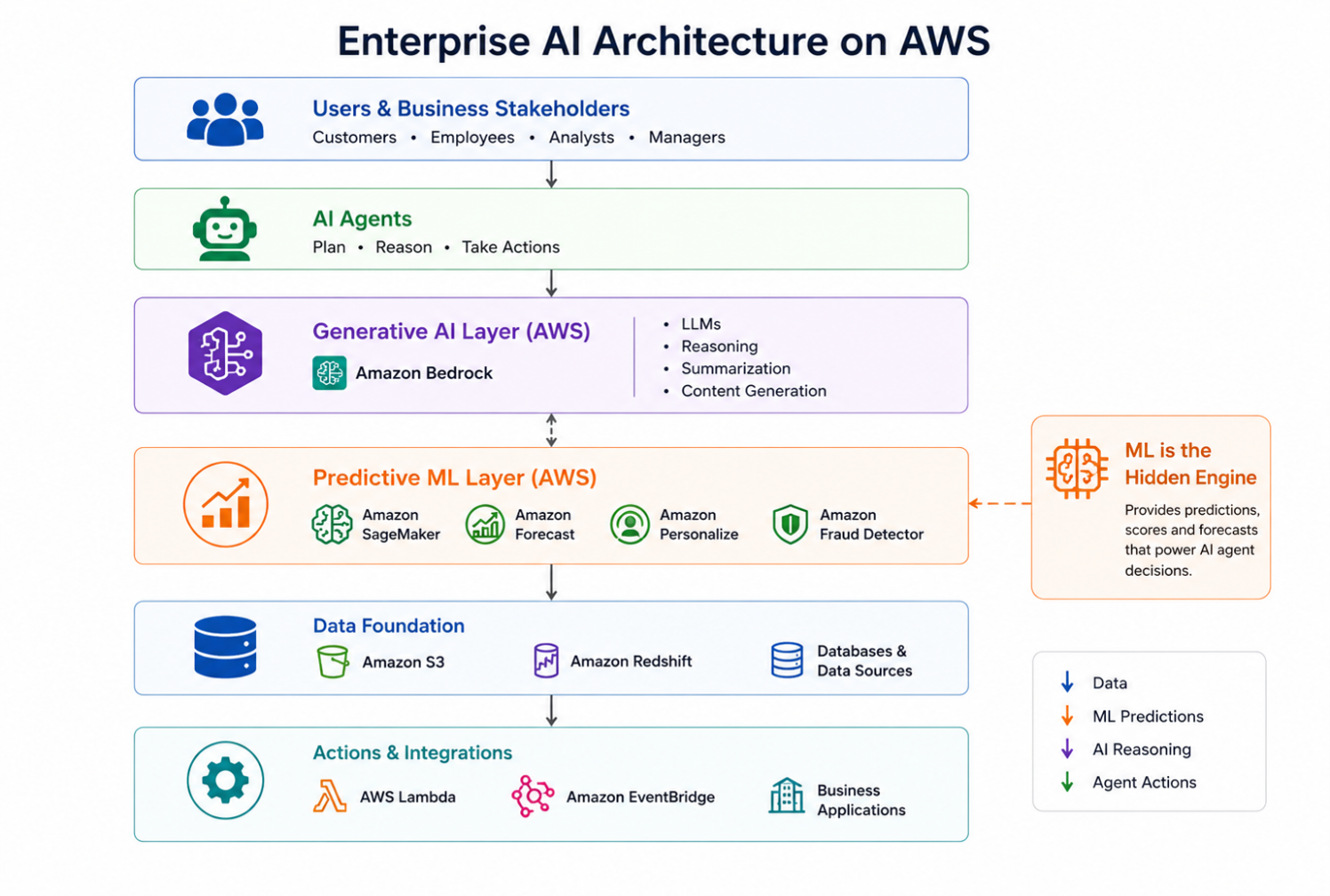
Fig 1: Enterprise AI Architecture on AWS.
Machine Learning services such as Amazon SageMaker, Amazon Forecast, and Amazon Fraud Detector provide predictive intelligence that powers AI agents. Amazon Bedrock delivers reasoning and language capabilities, while AWS automation services execute business actions based on agent decisions.
Real-World Use Cases
Customer service is one of the clearest examples of this partnership. An AI support agent may interact with customers using Generative AI, while Machine Learning predicts customer churn risk and lifetime value. These predictions help determine how the agent should respond to each situation. Amazon Bedrock Agentcore is a service taking this to another level altogether.
Supply chain operations provide another example. AI agents can automate inventory planning and procurement decisions, but those actions are typically driven by demand forecasting models developed using Machine Learning. The forecast guides the agent’s recommendations and actions.
In financial services, AI agents can summarize suspicious activities and assist fraud investigators. However, the actual fraud detection and risk scoring are performed by Machine Learning models, enabling agents to make accurate and reliable recommendations.
Why ML Remains Essential
Generative AI and Machine Learning solve different business problems. Generative AI excels at understanding language, generating content, and reasoning through complex situations. Machine Learning specializes in prediction, classification, recommendation systems, and anomaly detection.
Forecasting future sales, predicting equipment failures, or identifying fraudulent transactions requires models specifically trained for those tasks. These are areas where Machine Learning continues to outperform foundation models.
As organizations adopt more AI agents, the need for predictive intelligence will only increase. AI agents may become more autonomous, but they will still depend on Machine Learning to provide accurate forecasts and risk assessments.
Future of Enterprise Intelligence
The future of enterprise AI is not Machine Learning versus Generative AI. Instead, it is a combination of both technologies. While Generative AI and AI agents provide reasoning, communication, and automation, Machine Learning delivers the predictive intelligence required for effective decision-making.
On AWS, services such as Amazon SageMaker and Amazon Bedrock enable organizations to build powerful hybrid AI architectures that combine prediction, reasoning, and action. As enterprise AI continues to evolve, Machine Learning will remain the hidden layer powering the decisions behind every intelligent agent.
Upskill Your Teams with Enterprise-Ready Tech Training Programs
- Team-wide Customizable Programs
- Measurable Business Outcomes
About CloudThat


WRITTEN BY Sameer Karadkar
Sameer Karadkar is a Technical Lead at CloudThat, specializing in AWS DevOps and Development. With 14 years of experience in AWS, he has trained over 1000+ professionals/students to upskill in AWS DevOps and Development. Known for simplifying complex concepts, hands-on teaching, industry insights, he brings deep technical knowledge and practical application into every learning experience. Sameer's passion for teaching reflects in unique approach to learning and development.


 PREV
PREV











Comments