

 Login
Login

 June 18, 2026
|
Voiced by Amazon Polly |
Artificial intelligence has moved far beyond simple chatbots that answer one question at a time. Modern AI Agents can plan tasks, remember previous interactions, learn from outcomes, and make context-aware decisions over extended workflows.
One of the biggest reasons these systems are becoming more capable is their use of Memory.
Memory allows an AI agent to retain important information, refer back to earlier conversations or actions, and improve future responses based on past experiences. Without memory, agents behave like someone waking up with no recollection of yesterday’s work. With memory, they become significantly more useful for business operations, customer support, automation, and enterprise decision-making.
In this blog, we will explore how Decision-Making improves when AI agents use memory, the different types of memory architectures, real-world applications, and the technologies enabling these intelligent systems today.
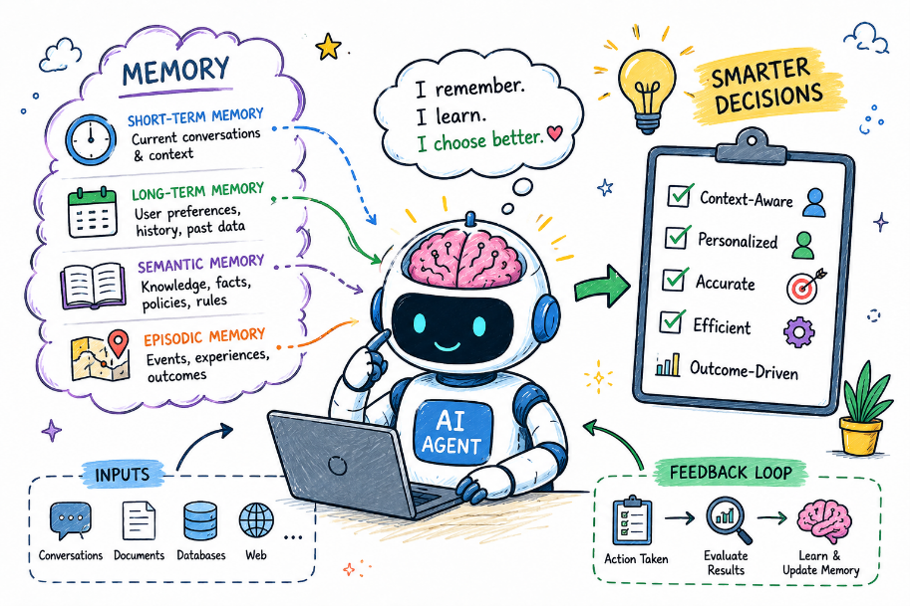
Fig 1: AI memory enables context‑aware decisions and continuous learning.
Start Learning In-Demand Tech Skills with Expert-Led Training
- Industry-Authorized Curriculum
- Expert-led Training
What Are AI Agents?
An AI Agent is a system that can independently perform tasks, make decisions, interact with tools, and respond dynamically to changing inputs.
Unlike traditional AI models that generate responses, AI agents can:
- Maintain context across interactions
- Use external tools and APIs
- Retrieve information from databases
- Execute multi-step workflows
- Learn from previous actions
- Adapt decisions based on historical data
Why Memory Matters in AI Systems
Human decision-making depends heavily on memory. We remember past conversations, mistakes, preferences, and outcomes before making new decisions.
AI systems operate similarly.
Without memory:
- Every interaction feels isolated
- The agent loses context after each prompt
- Decisions become repetitive or inconsistent
- Long workflows break down easily
With memory:
- Agents retain contextual understanding
- Responses become more personalized
- Decisions improve over time
- Multi-step reasoning becomes possible
This is especially important in enterprise environments where workflows involve continuous interactions rather than single prompts.
Types of Memory Used by AI Agents
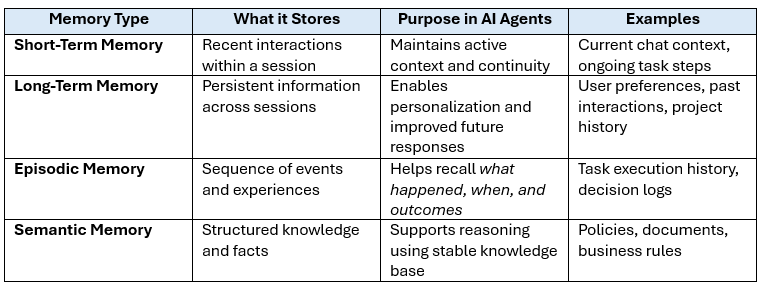
To understand enterprise-grade AI implementations, readers can explore Generative AI and Azure OpenAI training programs.
How Memory Improves Decision-Making
Memory significantly changes how AI systems evaluate situations and respond intelligently.
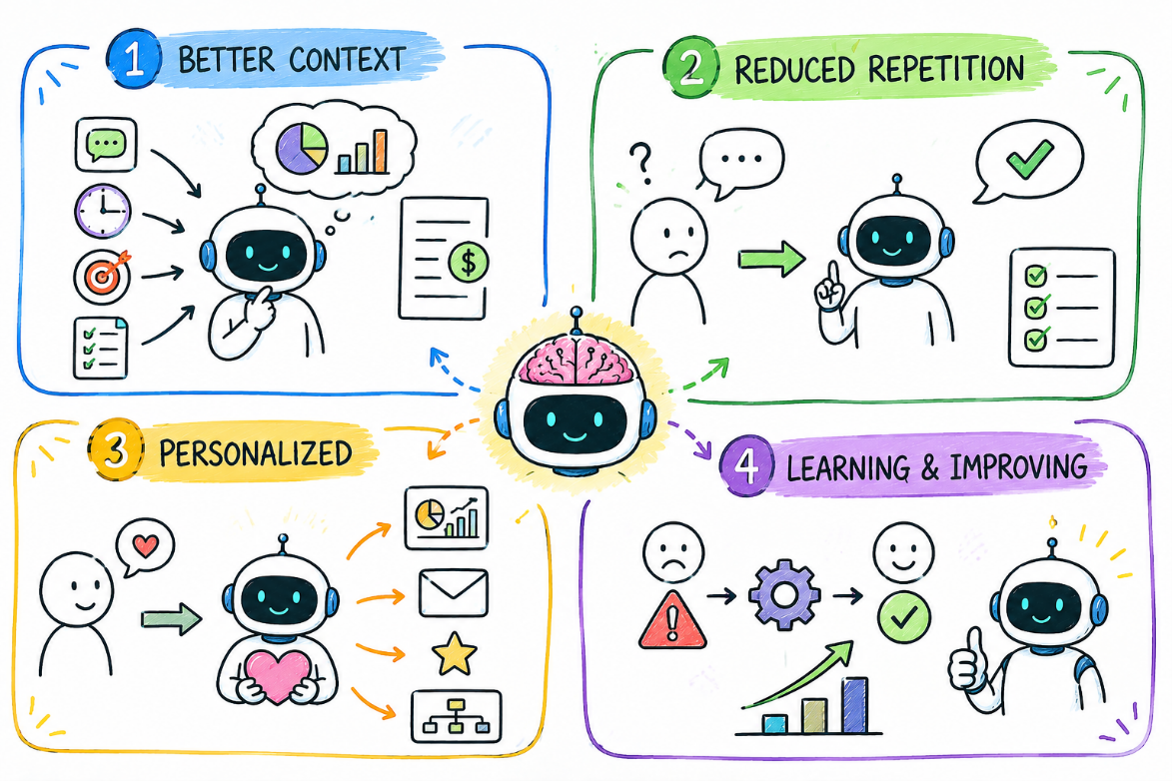
Fig 2: How AI memory improves context, personalization, and learning.
Better Context Awareness
Agents with memory understand the broader context of interactions.
Instead of responding only to the latest prompt, they evaluate:
- Past conversations
- Workflow history
- User intent
- Historical actions
For example:
A financial AI assistant reviewing expenses may recognize:
- Previous budget approvals
- Earlier spending patterns
- Existing compliance restrictions
This improves the quality of recommendations.
Reduced Repetition
Without memory, users repeatedly provide the same information.
Memory-enabled agents avoid:
- Asking duplicate questions
- Repeating completed actions
- Ignoring previous decisions
This improves user experience and operational efficiency.
Personalized Responses
Memory enables AI systems to adapt their responses to user behavior.
Examples include:
- Preferred report formats
- Communication styles
- Historical business priorities
- Frequently accessed workflows
A project management agent may prioritize concise summaries for one manager and detailed analytics for another.
Learning from Previous Outcomes
Advanced agents evaluate previous successes and failures.
This helps improve future decisions by:
- Avoiding unsuccessful approaches
- Reusing effective strategies
- Optimizing workflows over time
Future recommendations become more efficient.
Memory Architectures in Modern AI Systems
Modern AI platforms use multiple technologies to manage memory effectively.
Vector Databases
Many AI systems store memory embeddings inside vector databases, such as:
- FAISS
- Pinecone
- Chroma
These databases help agents quickly retrieve semantically similar information.
For example:
When a user asks a question, the agent retrieves related historical interactions using embedding similarity search.
Retrieval-Augmented Generation (RAG)
RAG combines:
- Information retrieval
- Large language models
- External knowledge sources
This enables AI agents to access memory dynamically before generating responses.
Instead of relying only on model training data, the system retrieves relevant contextual information during runtime.
Agent Frameworks with Memory
Modern frameworks support built-in memory orchestration.
Popular frameworks include:
- LangChain
- LangGraph
- Semantic Kernel
- AutoGen
These frameworks help developers:
- Store conversation history
- Maintain workflow state
- Track agent actions
- Manage multi-agent collaboration
This makes enterprise AI orchestration more scalable and manageable.
Real-World Applications of Memory-Driven AI Agents
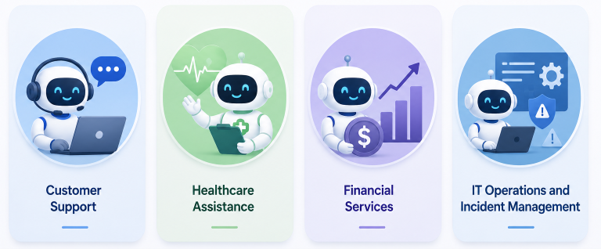
Fig 3: Memory‑driven AI agents powering real‑world business applications.
AI agents use memory to deliver personalized, context-aware support across industries. By learning from past interactions, they improve efficiency, accuracy, and user experience over time.
Challenges of Memory in AI Systems
Memory in AI systems improves contextual understanding and personalization, but it also brings key challenges. A major concern is data privacy and security, as stored memory may include sensitive user information that must be protected through encryption, access controls, and governance policies. Another challenge is memory accuracy, where outdated or incorrectly stored data can lead to irrelevant or wrong outputs, requiring continuous validation and cleanup mechanisms. Additionally, scalability becomes critical as systems grow, since managing large volumes of memory efficiently without degrading performance requires optimized storage, retrieval, and relevance-filtering techniques.
Intelligent Agent Evolution
Memory is a foundational capability that makes modern AI agents more intelligent, context-aware, and reliable. By combining short-term context retention, long-term knowledge storage, semantic retrieval, and historical learning, AI systems can significantly enhance decision-making across business workflows. Organizations adopting memory-driven AI are already seeing improvements in automation efficiency, customer experience, operational accuracy, workflow continuity, and personalized decision support. As AI architecture continues to evolve, memory will remain a key enabler of truly adaptive and intelligent systems.
Upskill Your Teams with Enterprise-Ready Tech Training Programs
- Team-wide Customizable Programs
- Measurable Business Outcomes
About CloudThat


WRITTEN BY Kiran Dambal
Kiran Dambal is a Microsoft Certified Trainer at CloudThat and a passionate tech enthusiast, with expertise in Python, machine learning, deep learning, and a variety of other technologies. With over 3.5 years of experience in training, he has successfully trained numerous working professionals. Specializing in delivering technical training across diverse topics, he excels in providing personalized training tailored to the specific needs of customers and businesses. He has actively contributed to numerous projects involving machine learning, deep learning, NLP, data science and data analysis in Python, MLOps, Generative AI, Prompt engineering, Fine-tuning LLMs, RAG etc. Additionally, he has created multiple POCs with Azure AI, Azure OpenAI Services, and Azure DevOps.


 PREV
PREV









Comments