

 Login
Login


 June 18, 2026
|
Voiced by Amazon Polly |
Generative models are transforming the way machines create, analyze, and interact with data. Unlike traditional models that only classify or predict outcomes, Generative AI models can create new content such as text, images, audio, code, and even videos that closely resemble real-world data. This capability is at the heart of many modern artificial intelligence (AI) breakthroughs and is rapidly reshaping industries.
Start Learning In-Demand Tech Skills with Expert-Led Training
- Industry-Authorized Curriculum
- Expert-led Training
What Are Generative Models?
Generative models are a class of machine learning models designed to learn the underlying patterns of data and generate new, similar data samples. Popular examples include Generative Adversarial Networks (GANs), Variational Autoencoders (VAEs), and Transformer-based models such as large language models.
These models are trained on massive datasets and can generate high-quality outputs that are often indistinguishable from human-created content.
Key Features of Generative Models
- Content Creation Capability
Generative models can create original content, including text, images, music, videos, and code. This makes them highly valuable for creative, technical, and business applications.
- Learning Data Distributions
Instead of memorizing data, generative models learn the probability distribution of the input data, enabling them to produce diverse and realistic outputs.
- Adaptability Across Domains
These models can be applied across multiple domains such as healthcare, finance, education, entertainment, and software development with minimal adjustments.
- Scalability and Automation
Modern generative models can scale to billions of parameters and automate tasks that once required extensive human effort, increasing both efficiency and productivity.
Use Cases of Generative Models
- Content and Media Generation
Marketing teams use generative models to create blog posts, advertisements, social media captions, and visual assets at scale. In entertainment, they assist in game design, animation, and music composition.
- Software Development
Developers leverage generative models to write code, suggest improvements, generate documentation, and detect bugs, significantly reducing development time.
- Healthcare and Life Sciences
Generative models help in drug discovery by generating potential molecular structures, simulating biological data, and creating synthetic medical images for research and training.
- Data Augmentation
In scenarios where real data is limited or sensitive, generative models can create synthetic data to improve training of machine learning models without compromising privacy.
Real-Time Applications of Generative Models
- Virtual Assistants and Chatbots
Real-time conversational AI systems use generative models to understand user queries and provide natural, context-aware responses in customer support, banking, and e-commerce.
- Real-Time Translation and Speech Generation
Generative models enable instantaneous language translation, speech-to-text, and text-to-speech solutions used in video conferencing, navigation systems, and accessibility tools.
- Personalized Recommendations
Streaming platforms and online retailers apply generative AI in real time to recommend personalized content, products, and experiences based on user behavior.
- Live Image and Video Enhancement
In photography, video calls, and surveillance systems, generative models enhance image quality, remove noise, and even generate missing details in real time.
Importance of Generative AI for Data Science
Generative AI (GenAI) has become a transformative force in Data Science. While traditional data science focuses on analyzing historical data to extract insights, Generative AI takes it a step further by generating new data, automating workflows, and enhancing decision-making. Its integration is reshaping how data scientists work, innovate, and deliver value.
- Automates Data Preparation and Feature Engineering
Data preparation is one of the most time-consuming tasks in data science. Generative AI helps by:
- Automatically cleaning and preprocessing raw data
- Generating meaningful features from complex datasets
- Handling missing values and noisy data
This allows data scientists to focus more on model building and interpretation rather than repetitive tasks.
- Synthetic Data Generation
One of the most significant contributions of GenAI is the ability to generate high-quality synthetic data. This is crucial when:
- Real data is scarce or sensitive (e.g., healthcare, finance)
- Data privacy regulations restrict data usage.
- Balanced datasets are required for better model performance.
Synthetic data improves model training while maintaining data privacy and compliance.
- Enhances Model Development and Experimentation
Generative AI accelerates experimentation by:
- Creating variations of datasets for robust testing
- Simulating real-world scenarios
- Supporting fast prototyping of machine learning models
This leads to faster iteration cycles and better-performing predictive models.
- Improves Predictive Accuracy
By learning complex, high-dimensional data patterns, generative models:
- Capture hidden relationships in data.
- Improve forecasting and anomaly detection.
- Enhance model generalization.
This results in more accurate predictions and insights, especially in complex domains.
- Natural Language Interaction with Data
GenAI enables data scientists to interact with data using natural language, making analytics more accessible:
- Query datasets using conversational prompts.
- Automatically generate insights and summaries
- Convert plain language into SQL or Python code.
This democratizes data science, enabling non-technical stakeholders to effectively explore data.
- Accelerates Insight Generation and Reporting
Generative AI can automatically:
- Generate reports and dashboards.
- Summarize trends and key insights.
- Explain model outputs in human-readable form.
This significantly reduces turnaround time from raw data to actionable business insights.
- Supports Decision Intelligence
In real-time environments, GenAI supports:
- Scenario simulation and what-if analysis
- Risk modeling and optimization.
- Intelligent recommendations
This enables organizations to make faster, data-driven decisions under uncertainty.
- Boosts Productivity of Data Scientists
By automating coding, documentation, and model tuning, Generative AI:
- Reduces manual effort.
- Lowers the entry barrier for beginners.
- Enhances the productivity of experienced professionals.
As a result, data science teams can deliver more value at scale.
Architecture
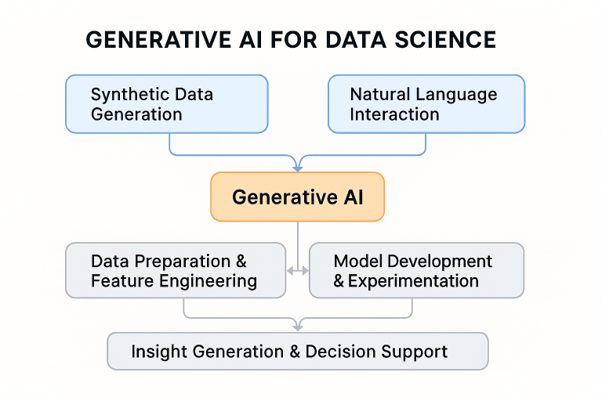
Fig 1: Generative AI workflow in data science and decision‑making.
If you want to learn more about Generative AI and its features, please refer to the Azure Data Science Engineer Associate DP-100 and Microsoft Certified: Azure AI Engineer Associate AI-102 certifications, which will provide more information.
Shaping Intelligent AI Futures
Generative models represent a major leap forward in artificial intelligence, enabling machines not just to analyze data but to create meaningful and intelligent outputs in real time. Their ability to automate creativity, enhance decision-making, and scale innovation is redefining industries worldwide. As technology advances, combining generative models with responsible AI practices will be essential to unlock their full potential while ensuring trust, fairness, and reliability.
Upskill Your Teams with Enterprise-Ready Tech Training Programs
- Team-wide Customizable Programs
- Measurable Business Outcomes
About CloudThat


WRITTEN BY Mahendra Patel
Mahendra Patel is Subject Matter Expert in Azure Infra/Arch at CloudThat, with a passion for empowering professionals through top-tier Microsoft training. As an MCT he brings over 13 years of rich experience in training, academics and research. He holds 18+ professional certifications across Microsoft ecosystem and has successfully trained over 2200+ professionals in Azure Solution Architect, Azure Administrator, Azure Network, PowerBI, Azure Security and AI Data Engineering. His hands-on, tool-driven approach to training is known for translating complex concepts into practical, real-world solutions.


 PREV
PREV












Comments