

 Login
Login

 June 18, 2026
|
Voiced by Amazon Polly |
The rapid evolution of AI is reshaping how organizations build intelligent systems. From copilots to fully autonomous agents, the transition is redefining modern data engineering, data pipelines, and application ecosystems. The DW-200 course, Accelerate Agentic AI, is designed to help professionals navigate this shift using Microsoft’s latest AI stack.
In this blog, we’ll walk through the 3-day learning journey of the DW-200 training, highlighting how it bridges foundational concepts such as data warehouse basics and the ETL process with cutting-edge agentic AI capabilities.
Start Learning In-Demand Tech Skills with Expert-Led Training
- Industry-Authorized Curriculum
- Expert-led Training
Course Overview
- Level: Intermediate-Advanced
- Duration: 3 days (5 hours/day)
This concise yet impactful format ensures learners can quickly grasp concepts and apply them in real-world scenarios
Why DW-200 Certification Matters Today
Modern enterprises are no longer just building dashboards; they’re building intelligent agents that can reason, act, and collaborate. The DW-200 certification equips professionals with:
- Skills in designing AI-powered agents
- Knowledge of integrating copilots into business workflows
- Understanding of scalable AI architecture
- Foundations aligned with the data warehousing tutorial, SQL tutorial, and data modeling
It’s ideal for professionals transitioning from traditional data systems into AI-driven ecosystems.
Day 1 – From Microsoft 365 Copilots to Foundry-Powered Agents
Building and Extending Copilots
Day 1 begins with an understanding of how Microsoft 365 Copilot enhances productivity through AI. A key concept introduced is Work IQ, an intelligence layer that leverages organizational data to deliver contextual insights.
You’ll explore:
- Extending copilots with custom agents
- Using Copilot Studio for low-code agent creation
- Designing task-specific assistants like HR bots
This builds on foundational knowledge, similar to how ETL pipelines transform data into actionable insights, except that here intelligence is embedded directly into workflows.
Building Agents with Microsoft Foundry
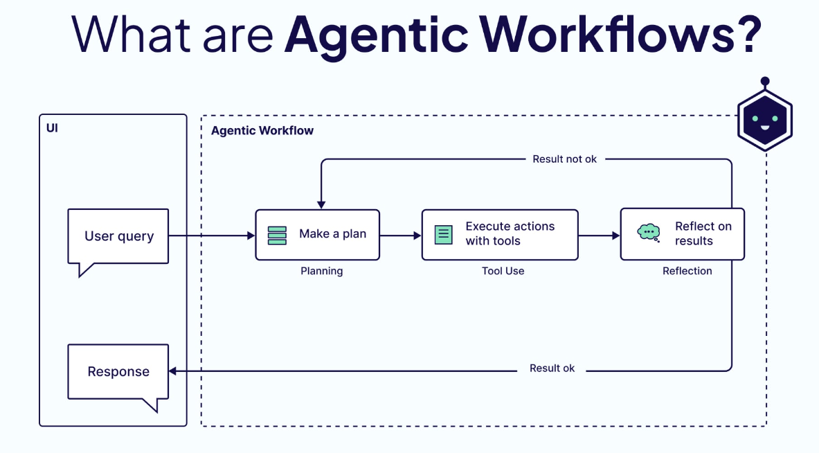
Fig 1: Agentic Workflow
The second module introduces Microsoft Foundry, a powerful platform for designing AI agents.
Key learnings include:
- Selecting the right models for different use cases
- Developing agents using Foundry Agent Service
- Understanding how AI apps fit into enterprise ecosystems
Hands-on Labs (Day 1)
Practical exercises include:
- HR Assistant Agent using Copilot Studio
- Chat completion via VS Code
- Health Insurance Analyzer AI Agent
- Multi-agent health report generation system
These labs simulate real-world data pipeline and AI integration scenarios.
Day 2 – Designing Scalable AI Agents
Intelligent Agents with Microsoft Foundry
Day 2 dives deeper into building intelligent, scalable agents. A major highlight is integrating external tools and APIs using:
- MCP endpoints
- OpenAPI specifications
- Agent-to-Agent (A2A) communication
You’ll also explore Foundry IQ and Fabric IQ, which enhance enterprise search and decision-making, much as the basics of data warehousing enable structured data retrieval.
Another critical concept covered is:
- RAG (Retrieval-Augmented Generation)
- Fine-tuning models for better performance
These techniques align closely with advanced data modeling practices, in which structured and unstructured data are combined to generate insights.
Multi-Agent Systems with Microsoft Agent Framework
This module introduces the open-source Microsoft Agent Framework, focusing on:
- Multi-agent orchestration patterns
- Workflow design for collaborative agents
- Building distributed AI systems
Hands-on Labs (Day 2)
- Retrieval-Augmented AI Agent
- Multi-agent communication system
- AI-powered ticket management system
- Agent deployment and runtime management
These exercises reinforce concepts similar to distributed data engineering systems.
Day 3 – Managing, Securing, and Governing AI Agents
Security and Governance in Copilot Studio
As AI adoption grows, governance becomes critical. This module introduces:
- Microsoft Agent 365 control plane
- Copilot Control System (CCS)
- Cost management across platforms
This is analogous to managing performance and cost in traditional ETL process pipelines.
Governance in Microsoft Foundry
You’ll learn how to:
- Monitor AI lifecycle using Foundry Control Plane
- Implement Azure AI Content Safety
- Manage identities with Microsoft Entra Agent ID
- Ensure continuous security and compliance
These concepts mirror governance practices in data warehouse basics, where data integrity and access control are essential.
Hands-on Labs (Day 3)
- Agent observability (AgentOps)
- Responsible AI implementation
- Fraud detection with human-in-the-loop AI
These labs highlight real-world enterprise scenarios where AI must be both powerful and trustworthy.
How DW-200 Training Connects with Data Fundamentals
Although the course focuses on AI agents, it strongly builds on traditional data concepts:
- Data warehousing tutorial → Organizing enterprise data
- ETL process → Feeding structured data into AI systems
- SQL tutorial → Querying and preparing datasets
- Data modeling → Designing schemas for AI consumption
- Data engineering → Building scalable pipelines
- Data pipeline → Powering real-time AI agents
This makes the DW-200 course a perfect bridge between data professionals and AI engineers.
Key Takeaways
- The DW-200 certification enables professionals to move from data systems to intelligent AI agents
- Microsoft Foundry and Copilot Studio simplify agent development
- Multi-agent systems are becoming the backbone of enterprise AI
- Governance, security, and cost control are critical for scalable AI
- Strong foundations in data engineering and data modeling remain essential
Learning Path with CloudThat
To explore and advance your expertise in Agentic AI, check out the specialized training programs below:
These courses provide hands-on labs to help you design AI systems.
Building Future-Ready AI
The DW-200 training is more than just another technical course; it’s a roadmap to the future of AI-driven applications. By combining traditional data concepts such as data warehouse basics and ETL processes with modern agentic AI frameworks, it prepares professionals to build intelligent, scalable, and secure systems.
As organizations continue to adopt AI agents, these skills are becoming essential.
Upskill Your Teams with Enterprise-Ready Tech Training Programs
- Team-wide Customizable Programs
- Measurable Business Outcomes
About CloudThat


WRITTEN BY Abhishek Srivastava
Abhishek Srivastava is a Subject Matter Expert and Microsoft Certified Trainer (MCT), as well as a Google Cloud Authorized Instructor (GCI), with over 15 years of experience in academia and professional training. He has trained more than 7,000 participants worldwide and has been recognized among the Top 100 Global Microsoft Certified Trainers, receiving awards from Microsoft for his outstanding contributions. Abhishek is known for simplifying complex topics using practical examples and clear explanations. His areas of expertise include AI agents, Agentic AI, Generative AI, LangChain, Machine Learning, Deep Learning, NLP, Data Science, SQL, and cloud technologies such as Azure and Google Cloud. He also has hands-on experience with Snowflake, Python, and Image Processing. His in-depth technical knowledge has made him a sought-after trainer for clients in the USA, UK, Canada, Singapore, and Germany. In his free time, Abhishek enjoys exploring new technologies, sharing knowledge, and mentoring aspiring professionals.


 PREV
PREV



Comments