

 Login
Login

 June 19, 2026
|
Voiced by Amazon Polly |
Organizations today are moving beyond traditional automation toward Agentic AI, a paradigm where intelligent systems can reason, act, and collaborate autonomously. The DW-230 learning path focuses on enabling this transformation using Microsoft Foundry, helping professionals design, manage, and pitch enterprise-ready AI solutions.
Whether you are exploring a DW-230 course or enhancing your skills through DW-230 training, this structured journey provides both conceptual clarity and real-world application.
Start Learning In-Demand Tech Skills with Expert-Led Training
- Industry-Authorized Curriculum
- Expert-led Training
Course Overview
- Level: Intermediate
- Duration: 3 days (2 hours/day)
This concise yet impactful format ensures learners can quickly grasp concepts and apply them in real-world scenarios.
Day-1: Design with the Best Models for Your Use Case with AI Foundry
The first step in adopting Agentic AI is understanding the challenges of modern AI development and selecting the right tools and models.
- AI Development Challenges and the Rise of Agentic AI
Organizations often struggle with:
- Model selection and scalability
- Integration with existing systems
- Managing data pipelines and governance
Agentic AI addresses these by enabling systems that can independently plan and execute tasks.
- Agent tooling – Choosing the Right Tools for Agent Development
Selecting the right tooling is critical:
- Low-code tools for rapid prototyping
- Advanced frameworks for scalable solutions
These decisions often depend on your familiarity with concepts like data modeling, ETL process, and data pipeline design.
- Microsoft Foundry – The AI app & agent factory
Microsoft Foundry serves as a unified platform to design, build, and scale AI applications and intelligent agents, enabling seamless integration, customization, and governance across enterprise-grade AI solutions.
- Getting started with AI Foundry
Microsoft Foundry acts as a centralized platform to:
- Build AI-powered applications
- Develop intelligent agents
- Integrate enterprise data seamlessly
This aligns closely with foundational concepts like data engineering, where structured pipelines and workflows power intelligent systems.
- Designing with the Best Models for your use case
Different use cases require different models:
- Conversational AI → Language models
- Analytics → Predictive models
- Automation → Task-oriented agents
A strong understanding of data warehouse basics and SQL tutorial concepts helps prepare and structure data effectively for these models.
- Customizing with a Multi-Agent Toolchain
Modern AI systems often involve multiple agents working together:
- Data ingestion agents
- Processing agents
- Decision-making agents
This mirrors traditional data warehousing tutorial approaches, where data flows through multiple transformation layers.
Day-2: Managing Enterprise-Ready AI with Confidence
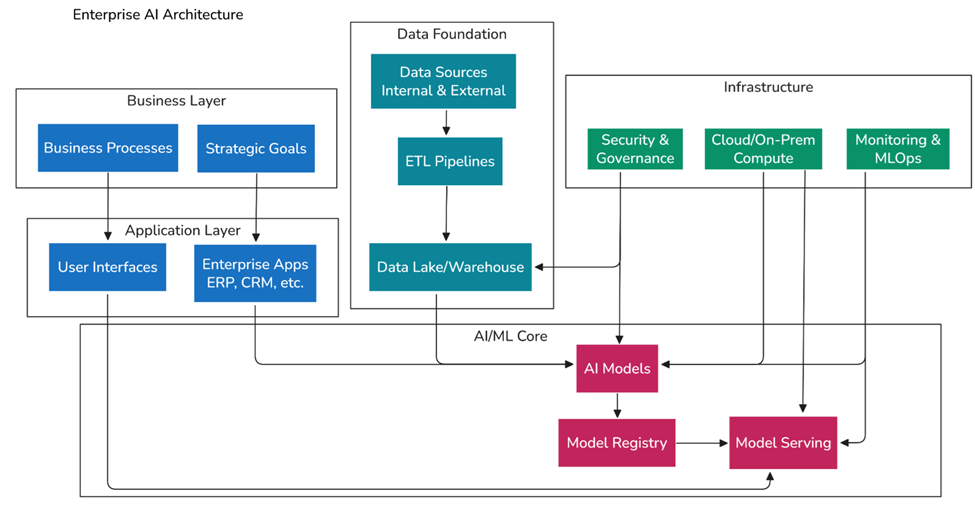
Fig 1: Enterprise AI Architecture.
Manage enterprise-ready AI with confidence – AI safety tooling
Once AI systems are built, managing them at scale becomes the priority.
AI Safety Tooling
Enterprise AI requires:
- Monitoring outputs
- Ensuring compliance
- Preventing bias and misuse
These practices are similar to maintaining data quality in a data pipeline.
AI innovation across landscapes – AI Foundry integrations
Microsoft Foundry integrates with:
- Enterprise applications
- APIs and external services
- Data platforms and warehouses
This enables seamless connectivity between AI systems and existing data engineering ecosystems.
Why Microsoft AI Foundry?
Key advantages include:
- Scalability for enterprise workloads
- Built-in governance and monitoring
- Flexibility in model selection
For professionals pursuing DW-230 certification, understanding these capabilities is essential.
Popular Customer Use Cases
Organizations are leveraging Foundry for:
- Intelligent customer support agents
- Automated document processing
These use cases rely heavily on structured data, often processed through ETL process pipelines and stored using data modeling best practices.
Customer Success Stories
Real-world implementations demonstrate:
- Reduced operational costs
- Faster decision-making
- Improved customer experiences
Getting Started
Getting started with Microsoft Foundry involves setting up your environment, exploring available AI models, and building your first intelligent agent using guided tools and templates.
- Set up the workspace and access the required resources
- Explore the model catalog and agent capabilities
Whether you’re aiming to advance in your current role or pivot to a new career in AI and Agentic AI, you should enroll in the Agentic AI Certification Training Program.
Day 3: Responding to Customers and Building Your Pitch
Customer Case Study Approach
The final stage focuses on applying your knowledge to real-world business scenarios.
Business Scenario
You will analyze:
- Industry context
- Business goals
- Existing technical landscape
Technology Background
- Outline current systems, tools, and architecture
- Assess AI readiness, data sources, and integrations
Customer Challenges
Common challenges include:
- Legacy systems
- Data silos
- Inefficient workflows
Requirements
Solutions must address:
- Scalability
- Security
- Integration with existing data pipelines
Objections
Customers may raise concerns about:
- Cost
- Complexity
- ROI
A strong foundation in data warehouse basics and AI architecture helps in addressing these effectively.
B-Pitch Perfect
The highlight of Day 3 is crafting a compelling pitch.
Build a 3–5 Minute Pitch as your response to the customer
Your pitch should:
- Clearly define the problem
- Present an AI-driven solution
- Highlight business value
Present Your Pitch
Focus on:
- Clarity and structure
- Real-world impact
- Technical feasibility
Handle Objections
Use:
- Data-backed insights
- Scalable architecture explanations
- Practical examples
This stage bridges the gap between technical expertise and business communication, an essential skill for professionals completing a DW-230 course.
Driving AI Transformation Forward
In today’s rapidly evolving digital landscape, Agentic AI is transforming how enterprises innovate, automate, and scale intelligent operations. The DW-230 learning path with Microsoft Foundry equips professionals with the practical skills to design, manage, and confidently present enterprise-ready AI solutions. From AI model selection and multi-agent orchestration to governance and customer-focused solution pitching, this program bridges technical expertise with business value, empowering organizations and professionals to drive successful AI-driven transformation initiatives.
Upskill Your Teams with Enterprise-Ready Tech Training Programs
- Team-wide Customizable Programs
- Measurable Business Outcomes
About CloudThat


WRITTEN BY Abhishek Srivastava
Abhishek Srivastava is a Subject Matter Expert and Microsoft Certified Trainer (MCT), as well as a Google Cloud Authorized Instructor (GCI), with over 15 years of experience in academia and professional training. He has trained more than 7,000 participants worldwide and has been recognized among the Top 100 Global Microsoft Certified Trainers, receiving awards from Microsoft for his outstanding contributions. Abhishek is known for simplifying complex topics using practical examples and clear explanations. His areas of expertise include AI agents, Agentic AI, Generative AI, LangChain, Machine Learning, Deep Learning, NLP, Data Science, SQL, and cloud technologies such as Azure and Google Cloud. He also has hands-on experience with Snowflake, Python, and Image Processing. His in-depth technical knowledge has made him a sought-after trainer for clients in the USA, UK, Canada, Singapore, and Germany. In his free time, Abhishek enjoys exploring new technologies, sharing knowledge, and mentoring aspiring professionals.


 PREV
PREV











Comments