

 Login
Login


 June 3, 2026
|
Voiced by Amazon Polly |
Introduction
Most people enrolling in an AI engineer course in 2026 are spending ₹50,000 to ₹2,00,000 on a track they haven’t really evaluated.
They watched a YouTube playlist. Tried a Udemy course at 90% discount. Maybe finished half of it. And now they think the next logical step is a “professional certificate” or a “bootcamp” because that’s what LinkedIn keeps showing them.
Here’s the issue. The AI engineer job in 2026 is not the same job it was in 2022. Recruiters are not screening for “knows TensorFlow.” They are screening for engineers who can ship Bedrock agents, fine-tune LLMs, run RAG pipelines in production, and explain why their MLOps setup won’t fall over on day two.
This blog is a decision guide. Not a sales pitch. By the end of it, you will know what an AI engineer course should actually teach you, what it should cost, which projects matter on a resume, and what employers shortlist on.
Already in IT? Switch to Cloud & Earn 55% More
- Weekend Batches
- Dedicated Career Support
- Official AWS Labs
What an AI Engineer Actually Does in 2026?
The AI engineer ships things. They build RAG pipelines on top of Bedrock or Vertex AI. They fine-tune open-source LLMs on domain data. They orchestrate agents with action groups. They figure out why the embedding model is returning junk on Tuesday. They handle observability, cost optimization, prompt management, and the boring infrastructure work that makes a demo into a product.
If your AI engineer course is heavy on theory and light on hands-on Bedrock, Sagemaker, Vertex AI, or LangChain work, it is preparing you for a job that doesn’t really exist at scale.
Look at any current job description. Companies want people who can deploy, not people who can describe a transformer architecture on a whiteboard.
Skills Your AI Engineer Course Must Cover (Or You Are Wasting Money)
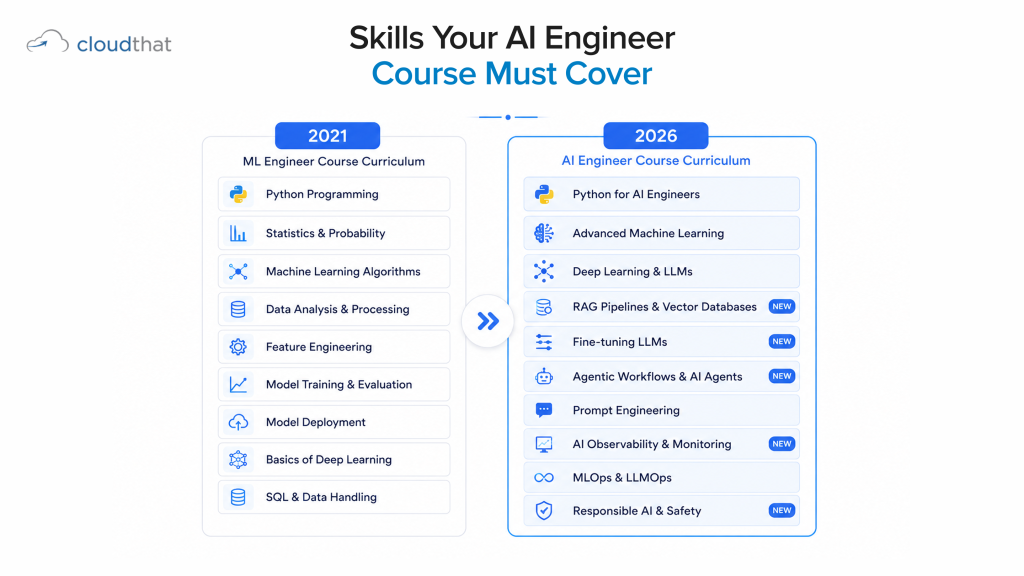
Here is the non-negotiable list.
Foundations you need before you touch GenAI:
- Python, with real comfort in writing scripts that hit APIs and handle errors
- A working understanding of vectors, embeddings, and similarity search
- Basic ML concepts. Not a deep theory. Just enough to know why a model fails
- Cloud fundamentals on at least one provider (AWS is the default ask in most JDs)
The GenAI core you will be tested on:
- Prompt engineering, including system prompts, few-shot patterns, and structured outputs
- RAG pipelines from end to end. Chunking, embedding, vector stores, retrieval, re-ranking
- LLM fine-tuning. Parameter-efficient methods like LoRA and QLoRA
- Agentic workflows. Action groups, tool use, and multi-agent coordination
- Evaluation. How to actually measure if your model is doing the right thing
The production layer that separates real engineers from tutorial finishers:
- MLOps basics. Versioning, deployment, monitoring
- Observability for LLM apps. Latency, hallucination tracking, cost per request
- Security and guardrails. Prompt injection, data leakage, and output filtering
For a deeper read on what production-grade GenAI workloads actually require, the AWS Generative AI Lens for the Well-Architected Framework is the most honest reference out there. It is also the standard most senior architects benchmark against.
Projects That Get You Shortlisted vs Projects That Don’t
A clean GitHub with three serious projects beats a certificate with zero projects every single time.
Here is what hiring managers actually open and read:
Projects that work:
- A RAG application on your own data, with chunking strategy explained and retrieval metrics documented
- A fine-tuned LLM for a narrow domain task, with before-and-after evaluation
- An agentic workflow that uses two or more tools and handles failure cases
- A small production deployment with observability built in
Projects that don’t work:
- “Sentiment analysis on Twitter data.” Done by a million people. Hiring managers scroll past.
- A Streamlit chatbot calling the OpenAI API with no retrieval, no eval, no infrastructure
- A copied notebook from a YouTube tutorial with your name on it
The CloudThat AWS Mastery Pass includes Bedrock-focused workshops in which you build agentic patterns and RAG pipelines through guided labs. The projects you walk away with are the ones that map directly to what AWS Premier Tier engagement teams ship for real clients.
What an AI Engineer Course Should Cost (And Hidden Fees Nobody Mentions)?
This is where most learners get caught. The course fee is rarely the full cost.
The visible cost:
- AI and ML courses range from free (DeepLearning.AI, freecloudcourses.com) to ₹2,00,000+ for full bootcamps
- The CloudThat AWS Mastery Pass is ₹1,14,900 for a full year of 35+ AWS courses, including the GenAI-focused tracks
- Microsoft Azure and Google Cloud certification tracks typically run ₹20,000 to ₹60,000 per track
The hidden costs nobody puts on the landing page:
- Exam vouchers. The AWS Machine Learning Specialty is around $300. Failing means buying another one.
- Cloud compute for hands-on practice. Fine-tuning even small models on your own card can run ₹10,000+ a month.
- Time. A 6-month bootcamp at 15 hours a week is 360 hours. If you earn ₹500 an hour, that is ₹1,80,000 of opportunity cost.
Certification Paths That Hold Weight With Hiring Managers
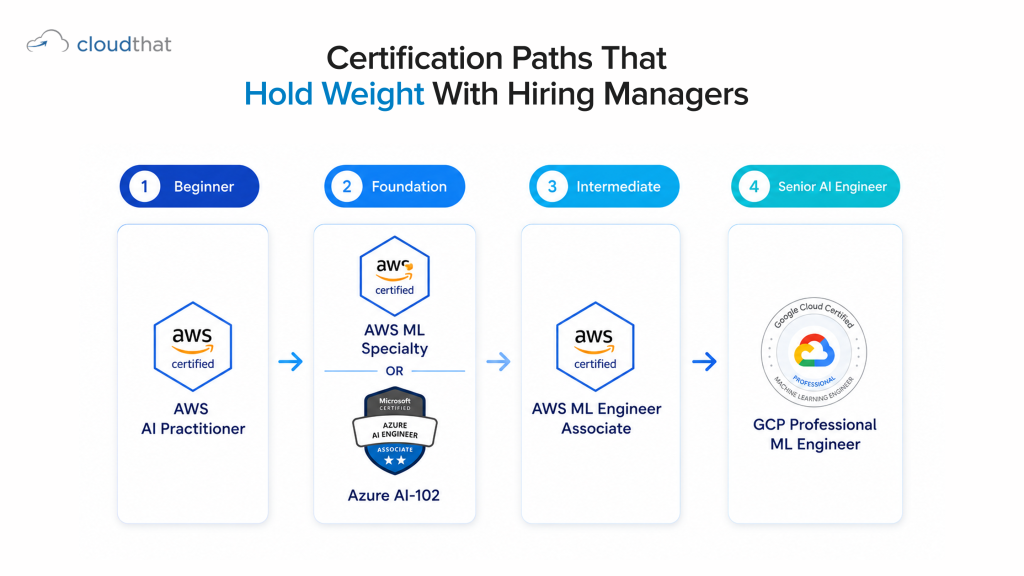
Here is what currently moves the needle for AI engineer roles.
AWS:
- AWS Certified Machine Learning Specialty
- AWS Certified AI Practitioner (entry-level signal)
- AWS Certified Machine Learning Engineer Associate
- AWS Certified Solutions Architect Associate (foundational for cloud-native AI work)
- AWS Certified DevOps Engineer (essential if your role touches MLOps pipelines)
Microsoft:
- Azure AI Engineer Associate (AI-102)
- Azure Data Scientist Associate (DP-100)
- Azure DevOps certification (AZ-400) for teams building CI/CD pipelines around ML workflows
- Azure Fundamentals (AZ-900) as a starting point if you are new to the Azure ecosystem
Google Cloud:
- Professional Machine Learning Engineer
- GCP Data Engineer certification for teams working on data-heavy AI pipelines
NVIDIA:
- NVIDIA AI certification and accelerated computing tracks, increasingly shortlisted at companies building GPU-intensive GenAI workloads
The AWS Machine Learning Engineer Associate and the Azure AI Engineer Associate (AI-102) are the two most commonly listed on AI engineer JDs in 2026. If a course doesn’t prepare you for at least one of these, ask why.
Career Outcomes and Realistic Salary Bands
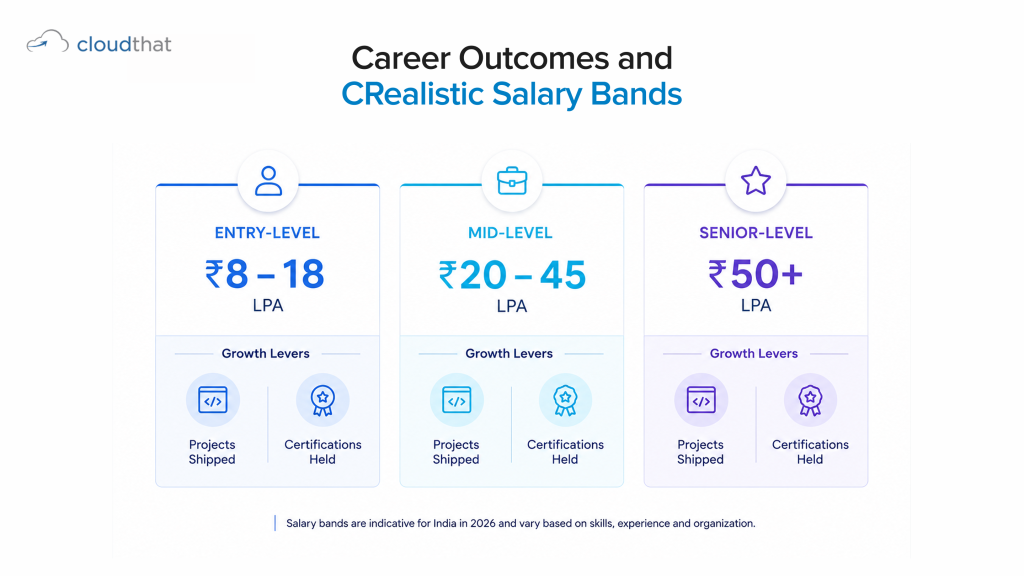
Entry-level AI engineer in India (0 to 2 years): ₹8 LPA to ₹18 LPA, depending on whether you have shipped projects and hold a recognised cloud certification.
Mid-level (3 to 6 years): ₹20 LPA to ₹45 LPA, with the upper end going to engineers who have production GenAI experience.
Senior (7+ years): ₹50 LPA and upward, often higher in product companies.
The 2025 Stanford AI Index report tracks the global AI talent market closely. The signal is consistent. Engineers with verifiable production GenAI work command premiums. Engineers with certifications alone do not.
This is why job-outcome programs matter. The CloudThat Job Ready Cloud Operations Engineer Program is built around the same idea. You don’t graduate when you finish modules. You graduate when you are project-ready.
Red Flags to Check Before You Enroll
Five things that should make you walk away from any AI engineer course in 2026.
The trainers are anonymous. Real practitioners have names, LinkedIn profiles, and case studies you can verify.
The curriculum still revolves around 2021-era ML concepts, with GenAI bolted on as a single module.
No hands-on labs. Or labs only on toy datasets that bear no resemblance to production.
Vague placement promises. “Job assistance” with no defined process is not a guarantee.
No partner credentials. AWS Premier Tier, Microsoft Partner, and NVIDIA Training Partner status are not vanity badges. They are gatekept by audits and revenue tests. They tell you that the platform vendors take the provider seriously. Look for these in the same way you’d check whether cloud computing course providers are authorized to teach what they’re selling.
Why CloudThat Is the Best AI Engineer Course Provider for Cloud and GenAI Training?
The AWS Mastery Pass is built for engineers who want to move from “I finished a tutorial” to “I shipped this.” 35+ AWS courses for a year. Bedrock workshops, Sagemaker tracks, agentic workflow labs, and the AWS Machine Learning Specialty prep, all under one subscription. EMI starts at ₹4,999 a month if you don’t want to pay the ₹1,14,900 upfront.
The labs are not toy datasets. The trainers are not freelancers. The same engineers who run Bedrock implementations, RAG pipelines, and fine-tuning rollouts through the GenAI Innovation Center also teach the classroom cohorts.
CloudThat’s cloud computing courses span AWS, Azure, and GCP, including the full range of Azure certifications from AZ-900 through AZ-400 and AI-102, NVIDIA AI and deep learning courses, DevOps training and certification tracks, full-stack development, and Microsoft Dynamics. Whether you are looking to crack the AWS Certified Solutions Architect exam, prepare for an Azure DevOps certification, or build production AI on NVIDIA infrastructure, the training calendar lists upcoming live cohorts across all tracks.
Need cloud expertise for a live production build, not just training? The CloudThat consulting team handles everything from cloud migration and DevSecOps to managed services and app modernization, and the same team feeds real-world patterns back into the classrooms.
Hiring instead of learning? The Hire From Us page connects you with AI engineers who have already completed the same training stack and shipped real projects.
And if you are an L&D head with a cohort of 50 or 500 engineers to upskill, the Capability Development Framework takes them from generic developer skills to billable AI engineer roles in 1 to 60 days. Skill assessment first. Custom learning paths next. Hands-on labs and need-based sessions in between. Project-readiness check at the end. No batch size minimum. The same framework has been used for corporate training programs at Accenture, Deloitte, HCL, and Protiviti, across AWS, Azure, GCP, DevOps, and GenAI tracks.
Everything sits atop the AWS Premier Tier Services Partner status, as well as partnerships with Microsoft, Google Cloud, and NVIDIA. Which matters because these aren’t badges you buy. They are audited.
Conclusion
Picking an AI engineer course in 2026 is less about brand recognition and more about whether the curriculum, projects, and certifications map to what hiring managers actually shortlist. Skip the courses that look great on a thumbnail and audit the curriculum, the trainers, and the lab depth before you enroll.
If the skills section told you what to learn, the projects section told you what to build, and the certifications section told you what to chase, the next step is simple. Explore the AWS Mastery Pass, check the training calendar for upcoming live cohorts, or if your organization needs a structured upskilling program, start with the Capability Development Framework. Everything is there. The decision is yours.
Key Takeaways:
- An AI engineer course in 2026 must cover GenAI, RAG, fine-tuning, agentic workflows, and production deployment, not just legacy ML theory.
- Three real GitHub projects beat any certificate. Build a RAG app, a fine-tune, and an agent workflow with observability.
- Total cost includes exam vouchers, cloud computing, and opportunity cost. Plan for all three.
- AWS Machine Learning Specialty and Azure AI-102 are the two most cited certifications on current AI engineer JDs.
- Partner credentials, named trainers, and hands-on lab depth are the three signals that separate a real course from a repackaged one.
No Job After Graduation? Cloud Engineering is Your Answer
- Beginner Friendly
- 92% Placement Rate
- Live Instructor-Led
About CloudThat
FAQs
1. What course should I take to become an AI engineer in 2026?
ANS: – Pick a course built around GenAI, RAG, fine-tuning, and agentic workflows on a major cloud platform. AWS, Azure, or GCP. If the course is still structured around 2021-era ML theory, skip it. The AWS Mastery Pass is built around the AWS Machine Learning Specialty and the GenAI tracks employers actually shortlist on.
2. What qualifications do I need to become an AI engineer?
ANS: – A computer science or engineering degree helps but is not required. Python proficiency, one cloud certification, and three real shipped projects are the minimum signal needed for a serious AI engineer interview.
3. Are AI engineers highly paid in India?
ANS: – Yes. Entry-level roles start at ₹8 LPA to ₹18 LPA. Mid-level engineers with production GenAI work command ₹20 LPA to ₹45 LPA. Seniors go higher.
4. How much does an AI engineering bootcamp cost?
ANS: – Anywhere from free to ₹2,00,000+. The AWS Mastery Pass is ₹1,14,900 for a full year of 35+ AWS courses with EMI options starting at ₹4,999 a month. Add exam vouchers and cloud compute on top of any course fee
5. What skills are essential for an AI engineering role?
ANS: – Python, prompt engineering, RAG pipeline design, fine-tuning, agentic workflows, evaluation, MLOps basics, and cloud fundamentals on AWS, Azure, or GCP.
6. Do AI engineer courses offer job placement?
ANS: – Some do, some don’t. Outcome-based programmes like the Job Ready Cloud Operations Engineer Program structure the learning around project-readiness and include placement assistance. Be cautious of vague “job assistance” claims without a defined process.
7. Is an AI engineer course worth it without a computer science degree?
ANS: – Yes, if you commit to building real projects and earning a recognised certification. Hiring managers in 2026 weigh shipped work more heavily than degrees for AI engineer roles.


WRITTEN BY Himisha Raval
Himisha Raval is a Digital Marketing Manager at CloudThat with a strong command of search engine optimization, web analytics, link building, and content strategy. She brings a data-driven approach to digital marketing, helping IT companies strengthen their online presence, improve search rankings, and generate consistent leads across channels. Beyond execution, she plays an active role in ideation, campaign strategy, and website performance optimization. Outside of work, she balances her analytical side with a love for travel, nature painting, and dancing.


 PREV
PREV











Comments