

 Login
Login


 June 16, 2026
|
Voiced by Amazon Polly |
Machine Learning (ML) has become the backbone of modern data-driven organizations. From personalized recommendations to predictive analytics, ML enables systems to learn from data and make intelligent decisions with minimal human intervention. In data science, ML serves as a powerful bridge between raw data and actionable insights.
This blog explores the key features of Azure Machine Learning, its real-world use cases, and its wide-ranging applications, highlighting why ML is indispensable for today’s data scientists.
Start Learning In-Demand Tech Skills with Expert-Led Training
- Industry-Authorized Curriculum
- Expert-led Training
Working of Machine Learning
Machine Learning in data science follows a structured process to convert raw data into intelligent predictions and insights.
- Problem Definition: Identify the business problem and determine the type of ML task (classification, regression, etc.).
- Data Collection: Gather relevant data from databases, files, APIs, or sensors.
- Data Preprocessing: Clean and prepare data by handling missing values, removing noise, and normalizing features.
- Feature Engineering: Create, select, and transform useful features that improve model accuracy.
- Model Training: Apply ML algorithms to learn patterns from historical data.
- Model Evaluation: Measure model performance using evaluation metrics to ensure reliability.
- The Model Deployment: Integrate the trained model into real‑world applications.
- A Prediction & Monitoring: Generate predictions on new data and continuously monitor performance for retraining.
One‑Line Flow:
A Problem → Data → Features → Model → Evaluation → Deployment → Monitoring
Key Features of Machine Learning
Machine Learning systems possess several defining features that make them uniquely suited for solving complex problems:
- Automation and Learning from Data: ML models automatically identify patterns in data without being explicitly programmed. As more data becomes available, these models improve their performance over time.
- Scalability: ML algorithms can handle massive volumes of structured and unstructured data, making them ideal for big data environments.
- Predictive and Prescriptive Capabilities: ML doesn’t just analyze past data; it predicts future outcomes and recommends optimal actions, enabling proactive decision-making.
- Adaptability: ML models can adapt to changing trends, such as evolving customer preferences or market fluctuations, ensuring relevance over time.
Machine Learning Use Cases
Machine Learning is widely used across industries to solve real-world problems. Some prominent use cases include:
- Customer Behavior Analysis: Retailers and e-commerce platforms use ML models to analyze user behavior, predict purchasing patterns, and offer personalized recommendations.
- Fraud Detection: Financial institutions use ML to identify unusual transaction patterns and flag potentially fraudulent activities in real time.
- Predictive Maintenance: Manufacturing companies apply ML to sensor data to predict equipment failures before they occur, reducing downtime and maintenance costs.
- Natural Language Processing (NLP): ML enables systems to understand, interpret, and generate human language, powering chatbots, sentiment analysis and opinion mining, and voice assistants.
Applications of Machine Learning in Data Science
Machine Learning plays a central role in turning data science concepts into practical solutions:
- Healthcare: ML models help in disease prediction, medical image analysis, drug discovery, and personalized treatment plans.
- Finance: In finance, ML is used for credit scoring, risk assessment, algorithmic trading, and churn prediction.
- Marketing and Sales: Data scientists use ML to optimize pricing strategies, segment customers, forecast demand, and improve campaign effectiveness.
- Transportation: ML powers applications like route optimization, demand forecasting for ride-sharing services, and autonomous vehicle technologies.
Why Machine Learning Is Critical for Data Science
Machine Learning enhances data science by:
- Enabling deeper insights from complex datasets
- Automating repetitive analytical tasks
- Improving accuracy and efficiency in decision-making
- Supporting real-time analytics and intelligence
Without ML, data science would mainly focus on descriptive analytics. With ML, it evolves into predictive and prescriptive analytics, significantly increasing its business value.
Architecture
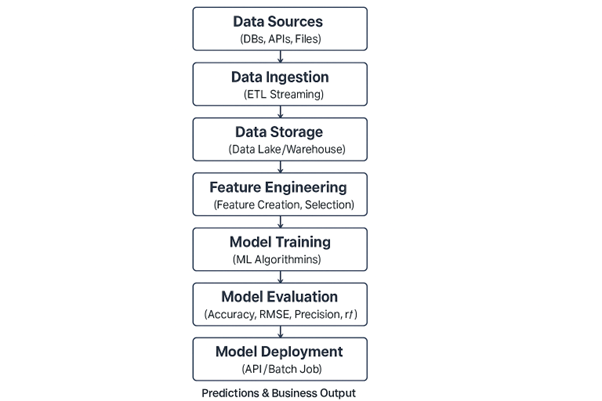
Fig 1: End-to-end machine learning lifecycle and deployment architecture.
If you want to learn more about Machine Learning and its features, then please refer to Microsoft Certified: Azure Data Science Engineer Associate DP-100 and Microsoft Certified: Azure Data Fundamental DP-900, which will provide more information.
Future of Intelligent Analytics
Machine Learning is no longer optional; it is a core capability of modern data science. Its features, such as automation, adaptability, and scalability, empower data scientists to transform vast amounts of data into meaningful insights and intelligent systems. As industries continue to adopt data-driven strategies, the synergy between machine learning and data science will be crucial to innovation, efficiency, and competitive advantage.
For aspiring and experienced data scientists alike, mastering ML techniques is essential to solving real-world problems and shaping the future of intelligent decision-making.
Upskill Your Teams with Enterprise-Ready Tech Training Programs
- Team-wide Customizable Programs
- Measurable Business Outcomes
About CloudThat


WRITTEN BY Mahendra Patel
Mahendra Patel is Subject Matter Expert in Azure Infra/Arch at CloudThat, with a passion for empowering professionals through top-tier Microsoft training. As an MCT he brings over 13 years of rich experience in training, academics and research. He holds 18+ professional certifications across Microsoft ecosystem and has successfully trained over 2200+ professionals in Azure Solution Architect, Azure Administrator, Azure Network, PowerBI, Azure Security and AI Data Engineering. His hands-on, tool-driven approach to training is known for translating complex concepts into practical, real-world solutions.


 PREV
PREV












Comments