

 Login
Login


 May 22, 2026
|
Voiced by Amazon Polly |
Overview
Artificial Intelligence is evolving faster than ever. Over the last decade, businesses have heavily invested in Machine Learning (ML) to automate predictions, improve analytics, and build intelligent applications. To manage these machine learning systems efficiently, organizations adopted a framework called MLOps.
Now, with the rise of Large Language Models (LLMs) like GPT, Claude, Gemini, and open-source foundation models, a new operational discipline has emerged, LLMOps.
While both MLOps and LLMOps focus on deploying and managing AI systems in production, they are not the same. LLMOps introduces entirely new challenges, workflows, and infrastructure requirements that traditional MLOps was never designed to handle.
Pioneers in Cloud Consulting & Migration Services
- Reduced infrastructural costs
- Accelerated application deployment
MLOps
MLOps stands for Machine Learning Operations.
It is a set of practices, tools, and processes designed to streamline the lifecycle of machine learning models from development to deployment and monitoring.
MLOps combines:
- Machine Learning
- DevOps
- Data Engineering
- Automation
The goal is to ensure ML systems are:
- Reliable
- Scalable
- Reproducible
- Maintainable
- Efficient in production
Why MLOps Became Important?
Building a machine learning model is only one part of the process.
The real challenge begins after training.
Organizations faced problems such as:
- Model deployment complexity
- Data drift
- Poor reproducibility
- Lack of monitoring
- Infrastructure scaling issues
- Collaboration difficulties between teams
MLOps emerged to solve these operational challenges.
Typical MLOps Workflow
A standard MLOps pipeline usually includes:
- Data collection
- Data preprocessing
- Feature engineering
- Model training
- Model evaluation
- Deployment
- Monitoring
- Retraining
MLOps pipelines heavily depend on structured datasets and predictive models.
Examples include:
- Fraud detection
- Recommendation systems
- Demand forecasting
- Image classification
- Predictive analytics
LLMOps
LLMOps stands for Large Language Model Operations.
It is a specialized operational framework designed for managing Large Language Models and Generative AI applications.
LLMOps focuses on:
- Prompt engineering
- Model orchestration
- Retrieval-Augmented Generation (RAG)
- Fine-tuning foundation models
- Vector databases
- AI agents
- Token optimization
- Human feedback loops
- Hallucination monitoring
Unlike traditional ML systems, LLM applications work primarily with unstructured language data and conversational interactions.
This creates an entirely different operational ecosystem.
Why LLMOps Emerged?
Large Language Models introduced capabilities far beyond traditional machine learning.
Instead of simply making predictions, LLMs can:
- Generate text
- Write code
- Summarize documents
- Answer questions
- Perform reasoning
- Interact conversationally
- Use external tools
However, managing these systems in production is much more complex.
Organizations now face challenges such as:
- Prompt management
- Context window limitations
- Hallucinations
- Token costs
- Latency optimization
- Multi-model orchestration
- AI safety and guardrails
Traditional MLOps practices alone cannot effectively handle these requirements.
This led to the rise of LLMOps.
The Core Difference Between MLOps and LLMOps
The biggest difference is simple:
MLOps manages predictive machine learning systems, and LLMOps manages generative AI systems powered by large language models.
But the differences go much deeper.
- Type of Models
MLOps
MLOps typically handles traditional machine learning models such as:
- Regression models
- Decision trees
- Random forests
- XGBoost
- CNNs
- Recommendation models
These models are generally task-specific and trained on structured datasets.
LLMOps
LLMOps focuses on foundation models and generative AI systems, such as:
- GPT models
- Claude
- Gemini
- Llama
- Mistral
These models are massive, pre-trained on internet-scale datasets, and capable of performing multiple tasks.
- Data Type
MLOps
Mostly works with structured data:
- Tables
- CSV files
- Numerical datasets
- Sensor data
LLMOps
Primarily handles unstructured data:
- Documents
- PDFs
- Emails
- Conversations
- Web pages
- Knowledge bases
This changes the entire processing pipeline.
- Development Workflow
MLOps Workflow
The workflow mainly revolves around:
- Dataset preparation
- Feature engineering
- Model training
- Hyperparameter tuning
Success depends heavily on improving model accuracy.
LLMOps Workflow
LLMOps workflows focus more on:
- Prompt engineering
- Retrieval systems
- Context management
- Fine-tuning
- Response quality
- Guardrails
- AI agent orchestration
Instead of training models from scratch, developers often build applications around pre-trained foundation models.
- Infrastructure Requirements
MLOps Infrastructure
Traditional ML systems generally require:
- CPU-based training
- Smaller datasets
- Standard deployment pipelines
LLMOps Infrastructure
LLMs require significantly more resources:
- GPU clusters
- Distributed inference
- Vector databases
- High-memory architectures
- Token streaming systems
Infrastructure complexity is much higher in LLMOps.
- Deployment Complexity
MLOps
ML model deployment is usually straightforward.
The model predicts outputs from inputs.
Example:
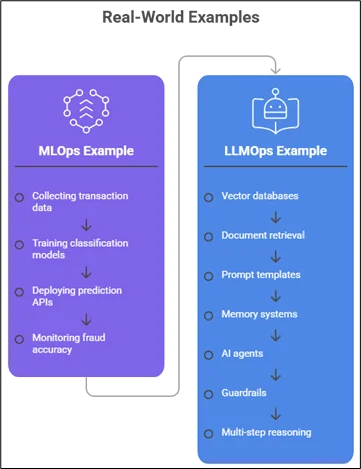
Input → Prediction
LLMOps
LLM deployment is far more dynamic.
Applications may involve:
- Retrieval pipelines
- Prompt templates
- External tools
- Multi-agent systems
- Memory management
- Context injection
LLM applications are often orchestration systems rather than standalone models.
- Monitoring and Observability
MLOps Monitoring
MLOps focuses on metrics such as:
- Accuracy
- Precision
- Recall
- Drift detection
- Latency
LLMOps Monitoring
LLMOps introduces additional concerns:
- Hallucinations
- Toxicity
- Response quality
- Prompt effectiveness
- Token usage
- Context relevance
- User satisfaction
Observability becomes much more subjective and human-centric.
- Fine-Tuning vs Prompt Engineering
MLOps
Traditional ML systems rely heavily on retraining and feature engineering.
LLMOps
LLMOps often prioritizes:
- Prompt engineering
- Few-shot learning
- Retrieval-Augmented Generation (RAG)
Instead of retraining large models, developers optimize prompts and context retrieval.
Can MLOps and LLMOps Work Together?
Absolutely.
In fact, many modern AI systems combine both.
For example:
An e-commerce platform may use:
- Traditional ML models for recommendation ranking
- LLMs for conversational shopping assistants
This creates hybrid AI architectures.
Future enterprise systems will likely integrate both MLOps and LLMOps together.
Challenges in LLMOps
LLMOps is still evolving and faces several challenges.
- High Operational Costs
LLM inference is expensive.
- Rapid Model Evolution
Foundation models change quickly, making standardization difficult.
- Evaluation Complexity
Measuring response quality is subjective.
- Security Risks
Prompt injection and hallucinations remain major concerns.
- Infrastructure Scalability
Large-scale LLM deployments require advanced cloud architectures.
The Future of AI Operations
The future of AI operations is evolving toward intelligent, autonomous systems driven by foundation models and AI-powered agents.
As Generative AI adoption increases, LLMOps will become a critical discipline for organizations building AI-native products.
We are likely to see:
- Autonomous AI workflows
- Multi-agent orchestration
- Real-time reasoning systems
- Hybrid AI architectures
- Self-improving AI operations
MLOps will continue to remain important for predictive systems, while LLMOps will dominate generative and conversational AI ecosystems.
Both will coexist and complement each other.
Conclusion
MLOps and LLMOps may sound similar, but they address very different operational challenges.
MLOps focuses on managing predictive machine learning models using structured data and traditional training pipelines.
LLMOps focuses on managing foundation models, generative AI systems, AI agents, prompts, retrieval systems, and large-scale conversational applications.
Drop a query if you have any questions regarding MLOps or LLMOps and we will get back to you quickly.
Making IT Networks Enterprise-ready – Cloud Management Services
- Accelerated cloud migration
- End-to-end view of the cloud environment
About CloudThat
FAQs
1. What is RAG in LLMOps?
ANS: – Retrieval-Augmented Generation (RAG) combines external knowledge retrieval with LLM generation to improve factual accuracy and context relevance.
2. What is the future of LLMOps?
ANS: – The future includes AI agents, autonomous workflows, multi-agent systems, real-time reasoning, and enterprise-scale generative AI ecosystems.
3. Does LLMOps replace MLOps?
ANS: – No. LLMOps does not replace MLOps. Both serve different purposes and often work together in modern AI systems.


WRITTEN BY Modi Shubham Rajeshbhai
Shubham Modi is working as a Research Associate - Data and AI/ML in CloudThat. He is a focused and very enthusiastic person, keen to learn new things in Data Science on the Cloud. He has worked on AWS, Azure, Machine Learning, and many more technologies.


 PREV
PREV











Comments