

 Login
Login


 May 22, 2026
|
Voiced by Amazon Polly |
Overview
Modernizing legacy .NET Framework applications is no longer just a technology upgrade, it has become a business necessity driven by rising operational costs, shrinking availability of legacy skills, and the demand for cloud-native scalability. Kiro’s spec-driven development approach simplifies this transformation by helping teams systematically migrate .NET Framework workloads to modern .NET 8 architectures running in Linux containers, on Amazon ECS Fargate, and on Amazon Graviton processors. This article covers the modernization journey, common transformation patterns, deployment architecture, and the measurable operational and cost benefits achieved through AI-assisted modernization workflows.
Pioneers in Cloud Consulting & Migration Services
- Reduced infrastructural costs
- Accelerated application deployment
Introduction
The application works. The business depends on it. And every month, it gets harder to hire developers who want to maintain a .NET Framework 4.x codebase running on Windows Server behind IIS.
Microsoft has moved on, .NET 8/9 is the future. AWS has moved on to Amazon Graviton ARM64 processors, delivering 40% better price-performance for .NET workloads on Linux. The economic case is clear. The technical path is defined. What’s been missing is a way to execute the migration without consuming 6-12 months of engineering time per application. That’s where Kiro’s spec-driven approach changes the game.
The Modernization Path
You have a .NET Framework 4.x application running on Windows Server, it works, your business depends on it, and every month it gets harder to hire developers who want to maintain it.
Microsoft ended mainstream support for .NET Framework 4.8 in favor of the modern .NET platform (now at .NET 8/9). AWS has invested heavily in .NET on Linux, Amazon Graviton processors offer 40% better price-performance for .NET workloads compared to x86 Windows instances. The economic and technical case for modernization is clear.
The execution is where teams get stuck. A typical enterprise .NET application has hundreds of files, tightly coupled dependencies, Windows-specific APIs, and zero test coverage. Manual modernization takes 6-12 months per application. Most teams have dozens of applications in the queue.
Kiro compresses this timeline dramatically.
The Modernization Path
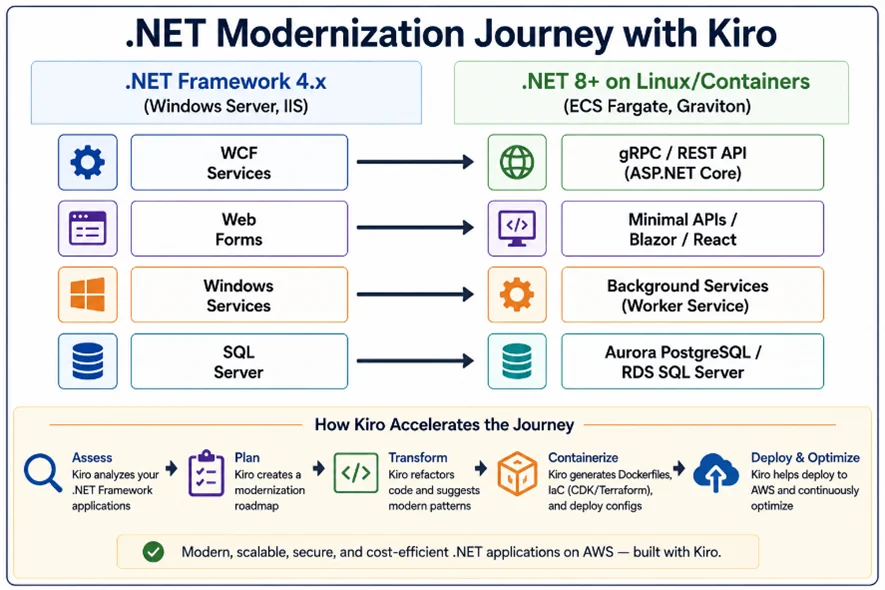
Using Kiro’s Spec Mode for Structured Modernization
Here’s where Kiro’s spec-driven approach transforms the process. Instead of opening files and hacking away, you define the modernization as a structured spec:
Step 1: Define Requirements
In Kiro’s Spec mode, describe what you need:
Feature: Modernize OrderProcessing service from .NET Framework 4.7 to .NET 8, containerized for Amazon ECS Fargate deployment.
Constraints:
– Maintain all existing API contracts (no breaking changes)
– Replace WCF endpoints with gRPC
– Replace Entity Framework 6 with EF Core 8
– Remove Windows-specific dependencies (Registry, EventLog)
– Target Linux containers on ARM64 (Graviton)
– Maintain connection to existing SQL Server during transition
Step 2: Kiro Generates the Design
Kiro analyzes your existing codebase and produces:
- Dependency map showing what needs to change
- Migration sequence (which files first, which have dependencies)
- Risk assessment (which transformations are mechanical vs. require judgment)
- Target project structure
Step 3: Kiro Breaks Down Tasks
Task Breakdown (Generated by Kiro):
1. Create a new .NET 8 project structure with SDK-style csproj
2. Migrate NuGet packages to modern equivalents
– EntityFramework 6 → Microsoft.EntityFrameworkCore 8.x
– System.Web → Microsoft.AspNetCore
– WCF references → Grpc.AspNetCore
3. Convert WCF service contracts to gRPC proto definitions
4. Rewrite the data access layer for EF Core
5. Replace Windows EventLog with ILogger + Serilog
6. Replace Registry access with IConfiguration + appsettings.json
7. Create Dockerfile targeting mcr.microsoft.com/dotnet/aspnet:8.0
8. Create ECS task definition and CDK stack
9. Generate integration tests for API contract validation
10. Configure health checks and observability (OpenTelemetry)
Step 4: Kiro Executes
Kiro works through each task, writing the actual code transformations. It reads your existing implementation, understands the business logic, and rewrites it using modern .NET patterns, preserving behavior while updating the framework.
Common Transformations Kiro Handles
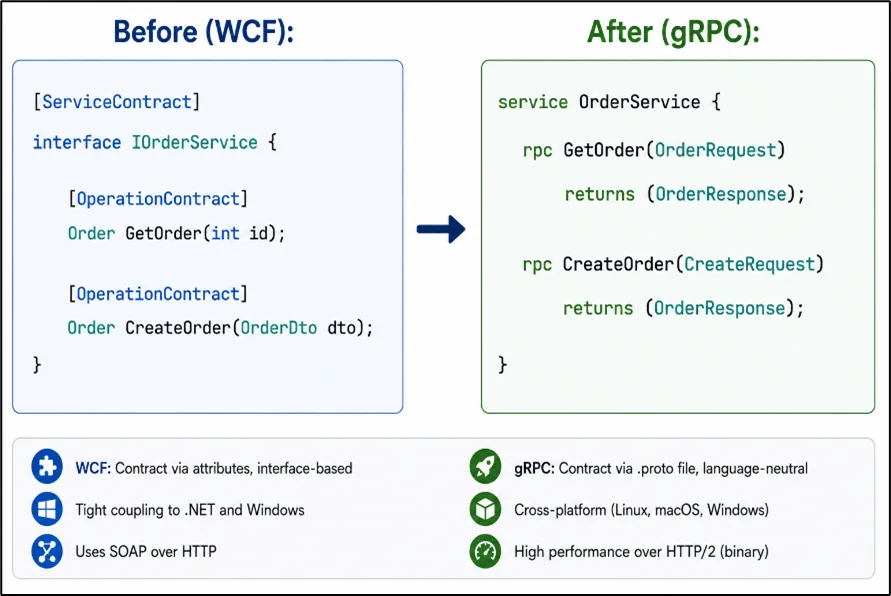
WCF to gRPC
Kiro reads your [ServiceContract] and [OperationContract] attributes, generates equivalent .proto files, and creates the gRPC service implementation:
Entity Framework 6 to EF Core
Kiro migrates your DbContext, entity configurations, and LINQ queries. It handles subtle differences, such as EF Core’s different lazy-loading behavior, the new HasConversion API for value objects, and the migration from Database sqlQuery to FromSqlRaw.
Windows Dependencies to Cross-Platform
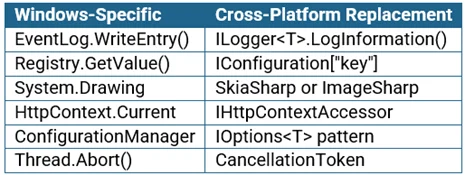
Deployment: From IIS to Amazon ECS Fargate
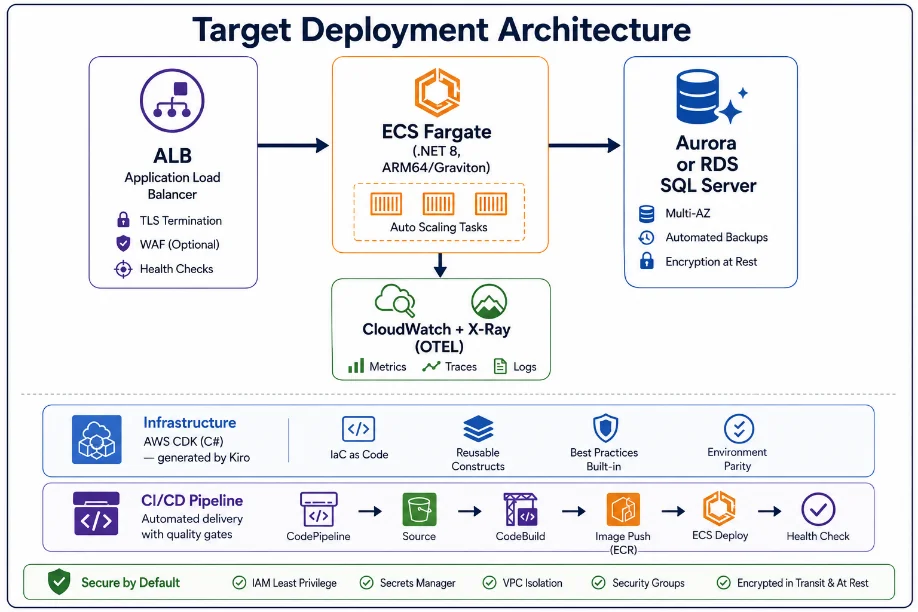
Kiro generates the complete CDK stack in C# (keeping your team in familiar territory), the Dockerfile, the buildspec for AWS CodeBuild, and the Amazon ECS service definition, all as part of the spec execution.
Cost Impact
Real numbers from a mid-size enterprise that modernized 5 .NET applications using this approach:
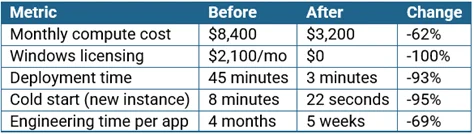
The savings come from three sources: Amazon Graviton ARM64 pricing (20% cheaper than x86), eliminating Linux vs. Windows licensing, and right-sizing through containerization (no more paying for a full Windows Server VM to run a 200MB application).
When NOT to Modernize?
Not every .NET Framework application should be modernized. Keep it on .NET Framework if:
- It’s in maintenance mode with no active development
- It uses COM interop or Windows-specific APIs that have no cross-platform equivalent
- It’s scheduled for retirement within 12 months
- The business logic is so poorly understood that rewriting risks breaking critical behavior
For everything else, especially applications under active development, the modernization investment pays back within 6-9 months through reduced infrastructure costs and faster development velocity.
Conclusion
The result: 62% compute cost reduction, zero Windows licensing, and 93% faster deployments. Start with one application, prove the pattern, and scale across your portfolio.
Drop a query if you have any questions regarding .NET modernization and we will get back to you quickly.
Empowering organizations to become ‘data driven’ enterprises with our Cloud experts.
- Reduced infrastructure costs
- Timely data-driven decisions
About CloudThat
FAQs
1. Can Kiro handle large solutions with 50+ projects?
ANS: – Yes. Kiro’s spec mode breaks large solutions into manageable tasks with dependency ordering. You can modernize projects one at a time, starting with shared libraries (which have no upstream dependencies) and working up to the application layer. Kiro tracks which projects are modernized and adjusts references accordingly.
2. What about NuGet packages that don't have .NET 8 equivalents?
ANS: – Kiro identifies these during the design phase and flags them. Common solutions include finding an alternative package (Kiro suggests options), wrapping the legacy package in a compatibility shim, or isolating that functionality in a separate service that remains on .NET Framework temporarily.
3. Do I need to migrate the database at the same time?
ANS: – No. EF Core works with SQL Server just as well as EF6 did. Modernize the application first (framework, runtime, deployment), then consider database modernization (SQL Server → Amazon Aurora PostgreSQL) as a separate phase. This reduces risk by changing one thing at a time.
4. How do I validate that the modernized application behaves identically?
ANS: – Kiro generates integration tests that call every API endpoint with the same inputs and verify the same outputs. Run these against both the old and new versions simultaneously during a parallel-run period. AWS ALB weighted routing lets you send 5% of traffic to the new version and compare error rates and response times before full cutover.


WRITTEN BY Vignesh J
Vignesh Jagadeesan is the Head of Presales at CloudThat with 12+ years of experience driving digital transformation for Public Sector, SMB, and Enterprise customers across India and the USA. He specializes in Cloud Consulting, Data Management, MDM, Analytics, and enterprise modernization. Vignesh has led transformation engagements spanning cloud adoption, analytics, managed services, and enterprise solutioning across government, BFSI, healthcare, retail, manufacturing, and energy sectors, partnering with business stakeholders and cloud partners to deliver scalable, outcome-driven solutions.


 PREV
PREV










Comments