

 Login
Login


 June 19, 2026
|
Voiced by Amazon Polly |
In many organizations, Employee Training still depends heavily on presentations, recorded sessions, and theory-heavy explanations. While these methods help introduce new topics, they often fall short of building real, usable skills, especially for technical teams.
Today’s developers, data engineers, and analysts are expected not just to understand concepts but to implement them in real environments. They need to build pipelines, debug code, and work with live datasets.
To meet these expectations, organizations must move beyond passive learning and adopt practical approaches like Hands-on Coding Labs, where learning happens through doing rather than just listening.
Start Learning In-Demand Tech Skills with Expert-Led Training
- Industry-Authorized Curriculum
- Expert-led Training
The Problem with Traditional Training
Traditional training methods typically involve slide-based sessions, one-way communication, and limited interaction. While these formats are useful for theoretical understanding, they rarely prepare employees for real-world challenges. For instance, a team might attend a session on cloud architecture or data pipelines and understand the concepts. However, when asked to implement the same in a project, they often struggle.
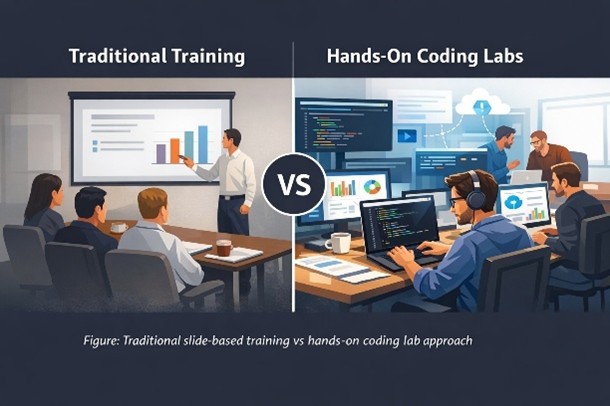
Fig 1: Traditional slide-based training vs hands-on coding lab approach.
This gap between knowledge and execution is one of the biggest limitations of traditional Employee Training approaches.
Why Hands-On Learning Matters
For technical teams, learning is most effective when it involves active participation. Hands-on learning helps employees:
- Retain concepts better
- Solve problems independently
- Gain confidence in real tools and platforms
- Apply knowledge directly to projects
According to the World Economic Forum, nearly half of core workforce skills are expected to change in the coming years. This makes practical, application-based learning more important than ever. This is why organizations must rethink how Employee Training is delivered, shifting focus from theory to execution.
Moving to Real Coding Labs
Coding labs provide a structured environment where employees can practice concepts in real time. Instead of only learning “what” something is, they learn “how” to build it. A typical coding lab includes:
- Guided exercises
- Real-world datasets
- Step-by-step tasks followed by independent practice
- Debugging and validation
For example, instead of just explaining data transformation, a lab would require learners to:
- Load raw data.
- Clean and transform it.
- Build a working pipeline.
- Validate the results.
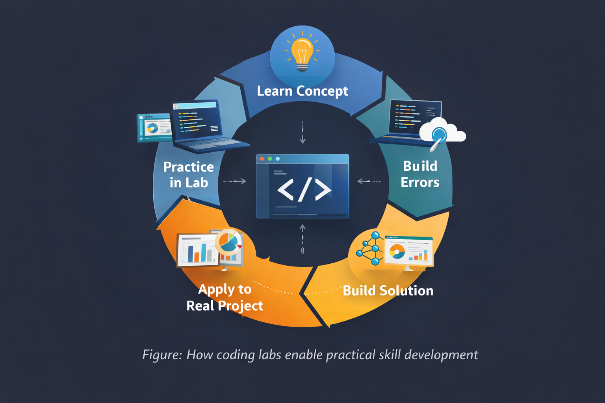
Fig 2: How coding labs enable practical skill development.
This approach forms the core of Hands-on Coding Labs, helping teams bridge the gap between theory and real-world execution.
Real-World Impact of Practical Training
Organizations that adopt hands-on learning models often see clear improvements in team performance. Teams trained through practical environments tend to:
- Deliver projects faster.
- Troubleshoot issues more effectively.
- Reduce dependency on external experts.
- Adapt quickly to new technologies.
Research from LinkedIn Learning shows that employees prefer learning methods that allow immediate application. This highlights how Hands-on Coding Labs build real capability, not just theoretical understanding.
Key Elements of Effective Tech Training Programs
To make training truly impactful, organizations should focus on a few core principles. Learning should begin with practical exposure, supported by minimal theory. Real-world scenarios should replace generic examples, and training should be continuous rather than one-time.
Structured programs can accelerate this process. For example, teams working on reporting and analytics can build hands-on expertise through the Power BI Training Program. Such programs focus on working with real datasets, building dashboards, and applying concepts in practical scenarios. Regular feedback and mentorship further enhance learning outcomes, making Employee Training more effective and results-driven.
Integrating Training with Business Goals
Training should always align with business needs. If an organization is adopting modern data platforms, employees should practice building solutions in those environments. Similarly, if the focus is on analytics, teams should work on real reporting scenarios. For instance, organizations implementing unified data platforms can benefit from programs like Microsoft Fabric Training
This kind of training focuses on end-to-end data workflows, giving teams real experience in building and managing solutions. Aligning Employee Training with business goals ensures measurable impact rather than just theoretical learning.
Challenges in Adopting Hands-On Training
Despite its advantages, organizations may face challenges when shifting to practical learning models. Common challenges include limited infrastructure, time constraints, and a lack of mentorship. However, these can be addressed through cloud-based lab environments, modular learning approaches, and structured programs. Building a culture that encourages continuous learning is equally important for long-term success.
The Future of Tech Training
The future of learning is practical, interactive, and continuous. Modern training approaches are evolving to include:
- Simulation-based environments
- AI-assisted coding tools
- Collaborative learning platforms
- Continuous skill assessments
Organizations that invest in modern Employee Training strategies will be better prepared for future technological changes.
The Future of Training
The shift from slide-based learning to practical execution is no longer optional. Technical teams need more than theoretical knowledge; they need the ability to apply what they learn. This is exactly what Hands-on Coding Labs enable. Organizations that modernize their Employee Training approach will build more capable teams, improve productivity, and adapt more quickly to new technologies. The real question is not whether to evolve training, but how quickly organizations can make this transition.
Upskill Your Teams with Enterprise-Ready Tech Training Programs
- Team-wide Customizable Programs
- Measurable Business Outcomes
About CloudThat


WRITTEN BY Reshu Goyal
Reshu Goyal is a Microsoft Certified Trainer and Subject Matter Expert at CloudThat with over 10 years of experience in data analytics and visualization. She has trained 1,000+ professionals across Power BI, Microsoft Fabric, Advanced Excel and Tableau, delivering sessions for top clients like Microsoft, Deloitte and TCS. Reshu is known for her hands-on, learner-focused approach and her ability to turn complex data into actionable insights.


 PREV
PREV











Comments