

 Login
Login


 March 24, 2026
|
Voiced by Amazon Polly |
Artificial intelligence systems are rapidly evolving from single chatbot experiences into coordinated, task-oriented agents capable of reasoning, planning, and executing actions. Microsoft’s modern agent ecosystem brings together structured orchestration, tool usage, memory, and secure enterprise integration.
In this blog, we will explore how the Microsoft Agent Framework supports AI Agents, Multi-Agent Systems, Agent-to-Agent (A2A) communication, the Model Context Protocol (MCP), and the role of Semantic Kernel. We will also look at when to use each approach in enterprise environments.
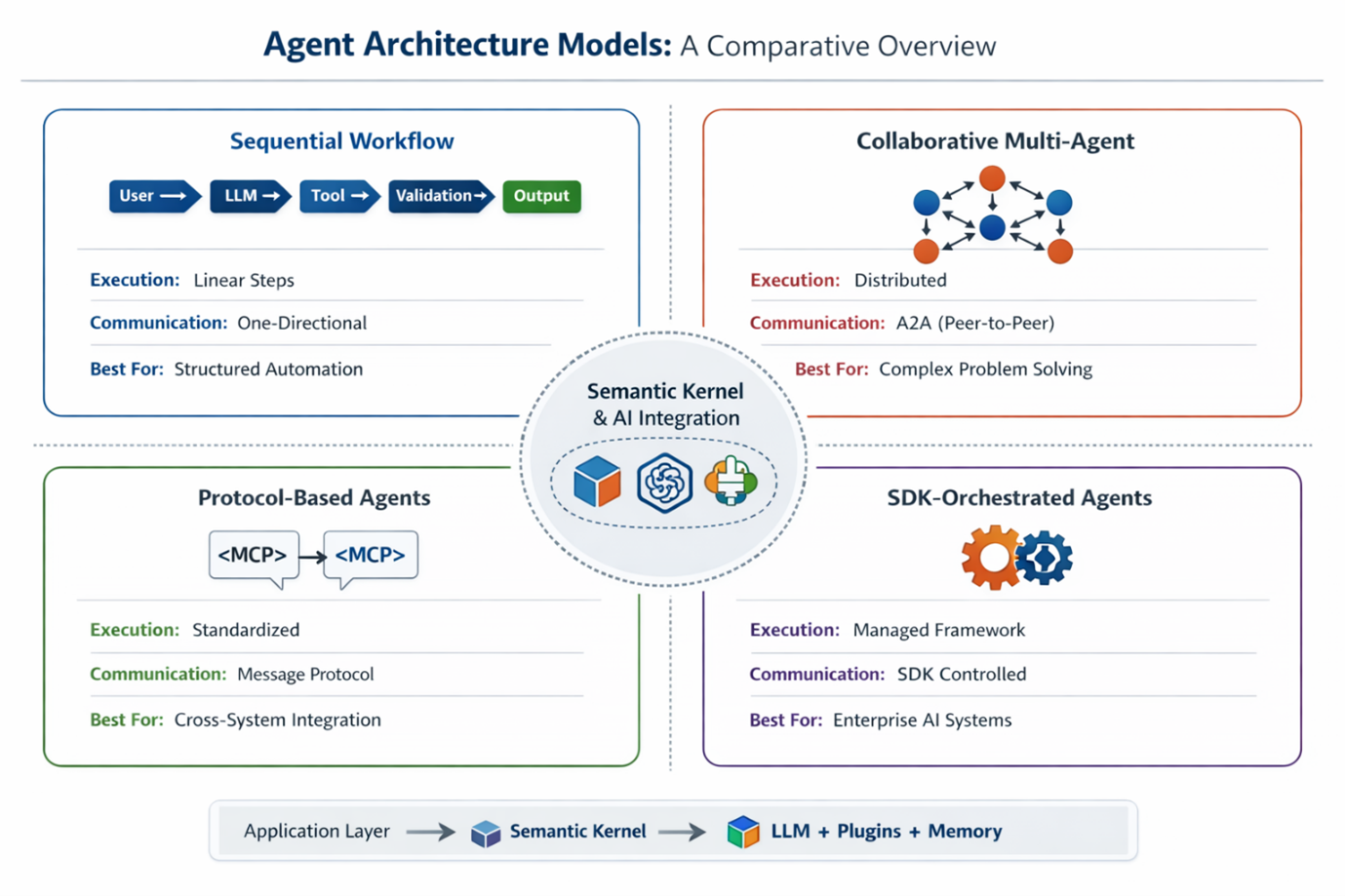
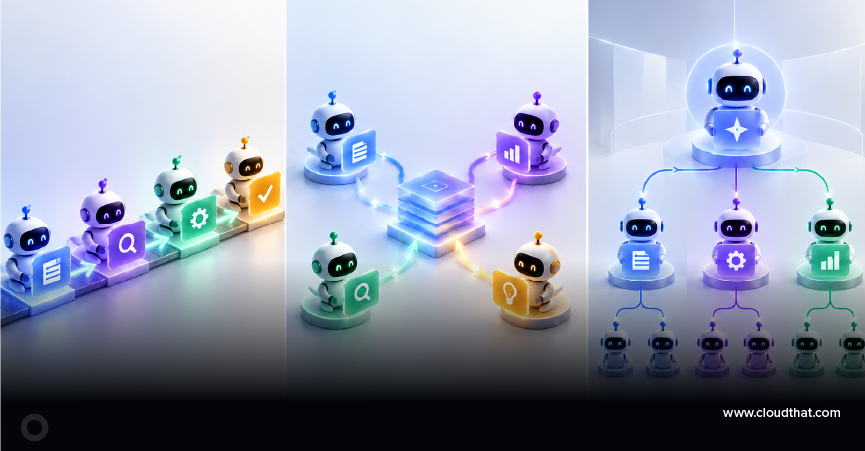
Fig 1: Overview of Microsoft AI agent architecture models and orchestration approaches.
Start Learning In-Demand Tech Skills with Expert-Led Training
- Industry-Authorized Curriculum
- Expert-led Training
What Are AI Agents?
An AI agent is a software entity that perceives its environment, makes decisions based on goals or instructions, and takes actions autonomously to achieve specific objectives. An AI agent is a rational system that selects actions based on precepts and an internal state to maximize the achievement of predefined goals.
For example, consider an HR assistant:
- Receive leave request
- Validate employee eligibility
- Check leave balance
- Generate approval summary
Each action runs in sequence. The agent may use tools such as databases or APIs, but the orchestration logic controls the execution order.
Agents are best suited for:
- Form processing
- Data validation pipelines
- Compliance checks
- Guided workflows
They provide clarity and easier debugging since execution steps are deterministic.
What Are Multi-Agent Systems?
A Multi-Agent System involves multiple specialized agents working together toward a shared goal. Instead of one agent performing all tasks, responsibilities are distributed.
For instance, in a financial advisory platform:
- One agent analyzes risk profile
- Another evaluates market data
- A third drafts the investment report
These agents collaborate, either independently or through a coordinator.
Multi-agent setups are useful when:
- Tasks require specialization
- Complex reasoning must be decomposed
- Scalability and modularity are important
Compared to agents, this approach offers greater flexibility but requires careful orchestration and monitoring.
If you’re building intelligent enterprise workflows using Azure AI, structured orchestration concepts are covered in AI-102 Certification Training.
Understanding A2A (Agent-to-Agent Communication)
A2A, or Agent-to-Agent communication, enables agents to exchange information directly rather than relying on a single controller.
This peer interaction allows:
- Delegation of subtasks
- Feedback sharing
- Distributed reasoning
In a customer support system, a triage agent may forward a technical issue to a troubleshooting agent. The troubleshooting agent may then respond with diagnostic results.
A2A becomes essential when:
- Systems are decentralized
- Agents are independently deployed
- Teams want reusable and composable AI services
However, governance and identity management become critical to prevent uncontrolled communication.
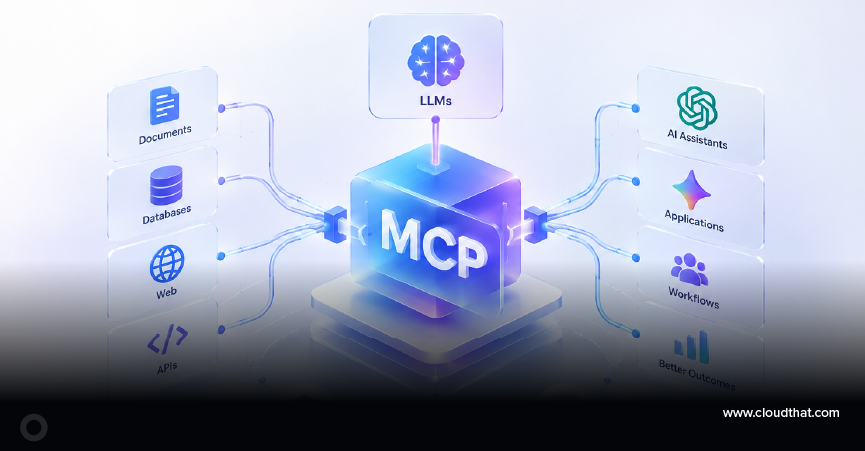
What Is MCP (Model Context Protocol)?
The Model Context Protocol (MCP) defines how context is structured and shared between AI models and tools. It standardizes how models receive memory, instructions, and external data.
MCP ensures:
- Consistent formatting of prompts
- Clear separation of system instructions and user input
- Controlled data grounding
Without MCP, context handling can become fragmented, especially in multi-agent environments.
For enterprises, MCP helps:
- Maintain traceability
- Apply governance policies
- Avoid accidental data leakage
When agents rely on enterprise knowledge sources, structured context handling reduces hallucinations and improves reliability.
Professionals working with enterprise AI architecture can deepen these concepts through Generative AI & Prompt Engineering on Azure Training.
The Role of Semantic Kernel in Microsoft’s Agent Ecosystem
Semantic Kernel is an SDK that helps developers orchestrate AI models, plugins, memory, and workflows in code. It bridges traditional programming with LLM reasoning.
With Semantic Kernel, you can:
- Create planners for multi-step reasoning
- Integrate APIs as plugins
- Maintain conversation memory
- Combine deterministic logic with AI responses
It plays a foundational role in the Microsoft Agent Framework by enabling structured orchestration and tool integration.
For example:
- A retail assistant agent can call inventory APIs.
- A finance agent can run calculation functions.
- A compliance agent can validate documents using custom plugins.
Semantic Kernel supports both agents and multi-agent systems, making it a flexible orchestration layer.
Real-World Enterprise Scenarios
- IT Helpdesk Automation
agents handle ticket validation, categorization, and escalation.
- Intelligent Sales Copilot
A multi-agent system separates lead qualification, proposal drafting, and CRM updates.
- Healthcare Data Review
A2A communication allows diagnostic agents and compliance agents to collaborate securely.
- Financial Risk Assessment
MCP ensures consistent context sharing between models evaluating regulatory data.
Enterprises building AI solutions on Azure often combine these approaches rather than choosing a single approach.
When to Use Each Approach
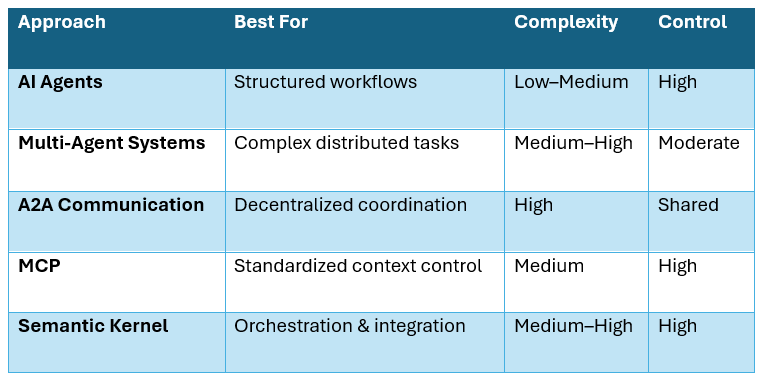
Choosing the right architecture depends on scale, compliance needs, and system modularity.
Modern AI Agent Systems
The Microsoft Agent Framework provides structured approaches for building intelligent, secure, and scalable AI systems. AI agents offer predictability, while Multi-Agent Systems enable specialization and scalability. A2A communication supports distributed collaboration, MCP standardizes context handling, and Semantic Kernel acts as the orchestration backbone.
Rather than viewing these as competing approaches, enterprises should treat them as complementary building blocks. The right design depends on workflow complexity, governance requirements, and long-term maintainability.
As AI systems continue to evolve, structured orchestration and standardized communication will play a central role in building reliable enterprise solutions.
Upskill Your Teams with Enterprise-Ready Tech Training Programs
- Team-wide Customizable Programs
- Measurable Business Outcomes
About CloudThat


WRITTEN BY Akhilash K
Akhilash Nambiyer is a Microsoft Certified Trainer and Subject Matter Expert at CloudThat, specializing in Cloud Technologies, Security, and Data Engineering. With over 5 years of experience in the cloud training and consulting domain, he has trained more than 10,000 learners across Microsoft Azure, AWS, Databricks, and Oracle. Known for his clear, real-world teaching style and ability to simplify complex concepts, he brings deep technical knowledge and practical application into every learning experience. Akhilash’s passion for creating impactful learning experiences and empowering professionals reflects in his engaging, hands-on approach to teaching and mentoring.


 PREV
PREV



Comments