

 Login
Login


 March 24, 2026
|
Voiced by Amazon Polly |
In today’s technology-driven world, machine learning and artificial intelligence have become some of the most sought-after skills across industries. Online platforms, universities, and training institutes offer hundreds of certifications promising to transform beginners into AI professionals in a matter of weeks. While these certifications can be valuable, they often create a misleading perception: that earning a certificate is equivalent to mastering machine intelligence.
The reality is far more nuanced. A machine learning certification may validate your theoretical understanding, but true machine intelligence skills go far beyond course completion. This blog explores the real difference between holding a certification and possessing the depth, adaptability, and problem-solving mindset required to excel in artificial intelligence.
Start Learning In-Demand Tech Skills with Expert-Led Training
- Industry-Authorized Curriculum
- Expert-led Training
The Rise of Machine Learning Certifications
The explosion of data, automation, and AI-driven products has created massive demand for professionals skilled in machine learning. In response, certification programs have multiplied rapidly. They offer structured curricula, guided projects, and standardized assessments, making them attractive to learners and employers alike.
Certifications are especially appealing because they:
- Provide a clear learning roadmap
- Offer proof of foundational knowledge
- Help beginners enter the AI job market
- Improve resumes and LinkedIn profiles
However, as the popularity of certifications grows, so does the confusion between credentialed knowledge and real-world capability.
What a Machine Learning Certification Really Teaches
Most machine learning certifications focus on building a solid academic and technical foundation. They typically cover:
- Basic statistics and linear algebra
- Core algorithms such as regression, decision trees, and neural networks
- Python libraries like NumPy, Pandas, and scikit-learn
- Model training, evaluation, and optimization
- Introductory artificial intelligence concepts
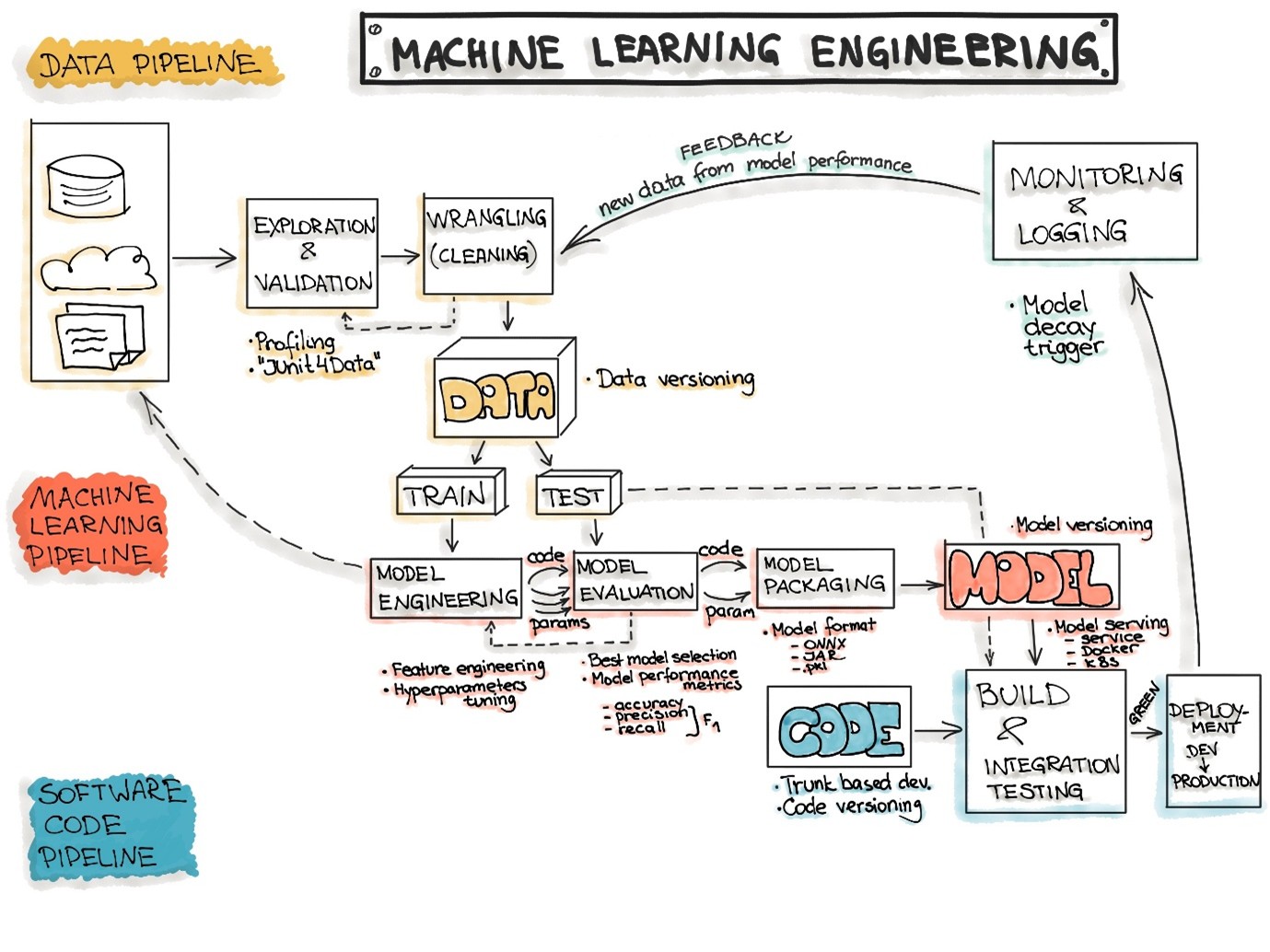
Fig 1: End‑to‑end machine learning engineering pipeline showing how real‑world ML extends beyond model training to data pipelines, deployment, monitoring, and feedback.
These programs are excellent for learning what machine learning is and how algorithms work in controlled environments. They emphasize correctness, reproducibility, and textbook scenarios. For beginners, this structured approach is extremely valuable.
Yet, certifications often stop short of addressing the complexity, ambiguity, and unpredictability of real-world machine intelligence systems.
The Gap Between Certification and Real-World Intelligence
The most significant difference between a certified individual and a truly skilled practitioner lies in their approach to contextual problem-solving. Real-world artificial intelligence rarely resembles clean datasets or perfectly labelled examples.
Common challenges certifications underemphasize include:
- Messy, biased, or incomplete data
- Changing business requirements
- Ethical considerations in AI decisions
- Model deployment and scalability
- Performance trade-offs in production systems
A certificate may teach you how to train a model, but not why the model fails in production or how to redesign it under real constraints. True machine intelligence skills emerge when theory collides with reality.
What True Machine Intelligence Skills Actually Look Like
True machine intelligence skills are less about memorization and more about thinking like a problem-solver. These skills develop through experience, experimentation, and failure.
Key characteristics of genuine expertise include:
- Deep intuition for selecting the right model for the right problem
- Ability to question data sources and assumptions
- Understanding trade-offs between accuracy, speed, and interpretability
- Skill in debugging models when results don’t make sense
- Awareness of ethical risks in artificial intelligence systems
Unlike certifications, these abilities cannot be learned quickly. They are cultivated through hands-on projects, real datasets, and long-term exposure to diverse AI problems.
Why Artificial Intelligence Demands More Than Credentials
Artificial intelligence is not just a technical field; it is inherently interdisciplinary. It intersects with psychology, economics, ethics, and domain-specific knowledge. A healthcare recommendation system, for example, requires far more than knowing machine learning algorithms.
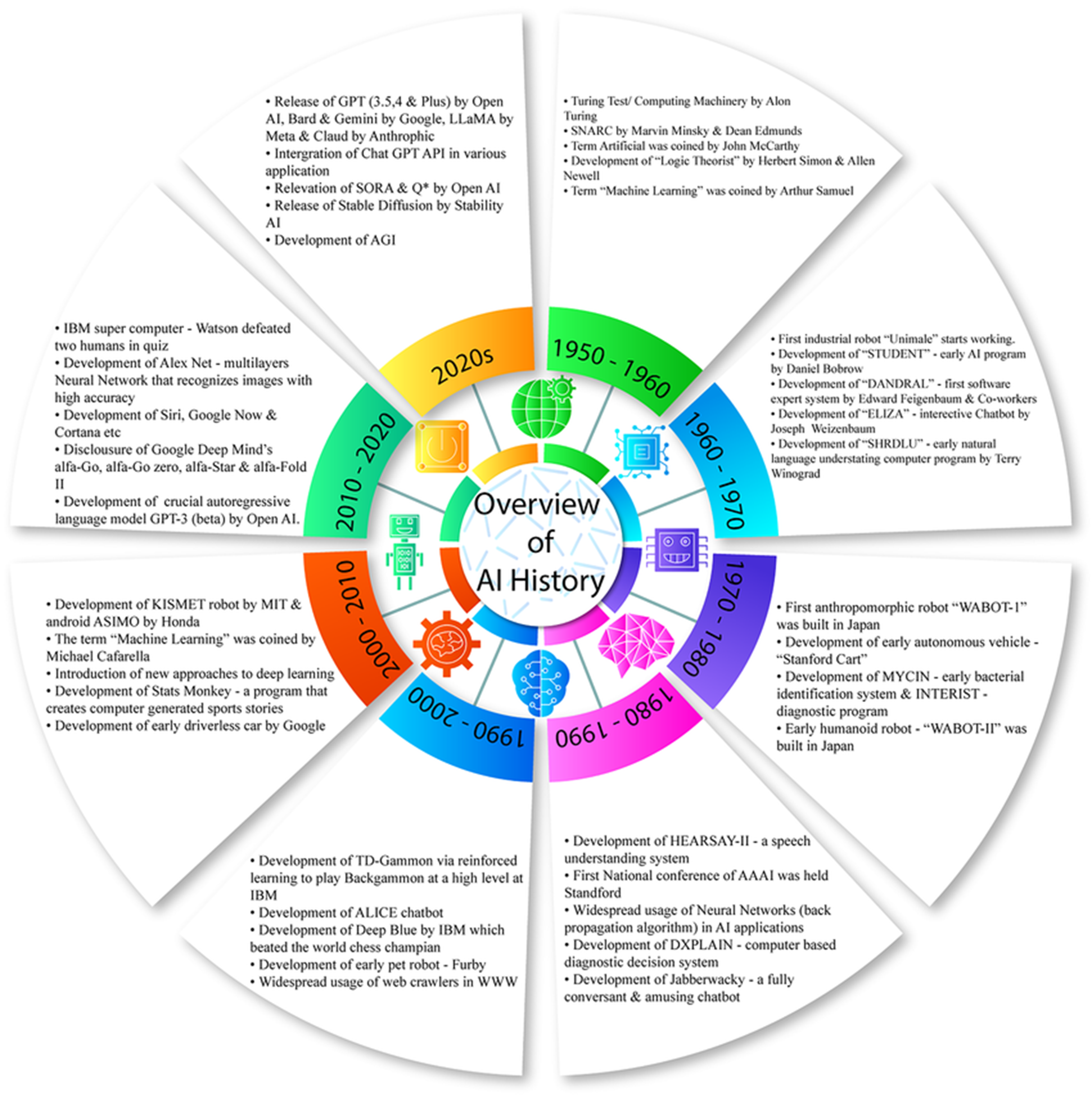
Fig 2: An overview of artificial intelligence history, showcasing major breakthroughs that shaped modern machine learning and intelligent systems.
True machine intelligence professionals:
- Communicate insights to non-technical stakeholders
- Translate business problems into ML solutions
- Continuously learn as tools and techniques evolve
- Adapt models based on user behavior and feedback
Certifications validate knowledge acquisition, but AI success depends on its application.
How to Bridge the Gap Between Certification and Expertise
Earning a machine learning certification should be the starting point, not the finish line. To build true machine intelligence skills, consider the following steps:
- Work on real-world projects using open datasets or personal initiatives
- Deploy models instead of stopping at training accuracy
- Study failures and understand why models break
- Collaborate with others to learn diverse approaches
- Read research papers and case studies beyond the course material
By combining structured learning with practical experience, certifications transform from mere credentials into stepping stones toward genuine mastery of artificial intelligence.
The Future of Machine Learning and Human Skill
As tools become more automated, the value of human insight increases. AutoML platforms can now train models with minimal effort, but they cannot replace critical thinking, ethical judgment, or creativity.
The future of machine learning belongs to professionals who:
- Understand both algorithms and context
- Balance automation with responsibility
- Think beyond code to long-term impact
In this future, certifications will still matter, but only when paired with authentic machine intelligence skills.
Skills Over Certificates
A machine learning certification is a powerful educational tool, but it is not a substitute for real expertise. True machine intelligence skills come from applying knowledge in complex, uncertain, and high-stakes environments. While certifications open doors, experience keeps them open.
To thrive in artificial intelligence, learners must move beyond checklists and exams, embracing curiosity, experimentation, and continuous growth. In the end, it is not the certificate that defines intelligence; it is the ability to solve meaningful problems in the real world.
Upskill Your Teams with Enterprise-Ready Tech Training Programs
- Team-wide Customizable Programs
- Measurable Business Outcomes
About CloudThat


WRITTEN BY Nehal Verma
Nehal is a seasoned Cloud Technology Expert and Subject Matter Expert at CloudThat, specializing in AWS with a proven track record across Generative AI, Machine Learning, Data Analytics, DevOps, Developer Tools, Databases and Solutions Architecture. With over 12 years of industry experience, she has established herself as a trusted advisor and trainer in the cloud ecosystem. As a Champion AWS Authorized Instructor (AAI) and Microsoft Certified Trainer (MCT), Nehal has empowered more than 15,000 professionals worldwide to adopt and excel in cloud technologies. She holds premium certifications across AWS, Azure, and Databricks, showcasing her breadth and depth of technical expertise. Her ability to simplify complex cloud concepts into practical, hands-on learning experiences has consistently earned her praise from learners and organizations alike. Nehal’s engaging training style bridges the gap between theory and real-world application, enabling professionals to gain skills they can immediately apply. Beyond training, Nehal actively contributes to CloudThat’s consulting practice, designing, implementing and optimizing cutting-edge cloud solutions for enterprise clients. She also leads experiential learning initiatives and capstone programs, ensuring clients achieve measurable business outcomes through project-based, real-world engagements. Driven by her passion for cloud education and innovation, Nehal continues to champion technical excellence and empower the next generation of cloud professionals across the globe.


 PREV
PREV







Comments