

 Login
Login


 November 11, 2025
|
Voiced by Amazon Polly |
Overview
In today’s data-driven world, organizations rely heavily on Business Intelligence (BI) tools to make informed decisions. However, even with sophisticated dashboards and visualization platforms, users often face a major bottleneck, the need to ask the right question before obtaining an answer. What if that step could disappear entirely? What if your BI system could understand the business context, predict your information needs, and deliver insights proactively?
Adaptive Agents in Business Intelligence, where AI-driven agents act as intelligent collaborators, transforming BI from a reactive process into a continuous, adaptive, and conversational experience. These agents are revolutionizing how businesses consume data, enabling real-time insights without writing a single query.
Pioneers in Cloud Consulting & Migration Services
- Reduced infrastructural costs
- Accelerated application deployment
From Static Dashboards to Intelligent Conversations
Traditional BI systems have always revolved around a single premise: you ask, and the system answers. Whether it’s through SQL queries, filters, or dashboard navigation, users are expected to know what they’re looking for. This model works for analysts but creates friction for non-technical users who just want quick, clear answers.
Adaptive agents eliminate that friction by turning data interaction into a natural dialogue. They don’t wait for questions, they anticipate needs.
Imagine a sales manager receiving a morning message:
“Good morning, Sarah. Yesterday’s revenue in the western region decreased by 7%, primarily due to lower conversion rates in high-value accounts. Should I prepare a strategy summary?”
That’s not BI. That’s Intelligent Business Awareness.
What Are Adaptive Agents?
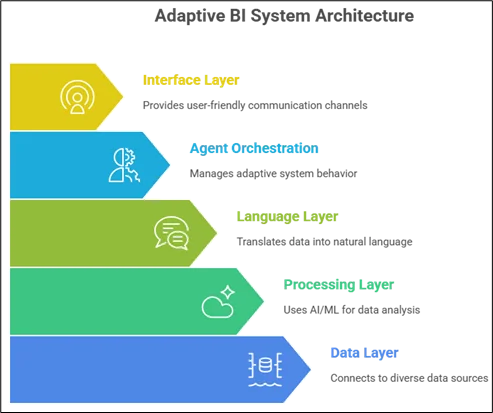
Adaptive agents are AI-powered entities that combine machine learning, natural language understanding (NLU), and context-aware analytics to dynamically interpret business data. They act as proactive digital analysts, continuously scanning data sources, identifying anomalies, and generating actionable insights, all without user intervention.
Core Capabilities of Adaptive Agents
- Contextual Understanding:
They understand what “sales drop” or “customer churn risk” means in the context of your business, not just as data points but as business events. - Proactive Insights:
Agents monitor key metrics and alert stakeholders automatically when anomalies, patterns, or trends emerge. - Conversational Interaction:
They can respond to plain language queries, such as “Why did revenue fall yesterday?” or “What’s our top-selling product this week?” with human-like explanations. - Adaptive Learning:
These agents learn from feedback, usage patterns, and past decisions to improve the relevance of future insights. - Seamless Integration:
They integrate with data lakes, ERP, CRM, and BI tools like Power BI or Tableau to pull data and generate context-rich insights.
Why Businesses Are Moving Toward Adaptive BI?
The growing complexity of enterprise data has made traditional BI tools harder to manage and slower to deliver value. Adaptive agents introduce a new layer of intelligence, transforming BI into an autonomous decision-making ecosystem.
Here are the top reasons businesses are adopting this approach:
- Speed and Real-Time Awareness
In fast-moving industries, insights delayed by hours or days are often worthless. Adaptive agents deliver real-time intelligence, enabling leaders to act before small issues become crises.
For example, an agent monitoring e-commerce transactions can immediately alert the operations team if a product’s return rate exceeds a threshold, even before customers start complaining.
- Democratization of Data
Not everyone in an organization can write SQL or interpret complex dashboards. Adaptive agents utilize natural language and conversational interfaces, enabling anyone, from HR to sales, to access insights effortlessly.
This democratization of data reduces dependency on data teams and encourages data-driven thinking across all departments.
- Continuous Learning
Unlike dashboards that rely on static filters, adaptive agents evolve. They learn from organizational goals, feedback, and usage behavior to refine their output. The more they’re used, the smarter and more aligned they become.
- Reduced Manual Effort
BI teams spend huge amounts of time creating reports that are outdated the moment they’re delivered. Adaptive agents automate that process, saving time, reducing human error, and ensuring data relevance.
- Actionable, Not Just Informational
While dashboards show “what happened,” adaptive agents explain “why it happened” and “what to do next.” They bridge the gap between analytics and action, making BI a true decision engine.
Use Cases Across Industries
Adaptive agents are not limited to one sector, their impact spans every domain where data exists. Here are a few real-world examples:
- Retail and E-commerce
- Detect sales dips by product category in real time.
- Recommend inventory adjustments or marketing pushes instantly.
- Summarize daily store performance automatically.
- Finance
- Monitor transaction anomalies to detect fraud.
- Provide real-time profit and loss summaries.
- Forecast revenue trends based on macroeconomic factors.
- Healthcare
- Track patient outcomes or hospital occupancy trends.
- Alert staff to rising admission rates or drug shortages.
- Generate compliance and performance summaries automatically.
- Manufacturing
- Detect machine anomalies or production bottlenecks.
- Suggest maintenance schedules.
- Predict supply chain disruptions.
The Future of BI
The next evolution of BI is anticipatory analytics, where the system anticipates your needs before you even think about them. Adaptive agents are the foundation of that future.
We’re moving from:
- Dashboards → Conversations
- Queries → Predictions
- Reports → Recommendations
In the coming years, these agents will integrate even deeper into business workflows, initiating actions directly, such as adjusting budgets, modifying supply schedules, or approving campaigns, based on pre-approved logic.
BI will no longer be a tool you open; it will be an intelligent entity with which you collaborate.
Conclusion
Adaptive Agents are reshaping Business Intelligence by making data truly dynamic, conversational, and proactive. They eliminate the barriers of technical expertise, speed up decision-making, and personalize insights for every stakeholder.
In this new paradigm, you don’t need to ask for insights, they come to you.
You don’t spend hours exploring dashboards, the system tells you what matters.
You don’t wait for reports, you act on real-time, AI-driven intelligence.
Drop a query if you have any questions regarding Adaptive Agents and we will get back to you quickly.
Empowering organizations to become ‘data driven’ enterprises with our Cloud experts.
- Reduced infrastructure costs
- Timely data-driven decisions
About CloudThat
FAQs
1. Are adaptive agents the same as AI chatbots used in BI tools?
ANS: – Not exactly. While both use natural language processing, adaptive agents go beyond conversational assistance. They proactively generate insights, understand business context, and provide real-time decision support. Chatbots typically respond to queries; adaptive agents, on the other hand, anticipate them.
2. Can adaptive agents work with existing BI platforms like Power BI or Tableau?
ANS: – Yes. Most adaptive agent frameworks integrate seamlessly with existing BI tools and data sources through APIs or connectors. They act as an intelligent overlay, enhancing your current BI ecosystem without replacing it.
3. How do adaptive agents ensure data privacy and security?
ANS: – Modern adaptive BI solutions implement strong governance models, including user authentication, role-based access, and data encryption. Additionally, many agents operate within your organization’s cloud environment, ensuring sensitive data never leaves your controlled infrastructure.


WRITTEN BY Modi Shubham Rajeshbhai
Shubham Modi is working as a Research Associate - Data and AI/ML in CloudThat. He is a focused and very enthusiastic person, keen to learn new things in Data Science on the Cloud. He has worked on AWS, Azure, Machine Learning, and many more technologies.


 PREV
PREV











Comments