

 Login
Login

 September 25, 2026
|
Voiced by Amazon Polly |
What Is Cache-Augmented Generation (CAG)?
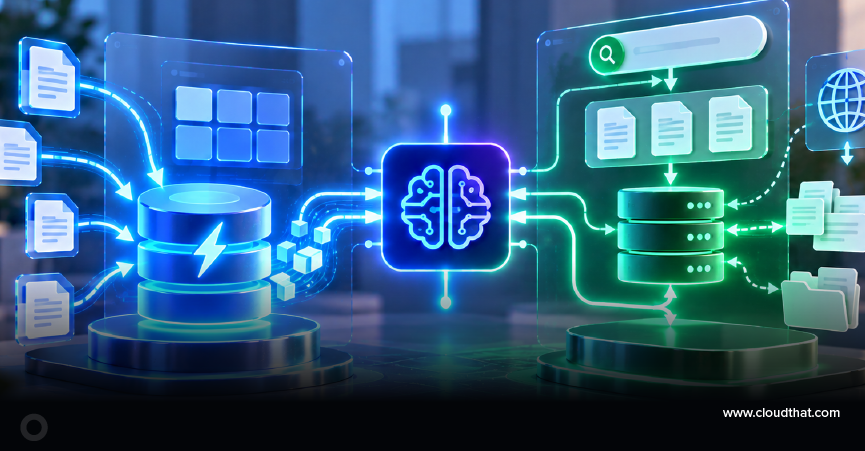
Cache-Augmented Generation (CAG) is an AI architecture that improves Large Language Model (LLM) performance by preloading relevant knowledge into the model’s context and storing the resulting Key-Value (KV) cache for future use. Unlike Retrieval-Augmented Generation (RAG)., which retrieves information from external databases whenever a user submits a query, CAG prepares knowledge in advance and allows the model to access it directly during inference.
By eliminating the retrieval step, CAG reduces latency, simplifies infrastructure, and improves response consistency. Instead of searching for documents at runtime, the model uses pre-cached information to generate answers immediately.
In simple terms:
- RAG retrieves information first and then generates a response.
- CAG prepares the information first, then generates a response.
This architectural difference can significantly impact performance, reliability, and operational complexity in enterprise AI applications.
Start Learning In-Demand Tech Skills with Expert-Led Training
- Industry-Authorized Curriculum
- Expert-led Training
Why Was CAG Introduced Over RAG?
CAG was introduced to address several limitations associated with traditional RAG systems, including retrieval errors, higher latency, infrastructure complexity, and increased operational costs.
While RAG successfully connects LLMs with external knowledge sources, every query requires multiple operations such as document retrieval, ranking, and context assembly. These additional steps can slow response times and introduce opportunities for inaccuracies.
Organizations adopting enterprise AI applications often encounter challenges such as:
- Retrieval failures despite relevant data being available
- Performance
- Complex infrastructure involving embeddings, retrievers, and vector databases
- Vector database maintenance requirements
- Additional maintenance and operational costs
CAG addresses these issues by leveraging the growing context window capabilities of modern LLMs. Instead of retrieving data at query time, knowledge is loaded into the model beforehand, enabling faster and more reliable responses.
Why Do Traditional RAG Architectures Face Growing Challenges?
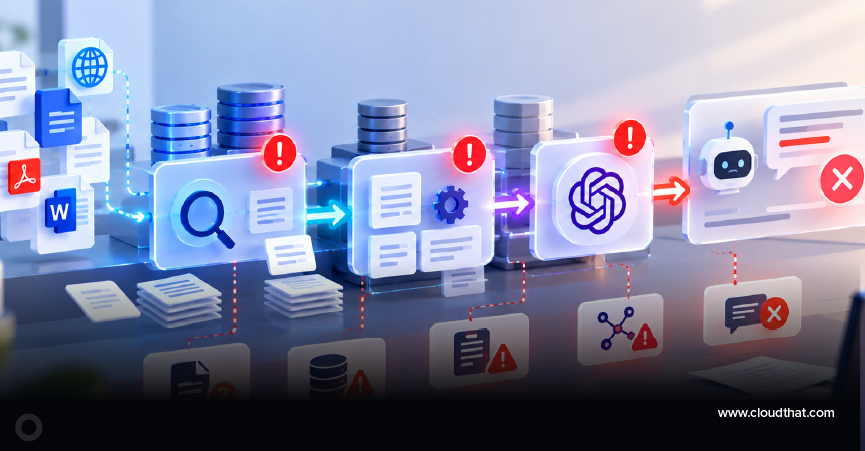
Traditional RAG architectures face growing challenges because they rely on multiple interconnected components, which increase complexity, latency, and maintenance requirements.
A typical RAG pipeline includes:
- Document ingestion systems
- Embedding generation
- Vector databases
- Retrieval engines
- Re-ranking mechanisms
- Context assembly workflows
Although effective, these components create several operational concerns.
- Retrieval Inaccuracies
RAG systems depend on retrieving the correct document before generating an answer. If the retrieval system fails to identify the most relevant information, the language model may produce incomplete or inaccurate responses, even when the required knowledge is present in the database.
- Higher Latency
Every user query triggers a retrieval process that searches, ranks, and retrieves information before generation can start. This additional processing increases overall response time.
- Infrastructure Complexity
Organizations must maintain multiple services, including vector databases, retrieval systems, embedding models, and indexing pipelines. These components increase operational overhead and introduce additional points of failure.
- Increased Costs
The infrastructure required to support RAG includes storage systems, embedded generation, vector search services, database maintenance, and monitoring tools, all of which contribute to higher operational expenses.
As LLM context windows continue to expand, many organizations are exploring alternatives, such as CAG, that reduce dependence on retrieval infrastructure.
What Is the Purpose of Using CAG?
The primary purpose of using CAG is to deliver faster, more reliable AI responses while reducing infrastructure complexity and retrieval-related errors.
By preloading domain knowledge into a Key-Value cache, CAG enables language models to access information instantly without performing external searches. This makes it particularly valuable for applications where response speed and consistency are critical.
Faster Response Times
Unlike RAG systems, CAG eliminates the retrieval step that occurs before answer generation. Since the required information is already available in the model’s context, responses can be generated more quickly.
This advantage is especially useful in:
- Customer support chatbots
- Enterprise knowledge assistants
- Virtual assistants
- Real-time decision-support systems
Improved Reliability
CAG minimizes the risk of retrieval-related failures because the relevant information has already been loaded into the model’s cache.
Rather than relying on a search mechanism to locate the correct document, the model works directly from prepared knowledge. This results in more consistent outputs and reduces inaccuracies caused by retrieval errors.
Simplified Architecture
CAG removes the need for many components commonly found in RAG systems, such as:
- Vector databases
- Embedding pipelines
- Retrieval services
- Re-ranking engines
This simplified architecture reduces maintenance requirements and operational overhead.
Lower Operational Costs
Because fewer infrastructure components are required, organizations can reduce costs associated with database management, vector search operations, indexing systems, and monitoring.
When Should You Choose CAG Over RAG?
You should choose CAG when your knowledge base is relatively stable, low latency is important, and the required information can fit within the model’s context window.
CAG performs particularly well in environments where information does not change frequently and where consistent, fast responses are a business priority.
Choose CAG when:
- Knowledge is relatively static
- Fast response times are critical
- Infrastructure simplicity is important
- Retrieval errors negatively affect performance
- The required information fits within the model’s context limits
Examples include enterprise policy assistants, internal knowledge systems, product documentation chatbots, and customer support platforms that rely on stable information.
When Should You Choose RAG Instead of CAG?
You should choose RAG when information changes frequently, knowledge repositories are extremely large, or real-time updates are essential.
Since RAG retrieves information at query time, it can access the latest available content without requiring the entire knowledge base to fit within the model’s context window.
Choose RAG when:
- Information changes regularly
- Knowledge repositories are very large
- Real-time updates are required
- The data exceeds context window limitations
- Access to continuously evolving information is necessary
Examples include financial research systems, news applications, regulatory compliance platforms, and environments with rapidly changing datasets.
CAG vs RAG: Key Takeaways
Cache-Augmented Generation represents a significant step forward in AI system design. By replacing real-time retrieval with preloaded knowledge and KV caching, CAG delivers faster responses, simpler architectures, and improved reliability. While it has limitations related to context size and knowledge freshness, it is an excellent choice for many enterprise use cases where information is stable and latency matters. For organizations evaluating CAG vs RAG, the best choice depends on knowledge freshness requirements, latency expectations, and operational complexity.
As AI continues to mature, understanding technologies like CAG will be essential for architects, developers, and business leaders who want to build the next generation of intelligent applications.
Cache-Augmented Generation (CAG) improves AI performance by preloading domain knowledge into an LLM context and leveraging Key-Value (KV) caching, eliminating the need for real-time retrieval in many enterprise use cases.
While it is not a complete replacement for Retrieval-Augmented Generation, it offers a compelling alternative for organizations working with stable knowledge bases where latency and reliability are high priorities.
As context windows continue to grow and AI infrastructure evolves, CAG is positioned to become a powerful architectural pattern for the next generation of intelligent business applications.
Upskill Your Teams with Enterprise-Ready Tech Training Programs
- Team-wide Customizable Programs
- Measurable Business Outcomes
About CloudThat
FAQs
1. How is CAG different from RAG?
ANS: – RAG: Retrieves relevant documents/chunks at query time. CAG Preloads the required knowledge beforehand and uses the cached context.
2. Does CAG require a vector database?
ANS: – Usually no. Unlike a traditional RAG architecture, CAG can operate without embeddings, a retriever, or a vector database because the knowledge is already loaded into the model’s context.
3. What are the limitations of CAG?
ANS: – The knowledge base must be small enough to fit within the model’s context window. CAG is also less suitable when information changes frequently.


WRITTEN BY Sindhu Priya M
Sindhu Priya M is a Technical Lead at CloudThat, specializing in Development, Infra-Management and DevOps. With 6+ years of experience in training and consulting, she has trained over 1000+ professionals to upskill in Architecture, Development and DevOps. Known for simplifying complex concepts, hands-on teaching, and industry insights, she brings deep technical knowledge and practical application into every learning experience. Sindhu's passion for development technology reflects in her unique approach to learning and development.


 PREV
PREV










Comments