

 Login
Login


 September 23, 2026
|
Voiced by Amazon Polly |
Most AI pilots never make it to production, and the reason is rarely the model. It’s the gap between a demo and a working system within someone else’s infrastructure, data, and compliance rules. Forward-deployed engineering exists to close that exact gap, and this post lays out what the role involves and the beginner-to-advanced roadmap to get there.
Start Learning In-Demand Tech Skills with Expert-Led Training
- Industry-Authorized Curriculum
- Expert-led Training
What is a forward-deployed engineer?
A forward-deployed engineer (FDE) is a software engineer who embeds directly inside a customer’s environment to build, integrate, and ship a working system, not a slide deck or a proof of concept. The role sits between product engineering, solutions architecture, and customer success, and the person in it usually writes production code on-site or in the customer’s systems rather than from within a product team. Originally pioneered by Palantir, the Forward Deployed Engineer (FDE) model was designed to embed technical talent directly within customer organizations to solve complex deployment challenges. What began in government and defense has since become a cornerstone of enterprise AI adoption. In 2026, OpenAI launched the OpenAI Deployment Company to scale this approach, while companies including Anthropic, Google Cloud, Salesforce, Adobe, Ramp, and Databricks have expanded hiring for similar customer-embedded engineering roles.
Why is forward-deployed engineering suddenly the hottest role in tech?
Enterprises are funding AI faster than they can make it work, and forward-deployed engineering is the role built to close that gap. A widely cited MIT NANDA study, also covered by The National CIO Review, found that 95% of enterprise generative AI pilots deliver no measurable profit-and-loss impact. The report concludes that these failures stem primarily from workflow integration, organizational adoption, and contextual fit rather than model quality, which is precisely the gap a forward-deployed engineer is positioned to address.
The hiring data reinforces this trend. Demand for forward-deployed engineers has surged as enterprises move from AI experimentation to production deployment, with job postings growing several hundred percent year over year. Box CEO Aaron Levie has described forward-deployed engineers as one of the most important roles for enterprise AI rollouts because they bridge the gap between powerful AI models and real-world business workflows
What does a forward-deployed engineer do day to day?
An FDE’s week splits between customer discovery, hands-on building, and production support, not just one of the three. A typical cycle looks like sitting with a customer’s team to map their actual workflow, writing the integration or agent that fits that workflow, and then staying on the hook when it breaks in production, rather than handing it off to someone else.
That last part is what separates an FDE from a solutions engineer or a consultant: solutions engineers scope and hand off, consultants advise and leave, but an FDE owns the outcome through go-live and beyond.
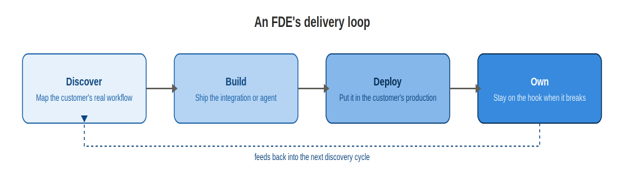
Fig 1: An FDE’s delivery loop: discover, build, deploy, own, and then feed back into the next discovery cycle.
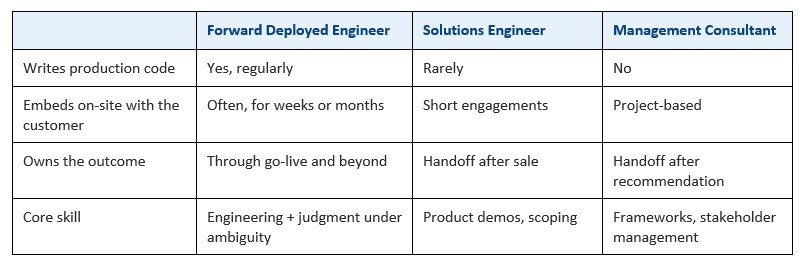
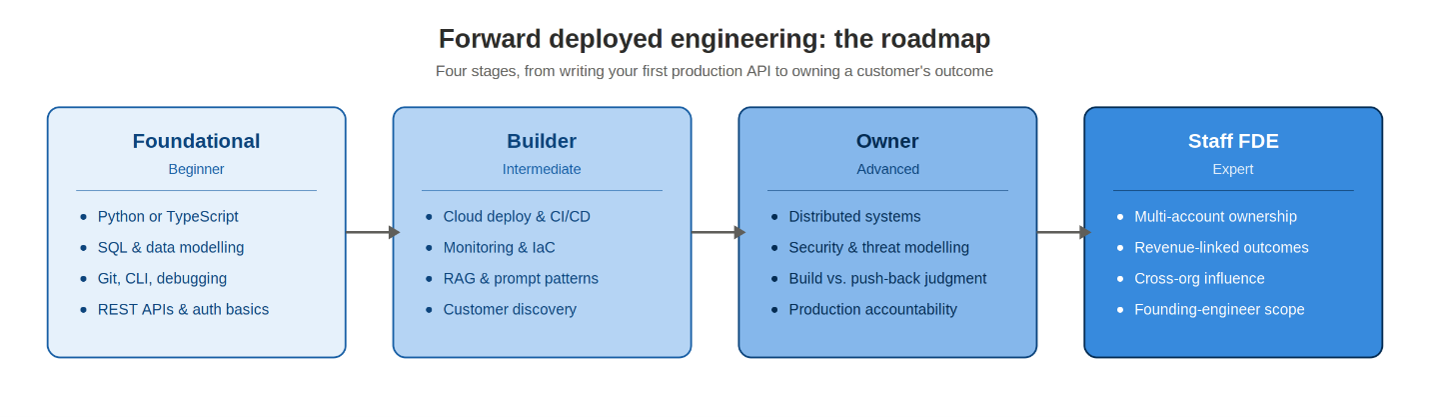
Fig 2: Forward-deployed engineering roadmap: four stages from foundational to staff FDE.
What foundational skills do you need to start?
At the beginner stage, you need strong general-purpose engineering skills, not AI-specific tooling. FDE work comes later, once you can reliably build and ship software. Focus on developing fluency in a backend language such as Python or TypeScript, a solid understanding of SQL and relational data modeling, proficiency with Git and the command line, and enough systems knowledge to design, build, and consume REST APIs with proper authentication and authorization.
This is also the stage to develop the habit of writing things down. Documentation, runbooks, design notes, and concise status updates are essential because FDEs spend nearly as much time communicating the state of a system as they do building it. One of the most valuable early exercises is to complete a single end-to-end project, including testing, deployment, and documentation, rather than starting several projects and leaving them unfinished.
What intermediate skills separate a working FDE from a beginner?
The intermediate stage is where you learn to ship and operate a system, not just build one. This means containers and CI/CD, basic cloud deployment and infrastructure-as-code, monitoring and logging, and, increasingly, the applied AI stack: retrieval-augmented generation patterns, prompt design, and evaluation frameworks for checking whether an AI feature is working, not just producing plausible output.
Alongside the technical layer, this is where customer-facing skills start to matter: running a discovery session, translating a vague business problem into a written technical requirement, and presenting a tradeoff to a non-technical stakeholder in a way they can actually decide on.
What advanced skills do senior and staff FDEs need?
At the advanced level, the job stops being about your own code and starts being about the system you’re accountable for and the decisions that shape it. That includes distributed systems and data pipeline design for handling customer scale, security, and threat modeling in regulated environments, and the judgment to know when to build versus when to push back on a customer’s request that doesn’t actually solve their problem.
Staff-level FDEs also carry commercial weight; they’re expected to connect what they ship to a customer’s renewal or expansion decision, which means understanding the account, not just the architecture. This is the layer where the role starts to resemble a founding engineer’s job on someone else’s product.
How much do forward-deployed engineers get paid?
Forward-deployed engineer compensation is unusually high for an engineering role because the skill combination is genuinely scarce. Reported total compensation for a mid-level FDE typically runs from roughly $200,000 to $480,000, with staff-level offers clearing $600,000 at the highest-paying AI labs, a premium that companies pay because strong engineering and high-stakes customer judgment rarely live in the same person.
How do you build this skill set on your team?
The most transferable skill here isn’t “using AI”; it’s learning to diagnose which part of a workflow needs an AI system and which part just needs a script, then having the platform skills to build either. The AB-730 course is built around exactly that judgment call, and it’s a practical starting point for anyone moving into a customer-facing technical role.
Upskill Your Teams with Enterprise-Ready Tech Training Programs
- Team-wide Customizable Programs
- Measurable Business Outcomes
About CloudThat
FAQs
1. Do I need a computer science degree to become a forward-deployed engineer?
ANS: – No. Hiring teams generally weigh demonstrated production experience and a strong portfolio project over a specific degree. A structured project that you built, deployed, and can explain end-to-end carries more weight than credentials alone.
2. Is a forward-deployed engineer the same as a solutions architect?
ANS: – No. A solutions architect typically designs a system and hands the build to someone else. An FDE writes the production code and stays accountable for it after go-live, which is a meaningfully different scope of ownership.
3. Which industries hire the most forward-deployed engineers?
ANS: – Regulated, high-complexity industries hire the most fintech, healthcare, defense, and enterprise SaaS. These are environments where a generic off-the-shelf tool typically fails to meet compliance or integration requirements.
4. Is forward-deployed engineering a good fit for someone who dislikes ambiguity?
ANS: – Probably not. The role rewards people who can create structure and momentum when a customer’s requirement is still vague, and that ambiguity doesn’t go away as you get more senior; it just shows up at a higher level of the system.


WRITTEN BY Pooja Sharma
Pooja Sharma is a Technical Trainer specializing in Data Science, Machine Learning, Generative AI, Agentic AI, and Azure Cloud AI solutions. With 17+ years of experience in AI, software development, research, and technology training, she has trained and mentored 10000+ professionals and students in Python, Azure AI, Microsoft Foundry, Azure OpenAI, RAG, and MLOps. She holds a PhD in Deep Learning and its applications and is known for simplifying complex concepts through practical, hands-on learning. Her passion for emerging AI and cloud technologies reflects in her engaging and learner-centric approach to learning and development.


 PREV
PREV











Comments