

 Login
Login


 September 3, 2026
|
Voiced by Amazon Polly |
Modern software delivery has fundamentally changed. Organizations deploy applications multiple times a day, provision infrastructure through code, and cloud-native architectures continue to expand. While development velocity has increased significantly, security practices in many organizations have not evolved at the same pace.
Traditional security reviews performed just before production releases are no longer sufficient. Vulnerabilities introduced during development can quickly propagate through automated deployment pipelines, making them more expensive and complex to remediate later. This challenge has led to the emergence of DevSecOps, an approach that integrates security into every phase of the software development lifecycle instead of treating it as a final checkpoint. However, despite widespread adoption of DevOps practices, many organizations struggle to implement DevSecOps successfully. The issue is rarely the technology itself; it is often the way teams approach people, processes, and automation.
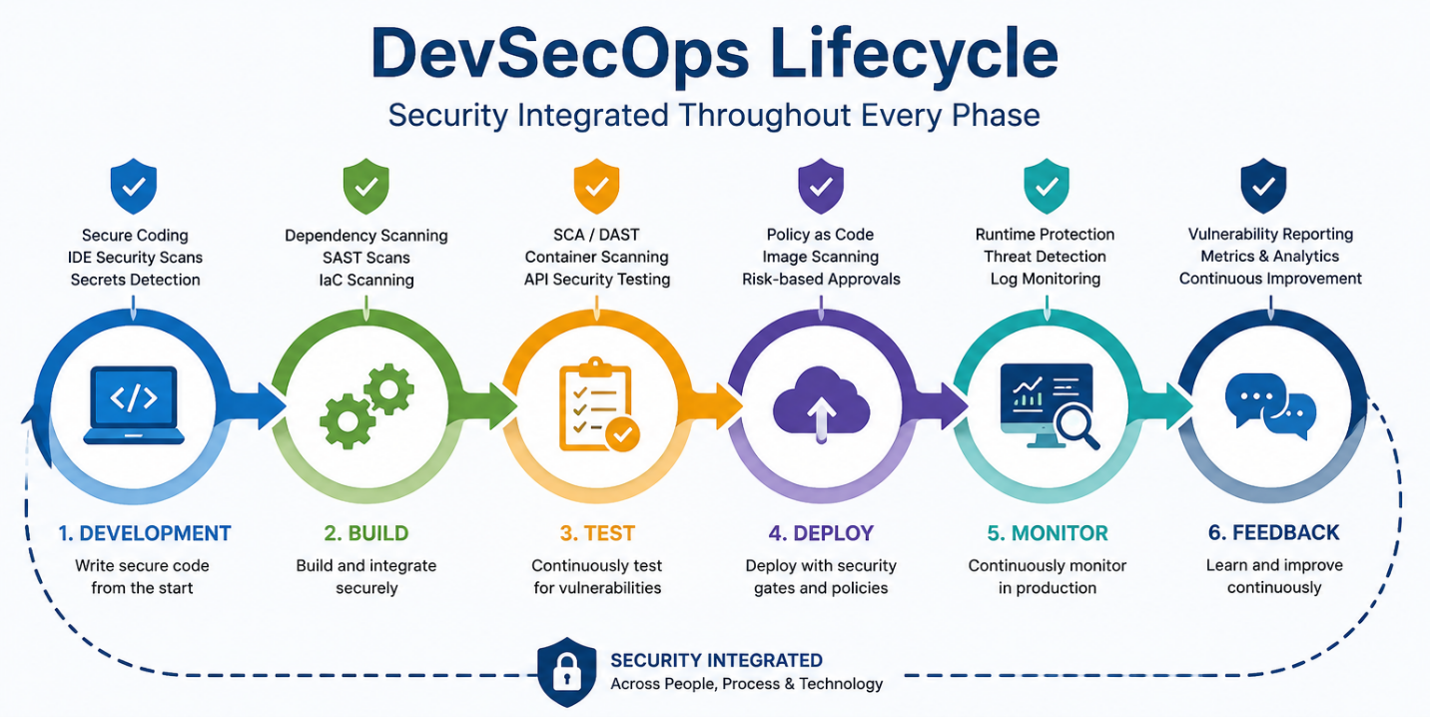
Fig 1: DevSecOps Lifecycle.
Start Learning In-Demand Tech Skills with Expert-Led Training
- Industry-Authorized Curriculum
- Expert-led Training
What Is DevSecOps?
DevSecOps is the practice of embedding security into every phase of software development and operations through automation, collaboration, and continuous validation. Unlike traditional approaches, where security teams perform reviews after development is complete, DevSecOps encourages developers, operations engineers, and security professionals to work together throughout the entire application lifecycle.
Core Principles of DevSecOps
Shift-Left Security
Shift-Left Security means identifying and addressing vulnerabilities early in coding and design rather than waiting until production deployment. This includes secure coding standards, IDE security extensions, secret detection before commits, SAST, and dependency vulnerability scanning.
Continuous Security Testing
Security testing should be embedded in every CI/CD pipeline rather than performed only occasionally or manually. Each code change should automatically trigger security validations, including static code analysis, DAST, SCA, container image scanning, and IaC scanning.
Security Automation
Manual security processes cannot scale with modern release frequency, so automation is essential. Automation helps scan commits, validate container images, detect exposed secrets, enforce policies, and block deployments that exceed defined risk thresholds.
Shared Ownership and Collaboration
Security should be a shared responsibility, not only the role of security engineers. Developers, operations teams, security professionals, and engineering managers all contribute by writing secure code, deploying secure infrastructure, creating reusable controls, and measuring both delivery and security outcomes.
Continuous Monitoring and Compliance
Security continues after deployment through ongoing monitoring and compliance validation. Organizations should monitor runtime vulnerabilities, configuration drift, identity and access anomalies, compliance violations, and threat intelligence.
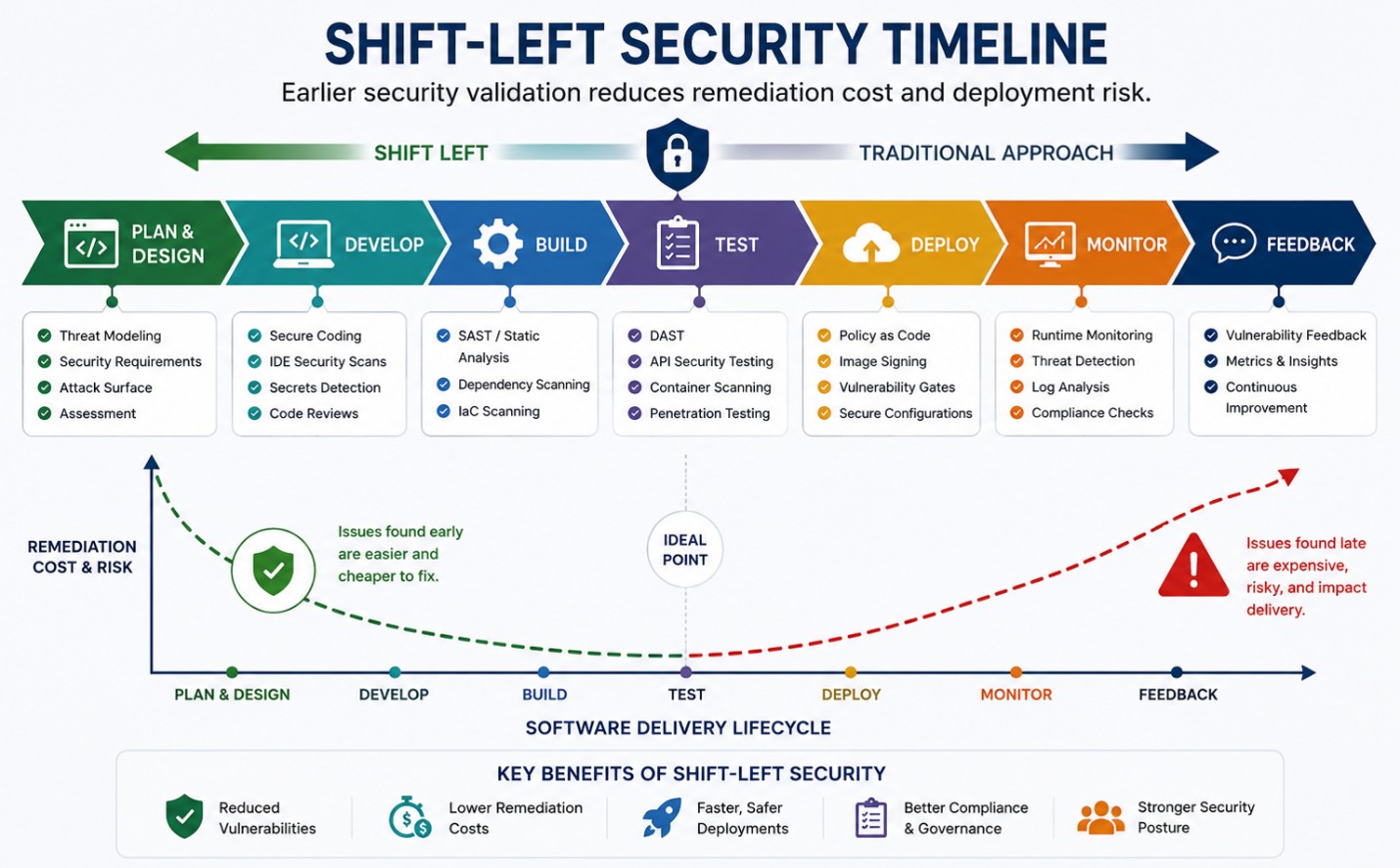
Fig 2: Shift-Left Security Timeline.
Why Do Teams Get DevSecOps Wrong?
Many organizations invest in modern DevSecOps tools but fail to realize the expected benefits because they focus too heavily on technology and overlook the people, process, and operational changes required for success.
Treating Security as a Separate Function
A common mistake is treating security as the responsibility of a separate security team. When reviews happen only before production, vulnerabilities are discovered late, releases are delayed, and friction increases between teams. This creates bottlenecks instead of encouraging continuous collaboration.
Lack of Automation
Many organizations still rely on manual vulnerability assessments and approval processes, which slow down otherwise automated delivery pipelines.
If security validation remains manual while build, test, and deployment steps are automated, security becomes the slowest part of the pipeline and cannot keep pace with modern release cycles.
Tool Overload and Poor Integration
Organizations often adopt multiple security tools independently without integrating them into developer workflows. A typical enterprise may use separate tools for SAST, container scanning, secrets detection, compliance dashboards, and reporting portals. When these tools are poorly connected, developers receive fragmented feedback, duplicate alerts, and inconsistent recommendations, resulting in alert fatigue rather than stronger security.
Limited Security Awareness Among Developers
Developers are expected to build secure applications, but many lack formal training in secure coding. Without clear guidelines and developer-friendly tools, they may unintentionally introduce risks such as hardcoded credentials or vulnerable third-party libraries.
Absence of Organizational Culture Change
DevSecOps cannot succeed through technology alone. If teams are rewarded only for delivery speed, they may bypass security controls. Successful adoption requires leadership support, shared objectives, and security metrics alongside delivery metrics.
Compliance Instead of Risk Management
Some organizations focus on passing audits rather than reducing real cyber risk. Compliance alone does not guarantee security, especially when controls emphasize documentation instead of operational protection.
Best Practices for Successful DevSecOps Adoption
Successful DevSecOps adoption can be summarized into five key practices:
- Embed security into CI/CD pipelines: Integrate security scans and validations directly into development and deployment workflows.
- Enable developers with secure coding practices: Train teams to identify and prevent vulnerabilities early in the development lifecycle.
- Automate security testing: Use automated SAST, DAST, SCA, container, and IaC scanning to maintain speed and consistency.
- Prioritize risk-based remediation: Focus on vulnerabilities based on business impact rather than treating all issues equally.
- Strengthen collaboration and monitoring: Improve coordination among development, operations, and security teams, and continuously monitor production environments while tracking meaningful metrics.
Platforms such as GitHub Advanced Security, Microsoft Defender for Cloud, Azure DevOps, and GitHub Actions can support these practices by embedding security into existing workflows, improving visibility, and reducing operational overhead.
Teams can further strengthen adoption through specialized DevSecOps training and Microsoft Secure DevOps guidance covering Azure DevOps, GitHub Advanced Security, secure delivery practices, architecture, and implementation recommendations.
Achieving DevSecOps Success
DevSecOps is not just about adding security tools to CI/CD pipelines; it is a cultural and operational shift that makes security a shared responsibility across the software lifecycle. With automation, continuous testing, monitoring, and developer enablement, organizations can deliver software that is both reliable and resilient. As cloud-native systems, AI-assisted development, and software supply chains become more complex, DevSecOps is becoming an operational necessity. Teams that invest in collaboration, automation, and continuous improvement now will be better prepared for future security challenges.
Upskill Your Teams with Enterprise-Ready Tech Training Programs
- Team-wide Customizable Programs
- Measurable Business Outcomes
About CloudThat


WRITTEN BY Pramod Sunagar
Dr. Pramod Sunagar is a Subject Matter Expert and Microsoft Certified Trainer at CloudThat, specializing in Microsoft Azure, DevOps, and GitHub Copilot. With over 12 years of experience in academics and corporate training, he has upskilled more than 2,500 learners through immersive, hands-on sessions. Dr. Sunagar is widely recognized for simplifying complex cloud and DevOps concepts through real-world examples, guided labs and a highly interactive delivery style. His approach blends academic depth with practical application, enabling professionals to confidently apply skills in real-world projects. Backed by a Ph.D. in Text Analytics and multiple Azure certifications, he delivers training across a wide range of roles—from beginners to advanced developers—focusing on certifications such as AZ-400, AZ-204, AZ-900, AI-102, GitHub Copilot, AI-900, DP-900 and SC-900. His passion for teaching, combined with a commitment to learner success, makes him a highly trusted mentor in the cloud and DevOps learning space.


 PREV
PREV









Comments