

 Login
Login


 August 10, 2026
|
Voiced by Amazon Polly |
Overview
Amazon Bedrock AgentCore has introduced Knowledge Bases (KB) as a new built-in tool for creating enterprise AI agents that can securely access organizational information. Developers can now create an Amazon Bedrock Managed Knowledge Base directly from the AgentCore console and expose it to agents through AgentCore Gateway as a preconfigured target.
This integration reduces the effort required to build retrieval-augmented generation, or RAG, systems. Instead of configuring document ingestion, parsing, embeddings, vector storage, retrieval, reranking, permissions, and agent integration separately, teams can use a managed workflow in AWS.
The result is a simpler path from enterprise documents to a production-ready AI agent that can answer questions using trusted business information.
Pioneers in Cloud Consulting & Migration Services
- Reduced infrastructural costs
- Accelerated application deployment
Introduction
A foundation model may be excellent at reasoning, summarization, and planning, but it does not automatically understand an organization’s internal policies, product documents, support manuals, project files, or operational procedures.
Traditionally, developers addressed this problem by building an RAG pipeline. Documents were collected from different systems, divided into chunks, converted into vector embeddings, stored in a vector database, and retrieved whenever a user asked a question.
Although the concept is straightforward, operating such a system is not. Different document formats require different parsing methods. Chunk sizes must be tested. Embedding and reranking models must be selected. Data must remain synchronized, and permissions must be applied correctly.
Amazon Bedrock Managed Knowledge Base is designed to handle much of this work as a managed capability. AWS manages key parts of the retrieval pipeline, including storage, embeddings, reranking, retrieval orchestration, and model selection defaults. This allows development teams to spend more time improving the actual agent experience rather than maintaining supporting infrastructure.
The new Amazon AgentCore integration makes this capability even easier to consume. Knowledge Bases now appear under Built-in tools in the Amazon Bedrock AgentCore console and can be added as targets in AgentCore Gateway.
Creating a Managed Knowledge Base in AgentCore
The process begins in the Amazon Bedrock AgentCore console:
Amazon Bedrock AgentCore → Built-in tools → Knowledge Bases (KB)
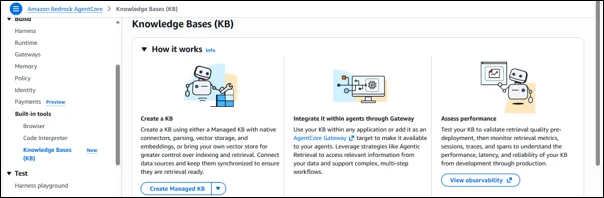
From this page, developers can choose Create Managed KB and connect the knowledge base to an enterprise data source. At launch, AWS supports native connectors for Amazon S3, Microsoft SharePoint, Atlassian Confluence, Google Drive, Microsoft OneDrive, and web crawling. Custom data sources can also be incorporated where required.
Once the source is configured, the knowledge base ingests and indexes the content. AWS provides optimized default settings, including managed choices for embeddings, reranking, and generation models. Advanced teams can still modify selected options when they need greater control over accuracy, latency, or cost.
This approach is useful for organizations that want to launch knowledge assistants quickly without designing a separate ingestion and vector-search platform.
Standard and Agentic Retrieval
Once information has been indexed, applications can retrieve it using different strategies.
Standard retrieval is suitable for focused questions where relevant information can usually be found through a single search. A question such as “What is the employee travel reimbursement limit?” may only require retrieving one section from one policy document.
Agentic retrieval is intended for more complex questions involving multiple documents, topics, or reasoning steps. Instead of performing only one semantic search, the retriever can interpret the user’s intent, create a query plan, execute multiple retrieval steps, evaluate intermediate findings, and rerank the final results.
Consider this question:
Can the infrastructure team use its remaining annual budget to prepay next year’s cloud commitment?
Answering it may require retrieving the infrastructure budget, identifying the responsible department, finding the organization’s procurement policy, and checking rules related to advance payments. Agentic retrieval can break this request into smaller searches and combine the resulting context.
This makes the feature valuable for finance assistants, policy agents, technical support systems, compliance applications, and enterprise research tools.
Adding a Knowledge Base to Amazon AgentCore Gateway
The most important addition is the ability to expose a knowledge base through the Amazon Bedrock AgentCore Gateway.
While creating or updating a gateway target, developers can select:
Connectors → Knowledge Bases (KB)
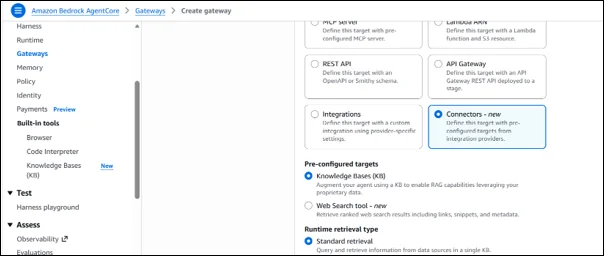
Knowledge Bases now appear as a preconfigured target alongside options such as MCP servers, Lambda functions, REST APIs, and API Gateway endpoints. The developer selects the required knowledge base, configures the runtime retrieval type, and makes it available to connected agents.
AgentCore Gateway exposes tools through the Model Context Protocol (MCP). As a result, MCP-compatible agent frameworks can discover and use the knowledge-base tool without requiring a separately developed integration layer. AWS lists support for frameworks such as Strands Agents, LangChain, LangGraph, CrewAI, and LlamaIndex.
In practical terms, the Gateway acts as a controlled access layer between an agent and the knowledge base. Agents call the Gateway, the Gateway applies the configured identity, permissions, and policies, and the knowledge base returns relevant organizational information.
Knowledge Bases, Memory, and Real-Time Tools
A knowledge base and agent memory solve different problems.
A knowledge base stores organizational facts, such as product documentation, event schedules, policies, and operating procedures. AgentCore Memory stores conversational context and useful user-specific preferences.
AWS demonstrates this combination through an intelligent event assistant. The knowledge base retrieves current session schedules and speaker details, while short-term and long-term memory help the agent remember the attendee’s previous questions and interests. Together, they produce answers that are both factually grounded and personalized.
Through Gateway, the same agent can also integrate the knowledge base with AWS Lambda functions, APIs, MCP servers, or web search tools. This creates an agent that can retrieve internal knowledge, remember context, and take approved actions.
Conclusion
The addition of Knowledge Bases as a built-in AgentCore tool is more than a console update. It brings enterprise retrieval, agent connectivity, governance, and observability into one managed environment.
Drop a query if you have any questions regarding Amazon AgentCore, and we will get back to you quickly.
Empowering organizations to become ‘data driven’ enterprises with our Cloud experts.
- Reduced infrastructure costs
- Timely data-driven decisions
About CloudThat
FAQs
1. What is Amazon Bedrock Managed Knowledge Base?
ANS: – It is a managed AWS capability that connects enterprise data to generative AI applications. It handles ingestion, parsing, indexing, vector storage, embeddings, retrieval, and reranking with managed defaults.
2. How is it different from Amazon AgentCore Memory?
ANS: – A knowledge base stores business information and documents. AgentCore Memory stores conversation history, session context, and selected user preferences.
3. Can a Knowledge Base be added directly to Amazon AgentCore Gateway?
ANS: – Yes. Knowledge Bases are available as a preconfigured Gateway target under the Connectors option. The selected knowledge base can then be exposed to agents as an MCP-compatible tool.


WRITTEN BY Yerraballi Suresh Kumar Reddy
Suresh is a highly skilled and results-driven Generative AI Engineer with over three years of experience and a proven track record in architecting, developing, and deploying end-to-end LLM-powered applications. His expertise covers the full project lifecycle, from foundational research and model fine-tuning to building scalable, production-grade RAG pipelines and enterprise-level GenAI platforms. Adept at leveraging state-of-the-art models, frameworks, and cloud technologies, Suresh specializes in creating innovative solutions to address complex business challenges.


 PREV
PREV










Comments