

 Login
Login


 June 19, 2026
|
Voiced by Amazon Polly |
Managing cloud storage costs efficiently is a top priority for organizations increasingly relying on Azure Blob Storage to store massive volumes of unstructured data. However, one of the biggest challenges in cost optimization is predicting access patterns, knowing which data will be frequently accessed and which will remain dormant. Azure’s Smart Tier capability directly addresses this challenge by automating data placement across storage tiers based on real usage patterns, helping organizations reduce costs without manual intervention.
Start Learning In-Demand Tech Skills with Expert-Led Training
- Industry-Authorized Curriculum
- Expert-led Training
Understanding the Challenge of Storage Tiering
Azure Blob Storage offers multiple access tiers- Hot, Cool, and Cold, each designed for a specific usage pattern. The Hot tier is optimized for frequently accessed data, while the Cool and Cold tiers are progressively cheaper options suited for infrequently accessed data. Traditionally, users had to manually configure lifecycle management rules to move data between these tiers. While effective, this approach requires effort, ongoing monitoring, and an accurate understanding of data usage patterns.
In real-world scenarios, access patterns often change over time or are simply unpredictable. Data that appears “cold” today might suddenly become critical tomorrow. This uncertainty can lead to inefficient tiering decisions- either overspending by keeping data in the Hot tier or degrading performance by moving needed data into colder tiers too early.
What is Azure Smart Tier?
Azure Smart Tier is designed to simplify this process by automatically managing data movement across tiers. Instead of relying on predefined rules, Smart Tier analyses actual usage and dynamically transitions data between Hot, Cool, and Cold tiers. This approach ensures optimal cost efficiency while maintaining data accessibility.
When Smart Tier is enabled, all eligible data starts in the Hot tier by default. From there:
- After 30 days of inactivity, objects are moved to the Cool tier
- After 90 days of inactivity, they transition to the Cold tier
- If accessed at any time, they automatically return to the Hot tier and restart their lifecycle
This continuous, automated cycle ensures that data is always stored in the most cost-effective tier based on its current usage.
Key Benefits of Smart Tier
- Automated Cost Optimization
Smart Tier eliminates the need to define and manage lifecycle policies. It automatically adjusts storage placement, ensuring that inactive data is stored at lower-cost tiers while active data remains highly accessible.
- Adaptability to Changing Access Patterns
Unlike static policies, Smart Tier responds to real-time usage. If data becomes relevant again, it is immediately promoted back to the Hot tier, preventing latency or performance issues.
- Simplified Management
With no need to manually create or monitor rules, administrators can focus on higher-value tasks rather than continuously tweaking lifecycle configurations.
- No Transition or Retrieval Costs
One of the most attractive aspects of Smart Tier is that transitions within it come at no additional cost, and there are no data retrieval fees.
How Smart Tier Works
Smart Tier leverages Azure’s existing storage infrastructure but adds an intelligent automation layer. It uses access signals from operations such as Get Blob and Put Blob to determine when data is actively used. Notably, metadata or property reads do not count as access events, ensuring that tier transitions are based on meaningful interactions.
Data always remains within online storage tiers, which means it maintains the standard availability, scalability, and performance guarantees of Azure Blob Storage. Unlike archive storage, there is no delay or rehydration time when accessing data.
However, there are some nuances:
- Objects smaller than 128 KiB remain in the Hot tier for efficiency
- Tiering decisions begin only after Smart Tier is enabled
- The first movement to a lower tier occurs 30 days after activation
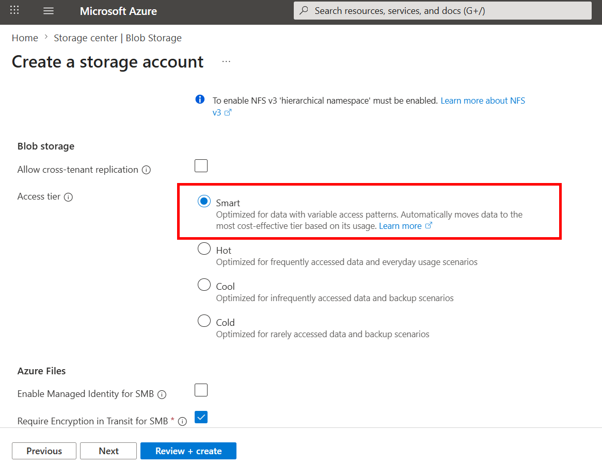
Fig 1: Choosing Smart access tier.
Requirements and Limitations
While Smart Tier is a powerful feature, it comes with specific requirements:
- It works only with Standard GPv2 storage accounts
- It requires zone-redundant storage (ZRS, GZRS, or RA-GZRS)
- It supports only block blobs
Additionally, Smart Tier cannot be applied to premium storage accounts or legacy GPv1 accounts.
Cost Structure Explained
Smart Tier uses the standard pricing model of the underlying storage tiers:
- Storage costs are based on whether data resides in Hot, Cool, or Cold tiers
- A small monitoring fee is applied for objects larger than 128 KiB
- No charges for:
- Tier transitions within Smart Tier
- Early deletion
- Data retrieval
All access operations are billed at Hot tier transaction rates, even if the data was previously in a colder tier. This simplification removes the complexity of calculating varied operation costs across tiers.
Monitoring and Visibility
Azure provides built-in metrics that allow you to track how your data is distributed across tiers. Metrics such as Blob Count and Blob Capacity can be segmented by tier to reveal patterns:
- Smart Hot: Frequently accessed data
- Smart Cool: Data inactive for 30+ days
- Smart Cold: Data inactive for 90+ days
- Smart Hot-small: Small objects that remain in Hot
These insights help organizations validate cost savings and understand their storage usage patterns over time.
When Should You Use Smart Tier?
Smart Tier is ideal for:
- Applications with unpredictable access patterns
- Large datasets where manual lifecycle policies are difficult to maintain
- Organizations seeking hands-off optimization
- Scenarios where avoiding retrieval and transition costs is important
However, for workloads with highly predictable patterns such as backups with fixed retention schedules, traditional lifecycle policies may still be more precise.
Smarter Cloud Cost Optimization
Azure Blob Storage Smart Tier represents a significant step forward in simplifying storage cost management. By automatically adjusting data placement based on actual usage, it removes the guesswork and operational overhead associated with traditional tiering strategies.
For organizations dealing with dynamic or unpredictable workloads, Smart Tier offers a compelling combination of cost efficiency, automation, and performance reliability. As cloud storage continues to grow in scale and complexity, features like Smart Tier will play a crucial role in helping businesses optimize costs while maintaining seamless access to their data.
Adopting Smart Tier is not just a technical improvement; it’s a strategic move toward smarter, more adaptive cloud resource management.
Upskill Your Teams with Enterprise-Ready Tech Training Programs
- Team-wide Customizable Programs
- Measurable Business Outcomes
About CloudThat


WRITTEN BY Mariyam Thomas
Mariyam Thomas is a Subject Matter Expert and Microsoft Certified Trainer at CloudThat, with a strong focus on Microsoft Azure and Hybrid Infrastructure. With over 10 years of experience in training and academics, she has empowered more than 5,000 professionals and learners through her engaging and hands-on training sessions. She was recognised as Top 100 MCT Quality Awards Winner for 2024-25. Mariyam is known for her ability to demystify complex cloud concepts using real-world scenarios, interactive labs, and a learner-first approach. Her deep technical expertise, combined with a passion for teaching, makes her sessions both insightful and impactful. Her dedication to continuous learning and cloud innovation reflects in her dynamic training style, making her a trusted mentor for aspiring cloud professionals.


 PREV
PREV











Comments