

 Login
Login


 June 18, 2026
|
Voiced by Amazon Polly |
Managing applications on the cloud is not just about running code. Behind the scenes, teams must also monitor performance, logs, security, and system health. These background tools, such as monitoring and logging agents, are essential, but managing them has traditionally been time‑consuming and complex.
To make this easier, AWS has introduced Managed Daemon support for Amazon ECS Managed Instances. This new feature helps platform and operations teams manage important background services separately from application workloads.
Let’s understand this new capability in simple language, why it matters, and how it helps organizations manage container environments more efficiently.
Start Learning In-Demand Tech Skills with Expert-Led Training
- Industry-Authorized Curriculum
- Expert-led Training
Understanding the Problem in Simple Terms
Imagine a company running hundreds of applications using containers. Each application needs background tools like:
- Monitoring to track system health
- Logging to capture system events
- Security tools for compliance
Earlier, these tools had to be added to each application setup. If a monitoring tool needed an update, every related application had to be changed and redeployed. This often led to:
- Delays
- Coordination issues across teams
- Higher chances of errors
AWS recognized this challenge and built a better approach.
How Managed Daemons Simplify Things
With managed daemons, AWS cleanly separates applications from background system tools.
Before Managed Daemons
- Each application handled its own monitoring and logging
- Updates required multiple redeployments
After Managed Daemons
- Platform teams manage monitoring centrally
- Applications run without extra configuration
- Updates happen safely in the background
This clear separation helps teams work faster and with fewer risks, as shown in the image below.
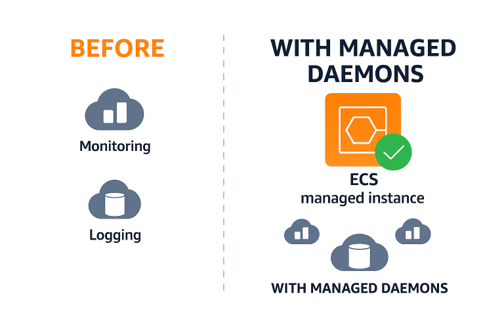
Fig 1: Comparison of Amazon ECS before and after managed daemons, highlighting centralized monitoring and logging.
How It Works (Without the Technical Details)
Here’s a simplified view of what happens:
- The operations team defines a background tool (daemon) once.
- AWS ECS automatically installs it on every managed instance.
- When the tool is updated:
- AWS creates new instances
- Ensures the new tool is running
- Moves applications safely
- Old instances are removed only after everything is stable
This ensures zero gaps in logging or monitoring, which is critical for production systems. More details on ECS Managed Instances are available here.
Key Benefits for Businesses
- Easier Operations
Teams no longer require coordinated changes across multiple applications. Background tools are managed separately and centrally.
- Better Reliability
Monitoring and logging are always available, even during updates.
- Faster Updates
Security agents or compliance tools can be updated quickly without affecting running applications.
- Cleaner Team Responsibilities
Application teams focus on features and customer value, while platform teams handle infrastructure needs.
- No Extra Cost
AWS does not charge extra for this feature; you only pay for the computing resources you use.
Who Should Use Managed Daemons?
This feature is especially helpful for:
- Enterprises running many containerized applications
- Organizations with separate platforms and application teams
- Environments with strict monitoring or compliance needs
- Businesses looking to simplify AWS operations
If you’re building or managing AWS container platforms and need guidance, AWS training partners, or you can check out DevOps Engineering on AWS, which helps in managing, building, and deploying on ECS and other compute environments as well.
Real‑World Example
Consider a large organization running microservices across environments like development, testing, and production.
Earlier, updating a logging tool meant coordinating with multiple teams and redeploying services. With managed daemons:
- The operations team updates the logging tool once
- AWS handles the rollout automatically
- Applications continue running without disruption
This saves time, reduces risk, and improves system stability.
Why This Matters in the Long Run
As cloud environments grow, managing them manually becomes harder. Features like ECS managed daemons:
- Reduce human effort
- Improve consistency
- Support scalable and modern cloud architectures
AWS is clearly moving toward making infrastructure management less manual and more intelligent, which benefits both small teams and large enterprises.
Modern ECS Operations
AWS Managed Daemons for Amazon ECS Managed Instances make cloud operations simpler and more reliable. By separating background system tools from application workloads, AWS removes unnecessary complexity and improves operational efficiency.
With guaranteed startup order, smooth updates, host‑level access, and centralized control, managed daemons help organizations build robust, scalable, and well‑monitored container platforms on AWS.
For teams looking to modernize their container strategy or improve operational visibility, this feature is a major step forward.
Upskill Your Teams with Enterprise-Ready Tech Training Programs
- Team-wide Customizable Programs
- Measurable Business Outcomes
About CloudThat


WRITTEN BY Kamlesh N
Kamlesh Nenwani is a Subject Matter Expert at CloudThat, specializing in AWS Architecting and DevOps. With 13 years of experience in training and consultancy, he has guided over 2500+ professionals and students in mastering diverse technologies. Renowned for his clarity in explaining complex topics and his commitment to continuous learning, Kamlesh delivers practical, interactive sessions grounded in deep technical expertise.


 PREV
PREV












Comments