

 Login
Login


 June 16, 2026
|
Voiced by Amazon Polly |
The past 18 months of enterprise AI adoption were defined by experimentation: copilots, chatbots, and knowledge assistants powered by LLMs. Impressive, but still reliant on human orchestration. Every AI-generated insight required a human to act on it. Analysts still clicked buttons. Engineers still triggered deployments. Operations teams still ran reports manually. That era is ending.
With AgentCore and agent plugins in Amazon Bedrock, we are witnessing a fundamental shift from LLM applications to autonomous AI systems. This is not a feature release; it is a paradigm shift in enterprise software architecture. Organizations that miss this transition risk being outpaced by competitors already building autonomous AI workforces.
Start Learning In-Demand Tech Skills with Expert-Led Training
- Industry-Authorized Curriculum
- Expert-led Training
The Limits of the “LLM Wrapper” Era
Most first-generation GenAI apps followed the same pattern: the user sends a prompt, the backend enriches it with RAG, the model responds, and the human acts. Even with frameworks like Langchain, these systems were stateless, short-lived, and human-dependent.

| Real-World Gap: Insurance Claims
An insurer’s GenAI assistant could summarize policies and suggest settlement amounts, but every recommendation still required an adjuster to log in, enter data, trigger approvals, and notify policyholders. AI created insight; humans remained the execution layer. AgentCore eliminates that bottleneck. |
Three Capabilities That Change Everything
1) Long-Running Agent Execution
Traditional LLM calls are complete in seconds with no persistent state. AgentCore introduces persistent memory, event-driven execution, and stateful reasoning loops, transforming AI from a function call into a continuous operational system.
| Example: Autonomous IT Ops
Instead of prompting an LLM for an error report, an AgentCore agent continuously monitors logs, detects anomalies, opens ServiceNow tickets, notifies teams via PagerDuty, validates fixes, and closes tickets without human intervention. |
2) Plugins as the AI-Native Integration Layer
Rather than building explicit workflows, organizations expose existing systems, CRM, ERP, ticketing, CI/CD, and security platforms as tools that agents discover and use autonomously. The agent decides when and how to call each tool, adapting in real time based on intermediate results. This eliminates the brittle, hand-coded integration logic that has plagued enterprise IT for decades. It is a fundamental evolution:
API-first → Microservices → iPaaS → AI tool ecosystems
3) Dynamic Workflow Composition
Traditional automation requires every branch and exception to be pre-coded in BPMN or Step Functions. Agents compose workflows dynamically, reasoning through novel situations rather than breaking on edge cases. This unlocks previously unautomatable processes:
- Incident response: detect, triage, remediate, document
- Continuous compliance monitoring and evidence collection
- Automated financial reconciliation and exception handling
- Self-healing infrastructure with autonomous remediation
What This Means for Enterprise Leaders
Software Delivery → AgentOps
Agents monitor repositories, generate patches, run test suites, and merge passing PRs. A company with 200+ microservices can remediate a published CVE across all repos in 4 hours, down from 3 weeks of manual engineering effort. Software delivery becomes a supervisory function, not a hands-on craft.
Security Operations → Supervisory Model
With 3.5M+ unfilled cybersecurity roles globally, alert fatigue is at a breaking point. AgentCore SOC agents triage and correlate across SIEM and EDR tools, execute remediation playbooks autonomously, and escalate only confirmed high-severity incidents. Mean-time-to-containment drops from hours to minutes, while analyst capacity is redirected to strategic threat hunting.
IT Operations → Self-Operating Cloud
FinOps agents continuously monitor utilization, rightsize resources within policy limits, and surface savings opportunities that quarterly manual reviews consistently miss. Enterprises deploying these agents routinely identify seven-figure annualized cloud waste within the first 90 days.
Governance: The Non-Negotiable Foundation
Autonomous systems require new organizational frameworks, not just new technology. When an AI agent approves a refund, isolates a server, or merges code into production, enterprises need complete visibility and control. Key imperatives:
- Audit trails: log agent reasoning chains, not just the actions taken
- Tiered autonomy: routine decisions auto-execute; high-risk actions require human approval gates
- Observability: monitor non-deterministic agent behavior, tool call patterns, and failure modes
- Guardrails: define and enforce permission boundaries for every agent role
- Incident response: establish clear protocols for when an agent makes an error
Building trust in autonomous systems is not a technical problem alone; it is a cultural and governance challenge that leadership must own. AWS’s governance-first approach to Bedrock makes it well-positioned to support regulated industries navigating these requirements.
The Starting Line
AgentCore signals the shift from desired-state infrastructure to desired-state work. Cloud computing taught us to define the infrastructure we want and let the system provision it. AgentCore applies that same principle to business operations. Instead of clicking buttons to trigger processes, enterprises will define outcomes, and autonomous agents will determine how to achieve them, adapting in real time as conditions change.
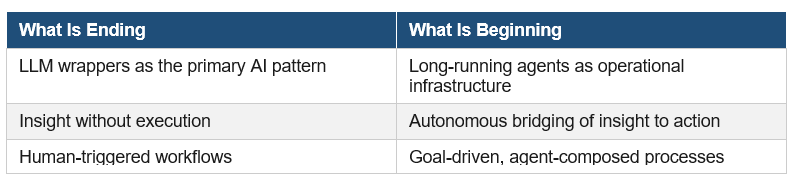
Organizations that understand this shift early will not just adopt AI; they will redesign how work happens. The future of enterprise systems is not dashboards or workflows. It is teams of autonomous agents, operating under human governance, achieving outcomes at machine speed.
AgentCore marks the starting line. The race has already begun.
Enterprise AI Future
AgentCore marks a genuine inflection point. Enterprise AI is moving beyond insight generation into autonomous execution, where agents monitor, decide, and act across complex systems with minimal human involvement. The shift from LLM wrappers to long-running, goal-driven agents is rewriting the rules of enterprise software architecture right now.
Enterprises that build the right agent architectures and governance frameworks now will set the benchmarks others chase. The question is no longer whether to adopt autonomous AI; it is how fast you can do it responsibly.
Upskill Your Teams with Enterprise-Ready Tech Training Programs
- Team-wide Customizable Programs
- Measurable Business Outcomes
About CloudThat


WRITTEN BY Shruti Bijawat
Shruti Bijawat is a Business Unit Head at CloudThat Technologies Private Limited, with deep specialization in Generative AI and Machine Learning. She is a Champion Amazon Authorized Instructor and a NVIDIA Certified Instructor, bringing over 16 years of combined industry and academic experience. Shruti has enabled thousands of professionals to upskill in cloud architecture, GenAI, and ML, delivering programs that balance strong conceptual foundations with real-world implementation. Known for her ability to customize training delivery based on participant profiles, she consistently translates complex technical concepts into practical, outcome-driven learning experiences. Her passion for learning and development is reflected in her structured, hands-on, and impact-focused teaching approach.


 PREV
PREV











Comments