

 Login
Login

 May 22, 2026
|
Voiced by Amazon Polly |
Overview
For years, automation has been the backbone of digital transformation. Businesses automated repetitive tasks, built workflows, integrated APIs, and reduced manual effort using scripts, bots, and rule-based systems. From email routing to invoice processing, traditional automation helped organizations save time and cut operational costs.
In the coming years, businesses will increasingly move away from rigid workflows toward intelligent AI-driven systems capable of reasoning, planning, and executing tasks independently. From customer support and software development to healthcare and finance, AI agents are increasingly replacing traditional automation methods across industries.
Pioneers in Cloud Consulting & Migration Services
- Reduced infrastructural costs
- Accelerated application deployment
Traditional Automation
Traditional automation refers to systems that execute tasks based on fixed rules and predefined workflows. These systems are excellent at handling repetitive and predictable processes.
Examples include:
- Sending automated emails after form submissions
- Running scheduled database backups
- Processing payroll based on fixed rules
- Automatically generating reports
- Moving files between systems
- Triggering workflows in CRM or ERP systems
Most traditional automation relies heavily on:
- Rule-based logic
- Structured data
- Fixed workflows
- Manual configuration
- Predefined conditions
If the input changes unexpectedly, the automation often breaks or requires human intervention.
The Core Difference Between Traditional Automation and AI Agents
Traditional automation follows instructions.
AI agents pursue outcomes.
This distinction changes everything.
Traditional Automation
- Rule-based
- Static workflows
- Requires structured input
- Limited adaptability
- Human intervention is needed for exceptions
AI Agents
- Goal-driven
- Dynamic execution
- Understands natural language
- Handles ambiguity
- Learns from context
- Makes decisions autonomously
Traditional systems answer:
“What should I do if condition X happens?”
AI agents answer:
“What is the best way to achieve this goal?”
This shift from rules to reasoning is transforming modern workflows.
Why Traditional Automation Is Reaching Its Limits
Traditional automation has served businesses well for decades, but it faces several limitations in today’s fast-changing digital environment.
- Rigid Workflows
Traditional automation depends on predefined rules. If business logic changes, workflows must be rewritten manually.
This creates operational bottlenecks.
- Inability to Handle Unstructured Data
Most business data today is unstructured:
- Emails
- PDFs
- Images
- Voice notes
- Conversations
- Documents
Traditional automation struggles to process this type of information effectively.
- High Maintenance Costs
As workflows become more complex, maintaining automation systems becomes difficult and expensive.
Even small process changes may require engineering support.
How AI Agents Are Replacing Traditional Automation
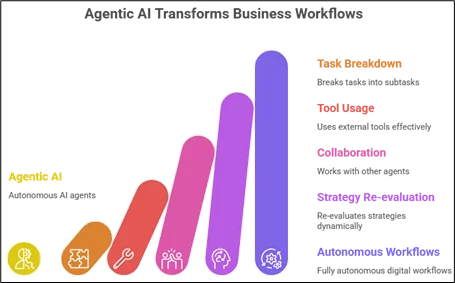
AI agents are not just automating tasks. They are automating thinking-based processes.
Here are some of the biggest ways they are replacing traditional automation.
- AI Agents Handle Complex Decision-Making
Traditional automation fails when decisions become too dynamic.
AI agents can analyze situations and choose the best course of action.
For example, in customer service:
A traditional bot may route tickets based on keywords.
An AI agent can:
- Understand customer sentiment
- Analyze previous interactions
- Prioritize urgent cases
- Recommend solutions
- Escalate intelligently
This creates smarter operations with minimal human supervision.
- AI Agents Work Across Multiple Systems
Traditional automation often depends on tightly integrated workflows.
AI agents can dynamically interact with multiple tools.
For example, a single AI agent can:
- Read emails
- Access CRM data
- Update spreadsheets
- Generate reports
- Send Slack notifications
- Create support tickets
All without requiring hardcoded workflows for every scenario.
This creates a more connected digital ecosystem.
Real-World Examples of AI Agents Replacing Automation
The transition is already happening across industries.
Customer Support
Traditional chatbots followed scripted conversations.
Modern AI agents can:
- Understand customer intent
- Maintain conversational memory
- Resolve issues autonomously
- Personalize responses
This improves customer experience while reducing support costs.
Healthcare
Traditional healthcare automation focused mainly on scheduling and billing.
AI agents can now:
- Summarize patient records
- Assist diagnosis
- Monitor patient history
- Recommend treatment options
- Automate medical documentation
This helps healthcare professionals focus more on patient care.
Challenges of AI Agents
Despite their advantages, AI agents also come with challenges.
- Accuracy and Hallucinations
AI systems can sometimes generate incorrect information or make poor decisions.
Human oversight remains important for critical operations.
- Security Risks
AI agents often access multiple systems and sensitive data.
Proper governance and access control are essential.
- Ethical Concerns
As AI agents replace human tasks, organizations must address concerns around job displacement and responsible AI use.
- High Infrastructure Costs
Running advanced AI systems requires computational resources, cloud infrastructure, and continuous optimization.
- Regulatory Compliance
Industries such as healthcare and finance must ensure that AI agents comply with strict regulations and privacy standards.
Even with these challenges, adoption continues to grow rapidly.
Will AI Agents Completely Replace Traditional Automation?
Not entirely.
Traditional automation will remain useful for simple, repetitive, and predictable tasks.
For example:
- Scheduled jobs
- Simple API triggers
- Data synchronization
- Fixed workflow approvals
However, for processes requiring intelligence, reasoning, adaptability, and decision-making, AI agents are becoming the preferred solution.
The future is likely to be hybrid.
Organizations will combine:
- Traditional automation for deterministic tasks
- AI agents for cognitive and dynamic workflows
Together, they will create highly efficient intelligent systems.
The Future of Work with AI Agents
We are entering a new era where software no longer simply executes commands.
It thinks, plans, collaborates, and acts.
AI agents are reshaping the relationship between humans and technology. Employees will increasingly shift from performing repetitive operational tasks to supervising intelligent systems and focusing on strategic work.
Businesses that adopt AI agents early will gain significant advantages:
- Faster operations
- Reduced costs
- Better customer experiences
- Improved scalability
- Higher productivity
- Smarter decision-making
The organizations that fail to adapt may struggle to compete in an AI-driven economy.
Conclusion
Traditional automation transformed businesses by reducing repetitive manual work. But its limitations are becoming increasingly visible in a world driven by dynamic data, complex workflows, and real-time decision-making.
AI agents represent the next evolution.They are not just automating tasks. They are automating intelligence.
From customer support and finance to software development and healthcare, AI agents are beginning to replace rigid workflows with adaptive, intelligent systems capable of reasoning and acting autonomously.
Drop a query if you have any questions regarding AI agents and we will get back to you quickly.
Empowering organizations to become ‘data driven’ enterprises with our Cloud experts.
- Reduced infrastructure costs
- Timely data-driven decisions
About CloudThat
FAQs
1. What is the biggest difference between AI agents and traditional automation?
ANS: – Traditional automation follows fixed rules and workflows, while AI agents can understand context, make decisions, and adapt to changing situations. AI agents focus on achieving goals rather than simply executing predefined instructions.
2. Can AI agents work without human supervision?
ANS: – AI agents can perform many tasks autonomously, but complete independence is still rare in critical industries. Most businesses use a human-in-the-loop approach, in which humans monitor, validate, or approve decisions made by AI agents.
3. Are AI agents replacing jobs completely?
ANS: – AI agents are more likely to transform jobs rather than eliminate them. Repetitive and operational tasks may become automated, while humans shift toward strategic, creative, and supervisory responsibilities.


WRITTEN BY Modi Shubham Rajeshbhai
Shubham Modi is working as a Research Associate - Data and AI/ML in CloudThat. He is a focused and very enthusiastic person, keen to learn new things in Data Science on the Cloud. He has worked on AWS, Azure, Machine Learning, and many more technologies.


 PREV
PREV







Comments